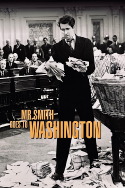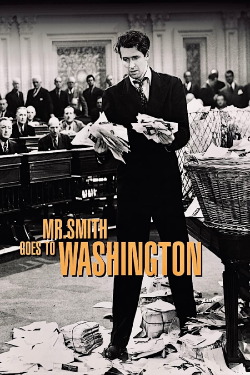
Review of Mr. Smith Goes to Washington (1939) by Adam Y — 10 Sep 2015
There have been, regrettably, few good films about the legislative process. This is one of them.
What makes Capra's film timeless is that the plot could play well today. Contemporary audiences will be amazed at how this film is still relevant, with muckraking journalism,. political payola, lobbyists and big money machines all vying for the life blood of our democracy.
What breaks these entrenched interests is Jefferson Smith, an emergency appointment to the Senate. Basement dweller, momma's boy, and youth camp counselor, Smith has just enough naiveté--and just enough idealism--to stand by his principles in the face of great pressure. He wants to build a youth camp. Unfortunately, his campground site is on a place earmarked for a dam, placing him in direct opposition to the party bosses and his co-senator, Joseph Paine (Claude Rains).
His love of country, and his love for his office secretary Ms. Saunders (Jean Arthur), give him the courage to persevere.
What is interesting, from a political philosophical perspective, is how this film can be viewed as a leftist or far-rightist film, depending on your perspective. Smith's crusade to speak truth to power is symbolic of the people's revolution in the purest sense. And, yet, one cannot deny the fascistic overtones of one man's quest to channel the founding fathers' vision to take the youth into the wilderness and away from the corrupt city life, against the journalists and statesmen of education and prudence.
It gets four starts only because the ending, to me, is too much of a deus ex machina to be believed. But it is a good film, with good imagery and a smart film, one which will respect the discerning eye.
This review of Mr. Smith Goes to Washington (1939) was written by Adam Y on 10 Sep 2015.
Mr. Smith Goes to Washington has generally received very positive reviews.
Was this review helpful?