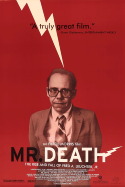
Review of Mr. Death: The Rise and Fall of Fred A. Leuchter, Jr. (1999) by Natalie M — 27 Sep 2012
What Happens When We Lie to People About Their Competence.
It is actually surprisingly easy to feel sorry for Fred A. Leuchter, Jr. Yes, his work was horribly flawed. It helped give false support to one of the most odious claims in all of conspiracism--the one I routinely forget about when I list conspiracies because it's so much more complicated than the others. He was unqualified to make the studies he did, and he is now unwilling to acknowledge that his results were fatally flawed. However, you have to look at his life and realize that he has always been told that he is capable of doing things he is not. He managed before; he did not manage this time. His life has fallen apart because of it, and it seems apparent that he doesn't understand why. I doubt anyone would be capable of explaining it to him in a way that would get through to him, and it seems that a basically good man may now have been lost to a hateful group he would otherwise never have known.
Fred A. Leuchter, Jr., got his start by creating an improvement to the electric chair. His father had, in fact, been a prison guard, so Fred came by his interest naturally, as you might say. And for some reason--even Leuchter isn't entirely sure why--someone decided that a man who could design an electric chair could design a lethal injection system. So he did. And then there were gallows; he made those, too. And then, of all things, he got a call about one Ernst Zündel. Zündel was on trial in Canada for publishing things he knew to be false that were likely to increase racial hatred. Specifically, that the Holocaust never happened. Zündel and his defenders hired Leuchter and sent him to Auschwitz to test the remains of the gas chambers for evidence of cyanide gas. Because, you know, that was totally something Leuchter was qualified to do. He went to Auschwitz. He took samples. He sent the samples to a lab. And the lab results showed no signs of cyanide on the samples.
Well, sort of. You see, documentarian Errol Morris interviews the chemist who performed the tests, James Roth, and the tests he performed were in no way accurate for what Leuchter wanted. In an attempt, I guess, at getting unbiased results, Leuchter didn't tell the lab where the samples came from. Which is fair enough. But instead of testing the surfaces, the only place you would expect to find cyanide, the chemist pulverized the samples and tested the whole thing, and that would obviously skew results. Especially given how large some of the samples were and how thin the cyanide deposits would be. What's more, Leuchter made untenable assumptions about his sampling technique, ignoring the effects that fifty years of weathering, for example, would have on things and claiming that everything at Auschwitz had remained exactly the same the whole time. It is, in short, a very good example of why you need to know what you're doing in order to produce accurate results.
Equally disgusted with Leuchter's techniques is historian Robert Jan Van Pelt, who presents for the camera just a little of the documentation available there in Auschwitz of exactly what happened there. Leuchter says he would expect to find evidence of a ventilation system; Van Pelt shows the blueprints, the order forms, and so forth--and the information showing why the system itself isn't there anymore. Van Pelt, in fact, seems to blame Sherlock Holmes for the whole thing. Leuchter expects the best evidence to be on the walls, and after these many years, the archives are a better place to start. The inescapable conclusion is that Zündel knew that a qualified historian would not present the result he wanted, so he rigged the deck. (It should be noted that it didn't work, and he was convicted.) Leuchter doesn't even read German or Polish, surely an important skill for anyone doing primary research at Auschwitz. By showing us Van Pelt, Morris makes it very obvious why Leuchter's results are untrustworthy.
I really do blame that first person who said, "Yes, this man who makes electric chairs is perfect to design our lethal injection system!" And after all, hardly anyone now uses Leuchter's lethal injection system, because it's too complicated. (Well, he also has a hard time finding work these days, for some reason.) His goals in preventing execution from being painful are admirable. However, he was assumed to be more competent than he really was, and he came to believe it himself. He has no qualifications in the kind of history or chemistry he would need to be the kind of expert he has come to believe himself to be. In the only moment in the whole film where Morris speaks, he asks Leuchter if he's considered the possibility that his conclusions are wrong, and Leuchter says that he can no longer accept that it is true. However, true science means always knowing you might be wrong. Leuchter not only doesn't seem to know that, he doesn't know why his conclusions might upset his former Jewish friends.
This review of Mr. Death: The Rise and Fall of Fred A. Leuchter, Jr. (1999) was written by Natalie M on 27 Sep 2012.
Mr. Death: The Rise and Fall of Fred A. Leuchter, Jr. has generally received very positive reviews.
Was this review helpful?