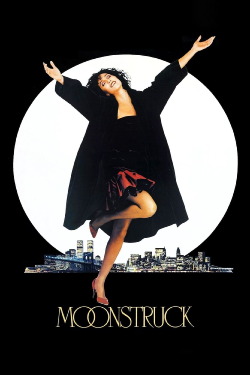
Review of Moonstruck (1987) by Paul Z — 01 Oct 2009
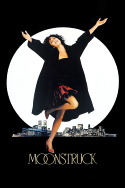
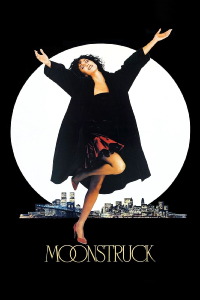
The most endearing aspect of Moonstuck is one that defies description, and that is the movie's mood. Reviews are disposed to make it sound like a madcap ethnic comedy, and that it is. But there is something more here, an undeniable both pleasant and painful longing that comes across as inexpressibly warm, and a definite mystical element that is indicated in the film's title. This endlessly charming movie has Cher as an aptly down-to-earth Italian-American widow in her late 30s, but she is not the only moonstruck one in the film. There is the moonlit night that her keen but crabby mother Olympia Dukakis goes out for dinner by herself, and meets middle-age university professor John Mahoney whose usual MO is seducing his young students, but who finds in this mature woman a particular unerring sexuality. There is the sneaky and still kind of adorable affair that Cher's father, hilarious Vincent Gardenia, has been carrying on for years with the seasoned, disabused Anita Gillette. And at the core of the story, there is Cher's staggering revelation that she is still capable of love.
As the movie opens, she becomes engaged to Mr. Johnny Cammareri, played by Danny Aiello, not so much out of love as out of boredom. But after he flies to Sicily to be at the bedside of his dying mother, she goes to talk to Mr. Johnny's alienated younger brother Nicolas Cage (who though he is indeed Italian is nonetheless the very least Italian actor in this entire film) and is overwhelmed when they are drawn almost spontaneously into a steamy caress. Moonstruck was directed with amazing grace by Norman Jewison and written passionately by John Patrick Shanley, and one of their achievements is empowering the film to be about all of these people. This is an ensemble comedy, and many of the laughs are drawn from the impression of family that Jewison and Shanley establish. There are crisp, priceless occasions of pure Italian-American physical theatricality and grand timing, and others involving the irritation that Dukakis feels for her ancient father-in-law, who lives upstairs with his dogs.
As Cher's absent fiancé clings to his mother's bedside, Cher and Cage grow even more hopelessly in love, and Cher learns the story of the enmity between the two brothers. Yet long-harbored resentment and bad blood and timeworn grief and contempt are everywhere in this film. The mother knows, in this manner, that her husband is having an affair. She asks from the depths of her heart why this should be so, and a friend replies, "Because he is afraid of dying." She sees immediately that this is so. Though does that make her offer consolation to her husband? Barely: "No matter where you go, or what you do, you're gonna die." Nonetheless, all of the ardor is emptied of its power to wound, by the ineffable control of the moon, which has beckoned these people and defends them from the ramifications of their weaknesses.
This pleasant surprise is permeated by fine performances, even though no one is young or old enough for their roles by any stretch, Cage playing a character about fifteen years older than his real age, eighteen years younger than Cher's and thirty-one years younger than his on-screen brother Aiello, not to mention there is only a fifteen year age difference between Cher and Dukakis, who play mother and daughter. But the delivery is all fine, by Cher, who in spite of an astonishingly generous Oscar win still was never funnier or more self-possessed, by Dukakis and Gardenia as her parents whose love runs as deep as their aggravation, and by Cage as the unfortunate, aggressive brother, who is so brimming with outrage that he has lost track of what began it all. In its affection and in its charm, as well as in its laughs, this is one of that small handful of romantic comedies that truly delivers on both counts.
This review of Moonstruck (1987) was written by Paul Z on 01 Oct 2009.
Moonstruck has generally received very positive reviews.
Was this review helpful?