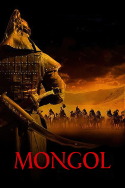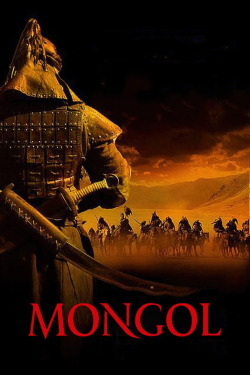
Review of Mongol: The Rise of Genghis Khan (2007) by Christopher B — 04 Dec 2011
Either History Made of Bits of Legend or Legend Made of Bits of History.
The strangest and yet most common complaint I've come across reading reviews and such about this movie is that it doesn't have enough action sequences. I mean, it has more than most other biopics, such as [i]The King's Speech[/i]. Actually, I think it has more than [i]The Conqueror[/i]. (Which I have watched and have not gotten around to reviewing. Maybe I'll sit down and write it this evening.) The fact is, we start when Our Hero is nine years old and considered too young to kill under Mongol law. Yes, all right, he did kill a lot more people personally than George VI, but they lived in very different times. The movie also ignores the fact that an enormous percentage of the human population, relatively speaking, can probably claim descent from him; the paternity of the only two children he has of the movie was doubted during his lifetime. The story this movie tells is simply elsewhere.
We start when Temudjin (for now Odnyam Odsuren) goes with his father, Esugei (Ba Sen), to choose a bride. Temudjin is nine. They are on their way to the Merkit, but they stop with another tribe, where Temudjin meets Börte (for now Bayertsetseg Erdenebat). She convinces Temudjin that they should marry. Unfortunately, the reason Esugei wanted him to choose a Merkit bride was that he needed the alliance, and Esugei is poisoned. The tribe is taken over by one of his men, Targutai (Amadu Mamadakov), who does not kill Temudjin because he's too young. Twice, Temudgin escapes; twice, he is recaptured. The first time, he meets Jamukha (Amarbold Tuvshinbayar). There is much conflict; eventually, Temudjin (by now Tadanobu Asano) marries Börte (by now Khulan Chuluun, the only Mongolian in the cast), but he is captured by Targutai a second time and then, in the end, the Merkit capture him and sell him into slavery. While there, he is seen by an aged monk (Ben Hon Sun), who foresees what will happen to Temudjin and goes out of his way to ensure that his monastery, at least, will be safe.
Honestly, the whole thing gets a bit confusing. But remember for one thing that we really don't know much of anything about the youth of Temudjin-who-became-Genghis. The closest we have to a history of the time is a poem called "The Secret History of the Mongols." Thus the idea that he was captured and escaped three times is as likely to be a fulfillment of the mystical number three as that it actually happened. And I suspect that a lot of the events rely for their sense on your familiarity with Mongolian traditions, which means that they don't quite connect to those of us who are not. The film, which was intended to be the first part of a trilogy, leaves off just as we start reaching the bits of his life which are actually documented anywhere else. This isn't an epic in the Hollywood tradition, which I think may well be the problem a lot of people have with it. It is much more, well, medieval in its plot structure.
Though of course the portrayal of Börte would be out of place in Medieval Europe. It isn't just that, while Khulan Chuluun is lovely, she isn't lovely by European standards of that era. It's that Börte only has one coin to her purse, and she isn't ashamed to use it. She's more just resigned. She knows it's the only way she's going to get her husband back--and what's more, her husband knows it. He doesn't hold it against her, and he accepts both her children as his without even asking her or doing the math. Remarkably, this actually seems to have been the case, though his later sons by Börte apparently stated that they would not be ruled by their brother, who predeceased their father anyway. I suppose that Temudjin and Börte both know that she doesn't have a lot of choice in the matter; after all, she is abducted on her honeymoon and isn't given much choice about whose bed she will share after that.
And of course, this movie is just visually stunning. It was filmed on location on the steppes of Mongolia; the first city we see doesn't appear until about two-thirds through the picture. When the monk goes after Börte upon Temudjin's request, he walks for (by our clock) several minutes through truly breathtaking scenery, eventually unable to walk anymore. It's mostly that he's old, unwell, and without supplies, but you could almost get the impression that he has merely succumbed to the astonishing scope of the steppes. I can understand some of the complaints people have with this movie; it's a bit disjointed, and it isn't always easy to tell which character is whom. It relies on a certain mystic treatment of Temudjin, one which he probably would have wanted to cultivate but one which does not fit terribly well into our current views of the man. He is, in this, a man favoured by his God--but it's a God most people today couldn't name on a bet. In a way, most historical figures fit into this vague realm of half-real, half-legend. It's just that we aren't used to thinking of them that way anymore.
This review of Mongol: The Rise of Genghis Khan (2007) was written by Christopher B on 04 Dec 2011.
Mongol: The Rise of Genghis Khan has generally received positive reviews.
Was this review helpful?