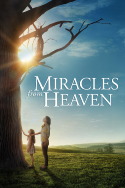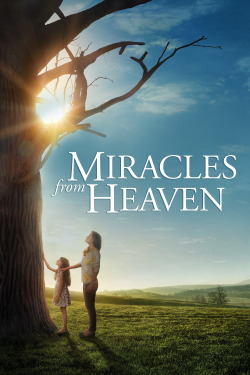
Review of Miracles from Heaven (2016) by Dave M — 18 Mar 2016
I love words. More specifically, I love finding just the right word or combination of words to effectively communicate a very precise thought or even a complex idea. Of course, for words to function as I just described, they each have to carry a consistent meaning - whenever someone speaks or writes the word and whenever anyone hears or reads the word. Take the word "miracle", for example. Although definitions vary, they can be summed up the way the voiceover does at the beginning of "Miracles from Heaven" (PG, 1:49) - an event which does not have a natural explanation. One of the problems with this film is that it doesn't stick to its own definition - and confuses the meanings of other words as well.
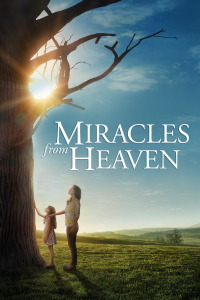
As hard as I try to avoid spoilers in my reviews, there's no way to talk about this movie without mentioning how the story comes out. Even though I won't go into any major plot points that aren't already in the film's trailer (and all over the internet), please consider this sentence your spoiler warning. This movie is based on the 2015 book "Miracles from Heaven: A Little Girl, Her Journey to Heaven, and Her Amazing Story of Healing" by Christy Beam. The book and the film (with only minor differences between the two) both tell the story of Beam's 12-year-old daughter, Annabel, who developed an incurable and deadly digestive disorder which suddenly disappeared after she fell 30 feet head-first through the hallowed-out trunk of a dead tree. Christy suffered only minor injuries and says she went to heaven and spoke with Jesus during the hours she lay unconscious before being rescued.
Homemaker Christy Beam (Jennifer Garner) and veterinarian Kevin Beam (Martin Henderson) live a happy and quiet life with their oldest daughter, Abbie (Brighton Sharbino), middle daughter, Anna (Kylie Rogers) and youngest daughter, Adelynn (Courtney Fansler) in a suburb of Fort Worth, Texas. They have a good-sized house with a little bit of land and Kevin has just opened up a veterinary hospital, for which Kevin and Christy took out a second mortgage on their home. The family goes to church regularly, as we see in the movie's first big scene (where the band "Third Day" sings). The Beams have close friends in that church, including the kind, funny Pastor Scott (John Carroll Lynch of TV's "American Horror Story").
The night after a church picnic, Anna is lying in her bed when she suddenly feels ill and calls out to her mother. Anna remains sick and in pain over a period of weeks, in spite of multiple hospital visits and consultations with several doctors, until Dr. Blyth (Zach Sale) makes the correct diagnosis of Anna's condition - pseudo-obstruction motility disorder. With Anna's digestive system unable to function properly, she begins a daily routine of feeding tubes, medication and restricted activities. Dr. Blyth says this condition has no known cure and implies that it's often fatal. However, he offers a ray of hope in a referral to world-renown gastroenterologist Dr. Nurko (Eugenio Derbez) at Boston Children's Hospital.
Dr. Nurko is very much in demand by desperate patients all over the world and getting an appointment with him is no easy task, but Christy Beam refuses to take "no" for an answer and insists on getting her daughter the best medical help available. As the entire family struggles to cope with emotional stress, family care and serious financial issues, Christy and Anna must make regular trips to Boston where Dr. Nurko uses his talent for medicine (and for dealing with sick children) to do all he can for Anna. Sadly, she continues to suffer, but Anna and Christy receive no small amount of comfort and encouragement from a local Boston waitress (Queen Latifah) who befriends the struggling mother and daughter. It looks like there's nothing more to be done when Anna and her sister are climbing a tree in their yard and Anna experiences that dramatic and terrifying fall, lying deep within that tree trunk needing a miracle.
The main problem with "Miracles from Heaven" is that it can't keep its message straight - or its own vocabulary. The word "miracle", as defined at the beginning of the movie becomes, in the movie's last big scene, a much broader term which is then rendered virtually meaningless. Another word the movie has a problem with is "impossible". It's used on the movie poster and in the film's trailer to describe Anna's healing. But Anna was indeed healed. Her healing was never (and ends up not being) impossible after all - especially for people of faith - which is the third word the film uses inconsistently. Is faith really faith if it goes away when prayers aren't answered quickly, but then returns once everything has turned out okay? And if prayers offered in faith led to Anna's healing (as the movie implies) what does that say about the prayers or faith of many parents around the world who have sick children that are never healed? Troubling questions for a movie that asks us to accept an impossible miracle on faith.
Some may consider the issues I just raised to be trivial or based on a misunderstanding of the film's message, but I just happen to think that words have meaning and that should count for something. However, I can't evaluate this movie objectively based on its use of words without also giving my subjective and more positive assessment of the film. "Miracles from Heaven" may be flawed in the choice of words in its script and inconsistent in its message, but it also happens to be a very meaningful and even entertaining story. Although the extent to which Anna's suffering is shown seems designed to increase the number of tears that audience members shed later in the film, overall it is a well-told, very well-acted story of the importance of a close family and true friends. I can't quite recommend this movie to a general audience, but the faithful will likely enjoy it. "C+".
This review of Miracles from Heaven (2016) was written by Dave M on 18 Mar 2016.
Miracles from Heaven has generally received positive reviews.
Was this review helpful?