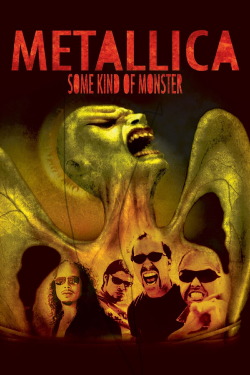
Review of Metallica: Some Kind of Monster (2004) by Edith N — 17 Aug 2011
A Disillusioning Glimpse Inside the World of Heavy Metal.
I'll admit that I'm not a huge Metallica fan. It's not that I dislike them, particularly, but it's just not a genre of which I am particularly fond. They've done one or two songs I like, but I couldn't name more than a few of their songs, and remembering the names of the band members is even less likely for me. This movie has been out for nearly a decade, and it's been in my consciousness only as "something I ought to get around to at some point." And that's mostly because I had a friend many years ago who was a big Metallica fan, and these things remind me of him. (And he's got such a ridiculously common name that finding him on Facebook would be challenging to impossible.) I can't help wondering what he would have thought of this movie, though, because I don't have the perspective of a true fan--or a complete outsider, come to that.
This movie was originally planned to be a miniseries on MTV. Metallica commissioned a film crew to follow them around and document the creative process involved in making the album which would become [i]St. Anger[/i]. This was a process which ended up taking about two years, in part because James Hetfield spent six months in rehab and then had an extremely limited schedule, only being able to work four hours a day. Their bass player, Jason Newsted, had left the group--I missed quite why--and they don't seem inclined to put much work into finding a new one even though bass is extremely important to their variety of rock. They are also in group therapy together. Not, unfortunately, individual therapy at the same time, but only therapy to work better together as a group. The camera crew gets near-complete access, even following Hetfield when he goes to his daughter's ballet class. In theory, this is essentially immersion into the life of a group of rock icons deep in the artistic process.
In practice? Kinda boring. For one thing, one of the effects of the counseling seems to be a tendency toward Therapy Speak. It's a little unnerving to see an extremely angry Lars Ulrich going on about the importance of his feelings during the recording session. And then screaming vast obscenities into a microphone. The effect it doesn't seem to have, unless Hetfield's choice to go into rehab when he did comes from it, is any improvement in the band's psyche. Or at any rate those of Hetfield and Ulrich. Kirk Hammett seems perfectly placid through the whole thing, having long since dealt with his life on his own terms. New bass player Robert Trujillo hasn't been around long enough by the end of the movie to be involved in the whole trauma. And their long-term producer, Bob Rock, seems to have a bit of a codependent relationship with the band. They're also managed by a mostly-offstage team called Q-Prime, apparently responsible for having brought in the therapist in the first place.
Oh, and it turns out the guy's unlicensed. He's technically a "performance-enhancing coach," because he relinquished his license rather than face charges in Kansas. As is apparent in the movie, he put unnecessary pressure on patients not to end therapy. He's also far too passive-aggressive to handle this particular group. One of the things Ulrich and Hammett are able to agree on is that they don't want this guy as a permanent part of the group, and when they level with him about it, Phil Towle tells Hammett that he has trust issues that he should be working out, and his choice to end therapy is clearly about that. Which it may well be, but unless you're in therapy in more of a court-ordered kind of way, it is absolutely your own decision to discontinue. Even then, there's a certain extent to which you have the right to choose a therapist. These guys are in therapy because their management team thought they should be, and they clearly have the right to walk away, even if their therapist doesn't want to lose the forty thousand a month.
Most of the movie dissolves into petty bickering. It takes a certain courage for the men of Metallica to be willing to show this footage, since only Hammett--of those who are involved with the band from the beginning of the film--comes across particularly well. He also comes across as a guy whose emotional health is best served by walking away from the whole thing, though of course there may be a lot that we don't see in the roughly two and a half hours of running time. These people didn't have to let their smaller, pettier aspects be made visible to fans--and critics. They don't even come across unscathed musically; they write thirty songs for the album and can initially only agree on four. The Napster lawsuit, then at its height, was only briefly touched on, not even enough for them to give their full statements on the subject. Perhaps to an impassioned Metallica fan, there would be more interest, more to delve. To a casual observer, it's not unlike being back in junior high school orchestra, which is where I met that Metallica fan in the first place.
This review of Metallica: Some Kind of Monster (2004) was written by Edith N on 17 Aug 2011.
Metallica: Some Kind of Monster has generally received positive reviews.
Was this review helpful?