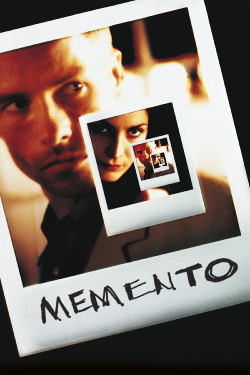
Review of Memento (2000) by Callum H — 11 Dec 2014
Original comments:
I'm still trying to fabricate my thoughts on Memento, after it left me reeling, so I'll provide a brief summary of my thoughts before a more in-depth review comes later:
Memento is one of the best films I've ever seen.
More coming soon.
Further comments.
"We all lie to ourselves to be happy."-Leonard Shelby.
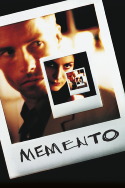
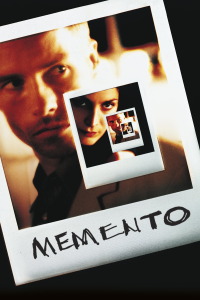
This is most obvious in Memento, a film about memory, self-deception and manipulation; it is also one of Christopher Nolan's finest directorial outings, ranking alongside modern classics like Inception and Batman Begins. Not only is it an immensely enthralling watch, containing strong pacing, impressive cinematography from Wally Pfister and understated but undeniably moving performances, but it is also an intelligent film, composed of themes and ideas that have rare placement in modern Hollywood and cinema. Unlike so many a director in today's money-hungry film industry, Nolan doesn't feel obligated to abide by story-telling conventions, nor does he feel an impulse to carefully guide his viewer through the experience he is allowing us to endure. Sure, Nolan allows voice-overs to provide inner monologue for the main protagonist, these giving us an insight into not only his thought process, but the plot in its entirety, yet still, these voice-overs don't necessarily seek to provide a web of safety for the viewer. One can not simply sit back and rely on inner dialogue to provide the answers that one may desire. Nolan seems to demand complete and utter concentration from the viewer, and due to his immediately creative and shocking style and use of imagery, we happily oblige.
Memento centres around the character of Leonard (Guy Pearce), a man who received short term memory loss when he was hit over the head by an unknown assailant whilst this man's partner in crime was raping and killing Leonard's wife. Ever since, Leonard's entire goal in life is to track down and kill the man who took his wife and his ability to form memories from him. Using various clues that he leaves himself before his memory resets, Leonard is able to navigate the world and figure out just who to trust, and who may very well be leading him astray. The question is though; is Leonard reliable enough to inform his future self of the supposed 'facts', or is his own advice misdirected instead?
In many ways, Memento asks the same questions as Inception; should we blame ourselves for the problems that occur around us, though it poses this thematic concept with a far more literal context than Nolan's dream-based blockbuster. Nolan, utilizing a non-chronological sequence of events, keeps us in the dark not only as to what may occur at the end of the film, but in regards to Leonard's own directions. The film encompasses two different set of sequences, one being set in black and white, the other being in colour. The black and white sequences occur at what many would consider, if this were any other film, to be the beginning of the story. It moves forwards. The coloured set of sequences begin at the end of the chronological story and move backwards (not physically reversing, but moving a scene back every switch between black and white and coloured, and then connecting back up to the prior scene at the end of the sequence). These two sets of sequences arrive at the middle at the end of the film, and we get to discover something far more interesting than the end results of Leonard's eventual actions. We get to discover his reasoning and character for doing such.
This is what makes Memento one of the most original and thoroughly unique films of the modern era. Instead of making the viewer's primary goal that of finding out Leonard's end results, Nolan implores us to find out the character behind the actions instead. To show the story in the chronological sequence instead of this intelligent way of sequencing actually used within the film would have been a fatal mistake, as Leonard would have become a far less interesting character; after all, his memory does reset at the end of each scene, so at first glance, it becomes almost entirely impossible to connect with him. But Nolan tackles this brisk challenge by looking at the character in a completely different form than what any other writer would have. Take any other screenwriter, and they would have focused on Leonard's system of telling himself what he has forgotten, this including using tattoos, notes and photos to inform his future self of the danger or trustworthiness of each; they would have focused on exploring this system with great depth. They would have focused on the end result of Leonard's deceptions and tribulations. Nolan sees this system and the chronological conclusion as irrelevant, for he instead sees it appropriate to judge and focus upon the conscious of a troubled individual; a man who strives to find a purpose in life. The film asks whether or not someone is willing to fabricate a fake life and problem, just so they may have a purpose in their actions. Ultimately, its answer is relatively inconclusive, so the viewer is left to ponder on this thematic concept.
The character at the centre of all this is played wonderfully by Guy Pearce, who gives the character a number of perhaps falsified traits and reactions, and determines Leonard's likability, as that is perhaps the most defining factor about the individual. For the majority of the film, we, along with Leonard, rely on his own information to help us understand exactly what is going on, and we respect and believe his hints not just because he is our protagonist, but also because he is a thoroughly likable person. He is relatable, sympathetic and understanding, and we immediately cling to his being, despite him doing a number of questionable and morally ambiguous things towards the beginning of the running time. Pearce is the perfect primary character, and handles the character with precision and a practiced ease. Honestly, after watching his performance, I can imagine few others fitting into the role so well. Acting alongside him are Carrie-Anne Moss as Natalie, a woman who takes advantage of Leonard's disability and uses it to advance her own position, as well as Joe Pantoliano, who plays Teddy, a shady undercover cop, who may or may not be willing to help Leonard. All of the ensemble give subtle performances, alluding to whether or not they may be hiding something from not only Leonard, but the viewer. Never have I been so unsure of who is trustworthy, and who is an enemy, and that is a credit to the actors and to Nolan.
Perhaps the only negative with the film is that of the score, from David Julyan, whose synthetic approach lacks much substance or story. It does the basics and nothing more; it allows a certain mood but doesn't provide a story or semblance of anything more. This is a very minor gripe though, as Nolan's sound mixer, William Fiege, managed to utilize both silence and Julyan's score to maximum effect, delivering a strong effort. The editing is also worthy of commendation, initializing a strong pace that helps to carry the film forward and keep it from slowing down. Nolan's editor, Dody Dorn, is also responsible for the coherence felt throughout the entire picture that allows the film to remain accessible, even whilst it traverses certain ideas and events which may become confusing for the viewer.
As a technical piece, Memento is perfection. But ultimately, it's the story-telling component that renders this picture one of Nolan's finest. Some may declare plot holes all over the shop; one of late prolific film reviewer Roger Ebert's readers posed the question in regards to Memento that reads, "If the last thing the main character remembers is his wife dying, then how does he remember that he has short-term memory loss?" One can make up excuses for the film (perhaps Leonard looks at a note that states his condition every day, but Nolan felt it unnecessary to dwell on it?), but I don't believe it's all that necessary, considering how completely flawless the rest of the film is. Despite the complex ideas and events occurring within the picture, Nolan establishes his characters and ordeals with tight story-telling prowess, allowing the story to unravel in an unnatural but highly innovative way, and one that keeps us guessing about motivations and thought processes until the very final few seconds. In my opinion, modern cinema has lost the ability to provide fulfillment for its viewer; this issue plagues most of my friends, who don't watch films too often. They view films which don't ask questions or pose problems that beg to be solved. They're simply as they appear; there are no underlying themes or concepts that keep them thinking after the running time concludes. What makes a film like Under the Skin an insta-classic is its ability to garner the imagination of the viewer. And when you finally develop a conclusion or idea for how or what something represents, or how the story really concludes, you feel like you've triumphed in something. It's the same feeling as conquering a race or acing a test; it provides a thrill and joy that is unmatched, at least in my experiences. Memento is sure to provide that exciting fulfillment when I finally understand its many ideas and plot points, and that in and of itself is deserving of high praise. Nolan may just very well be my favourite director of all time now.
"Now... where was I?".
This review of Memento (2000) was written by Callum H on 11 Dec 2014.
Memento has generally received very positive reviews.
Was this review helpful?