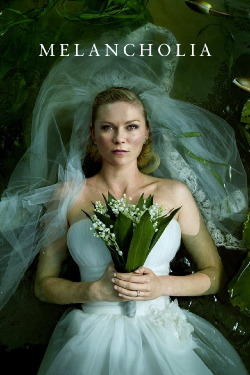
Review of Melancholia (2011) by Holly W — 10 Dec 2012
After watching this film, I'm feeling quite melancholy myself, as I'm depressed over 2 hours of my life that I'll never get back.
Lars Von Trier who wrote and directed the piece (so he cannot point a finger anywhere else other than back at himself), attempted to create something stately and grand, and although there are a few very visceral and beautiful bits of scenery, this film not only moves at glacial speed, but stays in scenes way too long - making me want to hit the fast forward button... of course I would only do that in a desire to get through to the end of the film, as this is one of the few films in recent memory that I wanted to simply turn off (yeah, I've got a good book to read...).
The film sets itself up to be a metaphor, how the possibility of a grand and damaging event can cause depression and inaction; mirroring the psychological state of melancholy - which has been defined as "the mental or emotional state of depression". Ok, we get it - and really don't need to see endless scenes of that glorious state of mental illness where a person gets stymied by the inability to act (and I'm not talking about Kirsten Dunst here, who does her best with a thorny role).
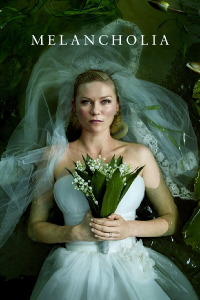
Looking for further clues - there is a rather nice bit of filming dealing with the collage at the beginning of the film (nice artsy fartsy stuff that once again dwells too long on each frame). One of the first uses of the term "melancholy" was in Shakespeare's Hamlet (the melancholy Dane). In the bard's play, Ophelia is in love with the conflicted Hamlet, and then kills herself when he spurns her love by telling her to "get thee to a nunnery". In the 1800's John Everett Millias painted a wonderful and chilling version of a drowning Ophelia - which the film copies here. A nice touch, but really there is no correlation between Dunst and Ophelia other than a state of depression (in other words, she has not been spurned, mistreated, or had any traumatic event in her upper class, privileged life).
I don't usually mention the filming aspects of a project - but simply feel compelled here, as the film editing is atrocious! Scenes are obviously cut and pasted together and - in one of my pet peeves - the music in a continual scene changes from edit point to edit point - for me there is nothing more jarring (I guess you're not supposed to listen to the background music - but I can't help myself, especially when there's little else going on to hold my attention).
There are a series of scenes right in a row that take place outside the manor house where Dunst runs into one character after another - almost like she is a placeholder and the action revolves around her and through her. But for me this seems like a bunch of stuff that would have otherwise ended up on the cutting room floor, but instead were kludged together... and the sad thing is that none of it advanced the plot (such as it is), so perhaps should have ended up on said floor.
A film dealing with the cataclysmic end of the world scenario could have been poignant and full of pathos - instead Von Triers offers a bloated, self important, over long, badly edited mess of a film. For end of the world offerings, the vignette called Last Night of The World in the film Illustrated Man (based on the Ray Bradbury novel), is much more direct, simple, and for it more heartrendering than this disastrous film.
This review of Melancholia (2011) was written by Holly W on 10 Dec 2012.
Melancholia has generally received positive reviews.
Was this review helpful?