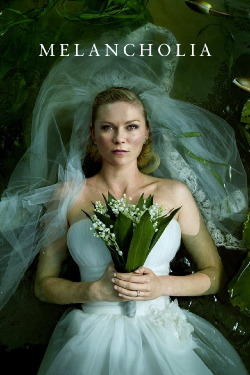
Review of Melancholia (2011) by Pamrosenthal — 16 Nov 2011
An odd thing happened to me on my way out of the theater last night after seeing "Melancholia." Suddenly, the movie, which I'd been mixed at best about, began to seem like a terrific set of jokes, most of them slyly, cunningly visual.
Suddenly, this art film about depression and the end of the world, with its upscale country-estate visuals and high-minded Wagnerian soundtrack, became lowdown laugh-out-loud funny. "And what was up, anyway, with that dress the bride's mother wore?" I asked my viewing companion.
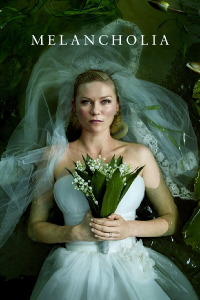
"Didn't it look more like a tie-dyed teeshirt?" Pretty soon we were both giggling and guffawing. "In fact, weren't all the dresses sort of tacky?" "Melancholia" begins with a gorgeous, expensive wedding party from hell, the lovely bride who's been functioning up until now in cheerful, productive denial collapsing into total depression in the midst of friends' and family's selfishness and bad behavior.
Both her parents make horrible, hostile speeches; her boss (also the best man) fires her after she tells him what she really thinks of him; the cute, babyish groom goes home with his parents after she rejects him sexually.
Every guest -- not to speak of the wedding planner -- has his or her moment of meanness, rudeness, or stupidity. But there's no sense that any of these characters have a shared history. Absent a believable social nexus, there can be no social satire: vintage Von Trier, the wedding scenes roll by as misjointed episodes of inappropriate behavior and jittery camera.
Nor is anyone on screen the kind of upscale movie rich person you can have fun feeling superior to even as you enjoy looking at them. No one except the clueless groom even looks that good; the nut-case bride, Justine, becomes increasingly oppressed by a silly, puffed-up, unbecoming, and ever more crushed and wilting gown.
For me the wedding was a long meandering frustration, much less fun than I kept expecting it to be. So I was glad (though not optimistic) when Part II -- shot much more serenely -- began. Some time has passed at the lush country estate (it belongs to Justine's sister Claire's rich husband).
Justine's mental condition has continued to deteriorate; Claire's taking care of her. There are some intimate domestic scenes and lovely landscapes, sugesting that perhaps even an awful wedding isn't the end of the world.
But wait, it IS the end of the world. A newly-discovered planet called Melancholia is making its way toward Earth. Scientists don't foresee a collision, just a fantastic cosmic show for amateur astronomers.
But we who have seen the movie's opening montage know differently and so does Justine, whose depression has put her in tune with the big engines of destruction. Pretty soon, of course, everybody can do the math or simply observe the rogue planet looming larger, ever more gorgeously visible even during the day.
Claire becomes as overwrought as I (and I'm guessing you) would be, while Justine begins to flourish. In a particularly stunning night scene with the Liebestod theme on the soundtrack, she reclines naked on a riverbank; bathed in Melancholia's deathly light, she's as open to ravishment by her own and everyone else's oncoming death as she was shut off from sex with her young husband.
None of this is exactly profound, but it was effective and I enjoyed it. Neither Justine nor Claire is given any genuine depth of character or specificity of motivation (Justine's the crazy one, Claire's reasonably adjusted to what seems a more-or-less typically imperfect life, except with a lot more money).
But in the face of imminent annihilation their words, actions, and expressions are freakishly recognizeable. I was particularly moved by Charlotte Gainsbourgh's Claire, clutching at her young son, making hysterical, futile attempts to escape to somewhere, do SOMETHING.
While as for Justine's wilder side of the equation: my natural tendancy is to respond with annoyance, even to take offence, at any romanticization of death; my guess is that lots of depressives would be just as terrified by the prospect of the world coming to an end as the rest of us; and don't even get me started about Wagnerian mysticism.
But for all that, I have to confess I found Big Oblivion as Von Trier delivers it in the final scenes to be big sublime fun, and terrific to look at. A nasty, narcissistic streak runs through it, of course: the adolescent fantasy of being in touch with big destructive forces, and of taking everybody less sensitive than you with you when you go.
Von Trier knows this, I think. His two-sisters structure is a way of identifying with Justine but not entirely. The movie has it both ways and so did I. And so does anyone emerging safe and sound from the theater, the deferred humor from the wedding scene bursting forth to break the tension, sending you into gales of helpless laughter, after the apocalypse, later, out there on the staircase.
This review of Melancholia (2011) was written by Pamrosenthal on 16 Nov 2011.
Melancholia has generally received positive reviews.
Was this review helpful?