Review of Mean Streets (1973) by Joel C — 01 Dec 2009
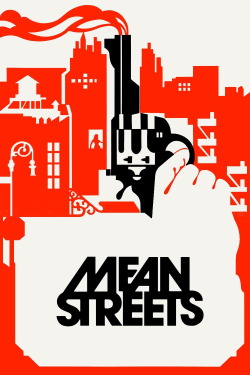
Martin Scorsese's "Mean Streets" presents a character who knows he's bound to burn in hell and offers scenes in which he holds his hand out to desensitize it to open flames in preparation. At first, he pulls it away in pain, but by the end of the film he is able to hold it over a burning barbecue stove and call it "fine". In a way, Charlie (Harvey Keitel) is the prototype of a lot of the tough-as-nails crooked Italian-Americans that Scorcese would come to showcase in his gangster pictures. There has always been a fascination with the paradox of the holy and the profane in Scorsese's scripts, but "Mean Streets" especially grants a look at how the spiritual sides of these men are burning away in their bodies.
Scorsese grew up with these character types. He saw them in Little Italy, hanging around in doorways, telling stories about bravado in the face of the law and the businessmen who could do them a lot of harm if they'd only catch them first. Scorsese has a lot of affection for his memory of these guys as they present their girlfriends like trophies and cover their backs when a punch is thrown. An unpaid debt is a mortal sin that requires confession. In a Scorsese film, morality is judged by capital, and those desperate for it inevitably twist it into survival at all costs.
Robert De Niro's Johnny Boy is a sinner, a defiler of the street order of things who believes that he can take advantage and not care about the people he shares a neighbourhood with. Early in the film, Charlie explains to a friend via voiceover that the Catholic Church is no longer enough to absolve his particular lifestyle and that he must do it on his own. All of the institutions seen in the film - religion, family, friendship, love, business - are intricately and tragically interconnected. Right is separated from wrong by who ends up with a bullet in their neck.
Charlie takes it upon himself to look after Johnny Boy, who repeatedly disappoints him. Michael (Richard Romanus), a local imported goods fencer, is growing increasingly tired of Johnny's cocky attitude and the fact that he'd rather spend money on hats and drinks than pay him off. Charlie is romantically involved with Johnny's cousin Teresa (Amy Robinson), so he walks a thin line between familial and business obligations. His ambition is to move up in the world, but he can't help but involve himself with dishonourable men.
A part of me is always baffled by gangster films. Strong feelings of sympathy and incredulity rush forward as I wonder why the characters can't simply put aside their filthy practices and start new lives, but the world of organized crime has a magnet at its nucleus. It spins with the combined indelible pull of easy success, chauvinistic macho stature, racial jealousy and the ideals of perverted saints. Charlie and Johnny converse in the graveyard of the first Catholic cathedral in New York City and death feels right next door. Charlie idolizes St. Assissi, but certainly there are many in hell who do, men who have gone too far and will never see paradise.
With his small frame, meek countenance and asthma, it is difficult to imagine Martin Scorsese the man fitting in with this crowd. But Scorsese was first and foremost a storyteller - it is his voice, not Keitel's, that we hear serving as narrator. He had an ear for dialogue and took great lengths to present it honestly and accurately. It was his actors that made the dialogue and inflection what it is today, positioning every "Get outta heah" and each exclamation of "Ay!" in the world's consciousness of New York at a specific time and street corner. It is a city that has become many things in many people's imaginations and a lot of that has to do with the film medium and Scorsese's contributions in particular.
In my favourite scene, Scorsese keeps the camera in a straight-ahead closeup on Charlie's face as he wanders drunkenly around a party with the deep red lights shining on his features like hellfire. People bump into him, spill drinks in his hair, kiss him on the cheek, and the smirk never leaves his lips before he passes out on a table. The party is for a returned Vietnam War vet, who experiences a flashback and attacks a woman on the dance floor. It's the kind of moment that gels Scorsese's vision of America, a country that raises fundamentally good people to do nefarious things for the sake of values they don't quite understand.
"Mean Streets" helped kick-start a far more visceral mode of storytelling in the cinema. Film became a reflection of and reaction to violence seen on television sets, in homes on the nightly news. Other directors such as Peckinpah, Cassavettes, Coppola and Hopper had already offered the initial blows to American cinematic convention, but Scorsese is the most responsible for how today's effective crime dramas operate. "Mean Streets" naturalizes the criminal life without exonerating it. It turns the bad guys into tragic figures who believe that they can shout louder than God can be silent.
This review of Mean Streets (1973) was written by Joel C on 01 Dec 2009.
Mean Streets has generally received very positive reviews.
Was this review helpful?