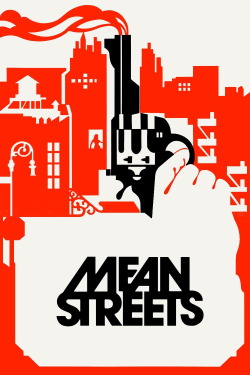
Review of Mean Streets (1973) by Francisco R — 09 Dec 2010
Director: Martin Scorsese.
Producers: Martin Scorsese, Jonathan Taplin.
Screenplay: Martin Scorsese, Mardik Martin (Story by Martin Scorsese).
Year: 1973.
Starring: Harvey Keitel, Robert De Niro, David Poval, Amy Johnson, Richard Romanus, Cesare Danova and others.
5 Stars out of 5 "The film that consolidated Martin Scorsese's career it's also one of his best works.".
Martin Scorsese is one of the living legends of modern cinema, his films trascend trough the time when were released, and they're subject of admiration between the followers of the "seventh art". But, as all the great artist, Scorsese had to start from the basic; he start directing short films ("What's a Nice Girl Like You Doing in a Place Like This?" or "It's Not Just You Murray") in 1963 and 1964. In 1967 he directed his last short work, "The Big Shave", a cult classic for Scorsese's fans.
At the beggining of the 70's, Martin Scorsese was a director in training, far from been the accomplished artist that he is right now, and from the same reason, he made independent films with low budget, but he started when the 60's were still in progress. His first feature film was "Who's That Knocking At My Door?" (1967), a film with a story that "play" between the traditional and complex. Received praise from the critics.
His next film was "Boxcar Bertha" (1972), one of his worst (and strange) of his career. A film about crime but very bound to the explotaiton films, produced by Roger Corman (now everyting makes sense). Barbara Hershey and David Carradine were starring. It was severely criticized for the experts... The film was so bad that John Cassavetes (good friend and mentor of Scorsese) said "You've just spent a year of your life making a piece of shit".
The only "good" thing that Scorsese learn by making "Boxcar Bertha" was to how to make films in a faster and economically way. With a bad balance since his last film, the director had just betrayed his style ( he didn't knew it in that moment).
But, in 1973, his third film was released, "Mean Streets". Acclaimed by the critics, it was, without any doubts, his starting point of what he was about to become.
Made silently, "Mean Streets", was another pleasant surprise of that year (with "Badlands" and "American Graffiti"); a movie that no one would put their hands in the fire for it, became in a classic of the independent cinema. A story that could have been simple as other works of the genre, was an admirable piece instead. For one moment to another, Scorsese was a good promise again.
The story revolves around the life of four young man from Little Italy, Charlie (Harvey Keitel), Johnny Boy (Robert De Niro), Tony (David Proval) and Michael (Richard Romanus), but focusing more in Cahrlie, showing his point of view and thoughts (Martin Scorsese). Charlie works in the family business, for his uncle Giovanni (Cesare Danova), collecting debts taking to owners of shops, restaurants, etc. Tony works in a bar, more like a cave with alcohol and "wild animals". Michael is in charge of the contraband and black market. But Johnny, have no work, no money, and no future.
Charlie wants to atone his sins (he is very catholic), so he decides to help Johnny with his monetary problems (he owes money to Michael), while he is about to be in charge of a restuarant; Charlie is in a secret affair with Johnny's cousin, who have epilepsy, so the people shouldn't know anything because of the prejudice; His uncle thinks that they're only friends, and even that, he says that he must be away from here because of her condition, or Charlie's posibilities about the restaurant will be smaller. That, and the fact about little interest of Johnny about paying and the impatince of Michael makes everything more difficult than Charlie thought.
Based on Scorsese's personal experiences, the story translate, and compares his condition as director with the condition of his characters, all being young people, with a lot of things to learn in the future.
The script, written by Scorsese and Mardik Martin, is different compared to others film directed by Scorsese, for the only fact of being part of it. The director, who was still in a process of discovery and exploration, writes an story, although similar to his future works, with a level less "festive", giving the film a darker tone and emphasizing the use of dialogues (most parts of the movie are conversations), with few dynamism, but loaded of intelligence that are a fundamentel part of the film (that's something that we can call a "key dialogue"). Probably "Mean Streets" is the most elaborated work of Scorsese, because it's the most crude fo his film, the situation showing in the picture are more inevitable and shows existential problems on the characters.
The close direction give a sensation of vitaltyon the film, even when there's no much complciated shots (one or two probably), Scorsese takes advantage of the premise in an exact way, using not expensive cameras, but cheaper than usual, probably, the film looks imperfect shoting like that, but that's the focusing needed, giving an "space" much more realistic and dynamic. In fact, Scorsese, direct some shots in a way of telling to the audience that what are they watching is not completely fiction, Scorsese not only creates, he documents, he is giving testimony.
Keitel acts very well as Charlie, probably, we never have saw him so vulnerable, cautious, close, scared, well, his performance is one of the best of his career, with a breakable character but also lovable, and probaly the most ingenuous of the film. De Niro, potent as always, gives one of his ten best performances of his life (he is a great actor, he have at least ten great performances), he submerge himself in the role of Johnny Boy, a man who is irresponsible, exalted, inmature, etc.
Proval as Tony is very good, a man who wants to keep his business right, just stay out of the problems (probably is the most mature character of the movie and curiously is a good friend of Johnny Boy). Romanus as Michael is amazing, showing anger and coldness, without saying a word.
Danova is both incredible, shows wisdom on his words and (contrary to Michael) patience, you can perceive his calm just hearing him. Johnson as Teresa is marvelous, so fragile, so concerned, she is the only 100% pure character.
The use of the music is one of the constants on every single film of Scorsese, just like "Who's That...", the director choose songs of the time, Rock, Pop, Jazz, etc...sometimes he use them for acclimate the story, sometimes to make some scenes more "light", or to contrast ironically some sequences. By the other hand the cinematography was work of Kent Wakeford. It's true that sometimes, his irregular, but helped by a wonderful direction by Scorsese, Wakeford, combines, styles, showing the scenes of the bar with a quiet camera, and the scenes on the street with some lack of control, just as the street itself.
It presents real problems more seriously, while Keitel is a religious man who have to carry with the charge of the "family business" and his clandestine relationship with his epileptic girlfriend, Johnny Boy looks like he have no path to follow, and his destiny is almost sealed because of his lawbreaker and destructive attitude. The restof the characters have them lifes almost built, and they must deal with typical problems of the "mean streets", at the point that at the end, them choices will become irremediable.
Scorsese shows the streets as something metamorphic, on day, they're have different situations and people that when we see them when it gets dark, corruption and violence, all motivated for the always present narcotics. It also raise major dilemmas for the human being: religion, money, love, etc, and he explores them gradually and passive.
Is a critic to the rapt youth, to the decadent urban environment that it's "breathed" in New York and agaisnt the discrimination of the minorities. All of that thanks to Martin Scorsese, who produces his first film of his career, and ends up being one of the most uplifting films of the 70's.
AMBITIOUS AND EXUBERANT, THE THIRD FILM BY MARTIN SCORSESE, IS NOT JUST HIS COMING BACK TO THE BIG CINEMA, IT'S ALSO, THE BEGGINING OF A CAREER THAT WILL MAKE HIM GET MORE THAN 7 ACADEMY AWARDS NOMINATIONS.
Now, Scorsese spent another year of his life and he finish a masterpiece...Coincidence? Maybe. But After "Mean Streets", Scorsese directed "Alice Doesn't Live Here Anymore", it was nominated for a BAFTA for Best Director and then he released "Taxi Driver" and he won the Golden Palm at Cannes. Now...That is coincidence? I don't think so.
This review of Mean Streets (1973) was written by Francisco R on 09 Dec 2010.
Mean Streets has generally received very positive reviews.
Was this review helpful?