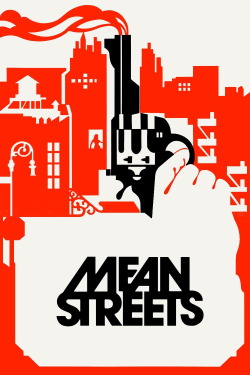
Review of Mean Streets (1973) by Shae S — 29 Sep 2010
"You don't make up for your sins in the church. You do it in the streets. You do it at home. The rest is bullshit and you know it.".
My favorite Scorsese film, hands down. My favorite '70s film. Overall, it's just one of my favorite films. I just love the flow of this movie. Scorsese being one of the pioneers in applying music of the time to his films rather than having an actual score, really kind of captures that time in not only the character's lives, but in the actor's and filmmaker's lives as well. That's where they were in 1973. Hanging out in bars, listening to the Stones, stiffing some punks for a coupla bucks to go see a movie, playing pool, all that good stuff. I really just like everything about this movie.
It's essentially a movie about guilt. After all, it comes from a time and place where guilt and punishment for your sins meant something. We see this tradition in Scorsese's work. We also see characters who perpetually keep themselves in a bad state. Characters who sin, feel remorse for their sins, and then continue to sin. Keitel is Charlie, a young hood in Little Italy who is very concerned about the life he leads and whether it's slowing earning him an eternity in Hell. He asks a question that I, as a Catholic, have also asked, and many other Catholics have probably asked as well. He asks, "If I sin, why can't I just pay for it my own way?" He gets his ten Our Fathers and ten Hail Marys, then he comes back next week and gets another ten Our Fathers and ten Hail Marys. And it just "doesn't work for him." Much in the same way it doesn't work for me. "They're just words." So he feels this guilt as a result of his lifestyle and yet he keeps it up. He keeps returning to Tony's bar. The bar is drenched in a red tint; red being the color of guilt, sex and blood. It's deep stuff. It's the same in Taxi Driver when De Niro can't stand all the scum in the city, and yet constantly surrounds himself by the scum he hates.
His guilt also manifests itself towards his friend Johnny Boy. They are long-time friends, but John has a tendency of getting himself in trouble. Here is the situation: Charlie is romantically interested in Johnny's cousin Teresa. Teresa has epilepsy, so Charlie's uncle, Giovanni (a caporegime for the local mob), has deemed her "sick in the head" and forbidden Charlie to see her. To make matters worse, Charlie would feel guilty being with Teresa and not helping her cousin Johnny with his problems.
Here we see Scorsese's gritty style come to life for the first time. There is a pool hall fight sequence in which Charlie and friends attempt to beat up "Joey Clams" and his friends. The fight is extremely sloppy. They all seem more concerned with their suits than their health (no doubt because those suits are the only suits they own). It's great.
This review of Mean Streets (1973) was written by Shae S on 29 Sep 2010.
Mean Streets has generally received very positive reviews.
Was this review helpful?