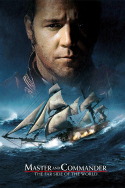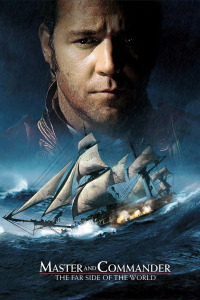
Review of Master and Commander: The Far Side of the World (2003) by Cameron J — 05 Sep 2014
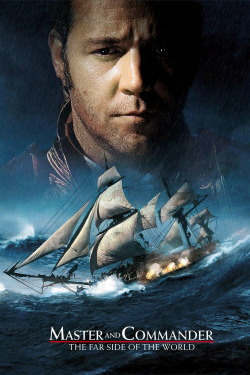
In 2002, "South Park" joked about Russell Crowe getting on a boat and fightin' people around the world, and one year later, well, here you go. Seriously though, in 2003, Peter Weir was finally able to present us with the prestigious period epic we all know he wanted to give us... and then it ended up only winning Best Cinematography and Best Sound Editing, because the stupid "Lord of the Rings Triloy" had to end! I would like to emphasize than "Return of the King" is, in fact, way better than this film, which leaves me to wonder how in the far side of the world it didn't get nominated for and subsequently win this film's Oscars? It pretty much won everything else, but hey, I guess the Oscars can't give everything to the cool action blockbuster, and have to give something to the dry period epics that are actually have something to do with real history. Granted, this film was still a blockbuster which cost $150,000 and got Russell Crowe in the lead role, but it's still by Peter Weir, the man who managed to make a film about a TV channel that's strictly about Jim Carrey kind of dull. No, "The Truman Show" is good, and this film is even better, but, seriously, even this film's title is a little too long and dry. Well, at least this film is less pretentious than "South Park", as well as more compelling, although it would be if it dedicated its length more towards fleshing out what exactly is going on.
The film is filled to the brim with a charming ensemble which defines a lot of the enjoyability of the film, due to the characters' being well-drawn and not surrounded by personal plots so distinguished that they take away from the real focus of the narrative, and yet, what characterization shortcomings there are go a long way, starting out with background development's being brought to the bare minimum, then proceeding to limit well-rounded exposition by unevenly juggling the individual colorful characters. Even though the narrative is singular enough to not get too wrapped up in its many characters' personal narratives, as I said, unevenness ends up being a pretty big issue in this episodic narrative, which sometimes has the nerve to get lost in unnecessary inconsistencies that do not pertain to the progression of the narrative, and defuse a sense of consequence and momentum. Really, momentum is not much of a factor in this film, even on paper, because even though Peter Weir's directorial pacing is as big an issue as anything, Weir's and John Collee's script succumbs to excess that leaves storytelling to drag its way along a familiar path whose juiciness is limited to begin with. The heights in conflict hit hard, and observing these men interact and face trials amongst and within themselves is a consistently compelling experience by its own right, but to carry such an epic scope, and such a sprawling length, this film does not have much action or consequentiality to its meanderings to points one might see coming, when he or she can, in fact, pay total attention. As I mentioned earlier, the biggest issue of this film is Weir's trademark steady directorial storytelling, which is particularly naturalist and realized in this film whose extreme thoughtfulness is instrumental in engagement value, but not consistent in its effectiveness, not with material this uneven in momentum, to where a lot of blandness ensues, often devolving into dullness. The film is so good, but it could have been better than simply strong, and it's barely even that, for it is such a challenge to patience with its expository shortcomings and inconsistencies in structure, pacing and focus, all backed by a dryness that all but does away with entertainment value. Still, what the film lacks in a fun factor it more than makes up for with dramatic realization, backed by even more realized visual spectacle.
This film isn't quite the looker that is the inexplicably snubbed "Return of the King", but so help me, it is gorgeous, for Russell Boyd's chilled, almost dreamy cinematography captures the exuberant beauty of the sea, the scope of which is done justice by framing that is both intimate and sweeping, drawing you into an environment brought to life by William Sandell's intricate production designs and Wendy Stites' timely costume designs, both of which are presented lavishly through spectacular art direction by Bruce Crone, Mark W. Mansbridge, Marco Niro and Hector Romero. By emphasizing most all environmental aspects with clean prominence, cinematic audio engineering legend Richard King's Oscar-winning sound editing also supplements the film's immersion value greatly, particularly in the heat of explosive battles, however rare they may be, thriving on grand and dynamic staging, and complimented by the power of Iva Davies', Christopher Gordon's and Richard Tognetti's underused, but worthwhile score, and by all the technical style that is mostly subtle, supplementing the meticulous building of a world with such lavish proficiency and immersion value that it goes a long way in bringing the engagement value of this film alive, by breathing some life into substance. Apparently taking from three installments in Patrick O'Brian's then-20-part "Aubrey-Maturin" series, this film's somewhat episodic story concept is not especially unique, coherent, or juicy in a manner just for a sweeping scope, but it remains rich with potential, not just as a detailed portrait on the happenings aboard a warship during the Napoleonic Wars of the early 19th century, but as a study on comradery that will mean survival on a great adventure. Though questionably structured, with inconsistencies in focus, pacing, and the exploration of a solid character roster, Peter Weir's and John Collee's script helps greatly in doing justice to O'Brian's vision, featuring many memorable, if minimalist and occasionally superfluous set pieces, as well as razor-sharp dialogue that utilizes witty humor and a degree of versatility to not get too lost in timely dialects, and to aide in coloring up the generally extensive drawing of distinct characters, each one of whom has an important role in this sometimes captivatingly humanized character study. The realized portrayals of these characters, while dramatically underwritten, are themselves captivating, with blistering charisma across the board that, through electric chemistry, endears you to the individuality and interactive dynamics of each role, thus finalizing the final product's considerable success as a character study, whose thoughtful writing and nuanced performances engross with a little more consistency than Weir's ultimately rewarding efforts as director. Weir's direction is rich with stylistic and aesthetic value to orchestrate technical proficiency as rather lively, but it is largely characterized by a naturalist dryness which is bland enough to exacerbate issues of pacing that most hold the final product back, and is, as irony would have it, simultaneously realized enough to be instrumental in the securing of the film's strength, drawing you into the environment, and into the wit, charm and nuance of the writing and performances, thus sustaining an adequate degree of your engagement value throughout the final product, until the plot thickens, at which point Weir's tasteful scene crafting and thoughtfulness drive emotional resonance home in the form of memorable, powerful heights in dramatics. Momentum is not always on this film's side, and the final product is very, very hard to get into, at least as strong, but with patience and a willingness to embrace the unconventionally intimate structure of this adventure epic, with the help of aesthetic greatness and tastefully subtle dramatics, the final product is not simply rewarding, but strong, never fully achieving excellence, yet flirting with such a point often enough to all but stand out.
When the adventure finally concludes, there's something uneven about the character study's expository depth, and about the focus and pacing which make the progression of a familiar story that is lacking in action almost as pressing of a challenge to one's patience as the directorial dryness which is almost dull enough for the final product to lose a strength that it, perhaps by some miracle, manages to hold onto, thanks to the gorgeous cinematography, engrossing art direction, technical proficiency, captivating subject matter, intelligent writing, nuanced performances and chemistry, and richly inspired, generally effectively thoughtful direction which allow "Master and Commander: The Far Side of the World" to all but soar as a dramatization of the grand adventures and personal fulfillment faced by early 19th-century men at sea.
3.25/5 - Strong.
This review of Master and Commander: The Far Side of the World (2003) was written by Cameron J on 05 Sep 2014.
Master and Commander: The Far Side of the World has generally received positive reviews.
Was this review helpful?