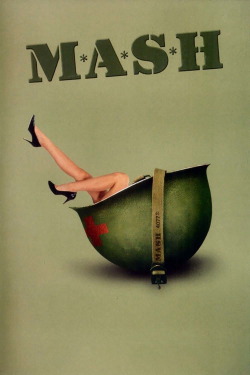
Review of M*A*S*H (1970) by Javier F — 28 Aug 2011
Not Just Because I Like the TV Show.
In one of those artificial divisions, one "two kinds of people" categorization is "those who like early seasons of [i]M*A*S*H[/i]" versus "those who like later seasons of [i]M*A*S*H[/i]." I am the latter. I don't think I dislike the movie because of it, however. I think that, because I'm the kind of person to like the later episodes, I have problems with the movie. The TV show moved away from the "zany" nature of the movie--and, presumably, the book, which I've never read. It developed a lot of characters who were one-dimensional in the movie and the early episodes, and indeed the reason Larry Linville left the show was that there was nowhere for Frank Burns to go. I'll go into more detail about the problems I have, but you have to understand going in that my dislike for the movie has nothing to do with my childhood crush on Alan Alda. After all, I have no real problem with Donald Sutherland, come to that. There is a differing feel, and I like one and dislike the other for reasons that have nothing to do with the fact that I've watched the TV show my whole life and didn't see the movie until adulthood.
As everyone knows, this is the story of three doctors drafted into the US Army during the Korean War. Hawkeye Pierce (Sutherland) and "Trapper" John McIntyre (Elliott Gould) knew each other, admittedly not well, before the war and have been stationed together at the 4077 Mobile Army Surgical Hospital in Korea. When there, they meet Duke Forrest (Tom Skerritt), and the three bond. Hawkeye and Trapper form an immediate dislike of their bunkmate, Frank Burns (Robert Duvall), though their dislike of Head Nurse Major Margaret Houlihan (Sally Kellerman) takes a bit longer. They destroy Frank's sanity, admittedly not a difficult task, and make Margaret's life very difficult. Their commanding officer, Lieutenant Colonel Henry Blake (Roger Bowen), has no control over them. The movie is more a series of vignettes than any kind of coherent story, culminating in a football game for literally thousands of dollars, which was even more in the early 1950s.
Famously, Sally Kellerman didn't want to do Margaret's nude scene. The doctors have made a bet about whether or not Margaret is a natural blonde, and they decide that the best way to show that is for all the men to get a look at her in the shower. Therefore, they ensure that she is alone in there and do some sort of Rube Goldberg contraption to pull up the shower walls and reveal her to literally the whole camp. All the men know this is going to happen, it seems, and none of the women do. And I think that, if they had told their plan to any nurse in the camp, they would have found out that it's a singularly distasteful plan. I think that, had Altman listened to Kellerman, he might have found out that it wasn't just that she didn't want to do a nude scene. Which you would think is something that would have been worked out before it happened, really, and I'm a little taken aback that it wasn't. Even more so than in early episodes of the series, the women in this movie are objects. Margaret isn't the hypercompetent Regular Army nurse of the show; she's just a Regular Army stick-in-the-mud.
Equally distasteful is the whole thing about how their dentist, "Painless" (John Schuck), had an incidence of impotence and is now convinced that he's a latent homosexual who has to kill himself over it. This is one where I'm aware that forty years of civil rights progress is altering my perspective on things. First off, the idea that his impotence is tied to latent homosexuality doesn't make the slightest bit of sense to me. Trapper, I think it is, tells him that it's happened to him a couple of times, and there's no suggestion that Trapper is gay. Latent or otherwise. Trapper then decides that the best way to resolve the issue is to talk a married nurse into cheating on her husband with someone she doesn't seem to care about one way or another, because "is your virtue more important than Painless's life?" As if those are the only two choices. The only character to express unease over the whole plan is Father Mulcahy (Rene Auberjonois), who might be expected to for at least three reasons that I can think of. Though the only one he brings up is the suicide thing. Again, I know that the problems I'm having with the movie stem from the fact that I have come of age after the beginnings of the gay rights movement, but that's the point. It isn't funny anymore, just as a similar storyline where the guy thinks he might be part black wouldn't be funny.
Robert Altman was a fine director, of course, and a lot of people have him to think for their careers. It is, after all, worth noting that half the cast have this as their first movie. Or, as is the case with Auberjonois, their actual first movie is obscure and their performance is uncredited. Ring Lardner, its ostensible and Oscar-winning screenwriter (large amounts of the script as it appears onscreen were ad-libbed), was just rising out of the ignominy of the Blacklist. Altman helped make it okay to hire the blacklisted again, though I suppose more credit for that ought to go to studio head Daryl Zanuck. I get all that. I really do. And of course, without the movie, there wouldn't be the show. Yes. I know. Better than a lot of people, I'm sure. I imagine that a lot of people find my attitude toward the movie distasteful from such a rabid fan of the show. But the parts I like about the show are the parts where it changed from the misogyny and anarchy of the movie.
This review of M*A*S*H (1970) was written by Javier F on 28 Aug 2011.
M*A*S*H has generally received very positive reviews.
Was this review helpful?