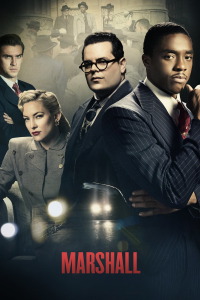
Review of Marshall (2017) by Spangle — 14 Oct 2017
Far too often, biographical films can be too ambitious. Often trying to capture every crucial moment of an individual's life and then sew them all together in a condensed package, biopics can be bloated messes that never seem to hit a consistent flow. Instead, they jump from moment-to-moment trying to paint a picture of the protagonist along the way. 2014's Get on Up - which also starred Chadwick Boseman in the leadinr role - is the perfect embodiment of this flawed approach. Reginald Hublin's Marshall is the exact opposite. Blending biopic ambitions with the formula of a courtroom drama, Hublin manages to make a film that may not tell the story of Marshall, but does something all the more important: it lets the audience get a feeling for who the man was in life and in the courtroom. As an attorney for the NAACP and eventually a Supreme Court justice, Marshall's life was defined by his words and passions in a courtroom. Thus, it is only appropriate to use this one case of a man accused of a heinous crime due to his race as a microcosm of the lifelong fight for equality embarked upon by Marshall and many others.
It is a film that may not reinvent the wheel in its narrative structure, but it nonetheless embodies the possibility of both the biopic and the courtroom drama genres. For that, the appeal is easy to understand. After a black chauffeur named Joseph Spell (Sterling K. Brown) is accused of rape by his white employer Eleanor Strubling (Kate Hudson), young trial attorney Thurgood Marshall is sent by the NAACP to represent Spell, provided he is an innocent man only accused because of his race. Unable to try the case himself due to not being licensed to practice law in the state of Connecticut, Marshall must rely upon local civil lawyer Sam Friedman (Josh Gad) to try the case. Limited to only sitting at the defense table in the courtroom, Marshall instructs Friedman on what he must do, what he must say, and what questions he must ask. Directing the trial like a silent but firm teacher, Marshall is in full control and is not a man who can be muzzled by those who wish for him to stop talking.
A thrilling and thoroughly engrossing courtroom drama, Marshall is a film that continuously keeps the audience captivated and fully engaged in the proceedings. As we are left hanging on every word, Marshall shows the murkiness of the case. Joseph Spell is a man with a lot of baggage - such as a dishonorable discharge and adultery - that makes him an easy man to convict. Comparatively, Eleanor is a rich socialite. In 1940s America, it is easy to assume what the result of the case is going to be, even if Marshall lends his legal mind to the case. What makes the film often so captivating, however, is the demonstration of the uncertainty as to whether or not Joseph committed the crime. He is passionate in arguing his innocence. Eleanor's story does not gel with what a reasonable person would be expected to do under similar circumstances. Yet, Joseph's story continuously changes. Is he a man who can be trusted? Thurgood Marshall hardly trusts him, incessantly asking Joseph to reaffirm his innocence to avoid an embarrassment for the NAACP.
It is in this that the film barrels towards its conclusion in a shroud of mystery. We believe Joseph and the film expects us to believe him, but the film does not share the same regard for the justice system. Matching the mystery and confusion regarding Joseph with a great tension regarding whether or not the system will oppress Joseph or not, Marshall plays up this element to great impact. A great example of this comes as prosecutor Lorin Willis - portrayed by the excellent Dan Stevens who turns in a great villainous, racist, and deeply smarmy turn as this reprehensible character - moves for an answer given by Joseph under cross-examination to be stricken from the record. The question, pertaining to why Joseph would lie about having sex with Eleanor and only now claim it to be consensual, is answered passionately by Joseph as he details how, in this case, it is truth that would get him killed in the South because he is black and the woman is white. Incensed by the answer and recognizing the damage it can have on his case, Willis looks at the judge (James Cromwell) for help. With a dramatic pause - which was met with cries for the judge to "do the right thing" in my theater - Hublin builds great anticipation for what the judge will say that speaks to the strength of the film. Yes, it is a courtroom drama. However, it is never predictable. Instead, the court proceedings and even the case itself are shrouded in doubt. This uncertainty and the way in which Hublin utilizes it to create tension and anticipation of every word to come, is what makes Marshall such a courtroom drama. It is a film about racial tension, injustice, and the man who fought for equality. Yet, it does not just allow its courtroom setting to be a backdrop with the result of the case a foregone conclusion.
This review of Marshall (2017) was written by Spangle on 14 Oct 2017.
Marshall has generally received positive reviews.
Was this review helpful?