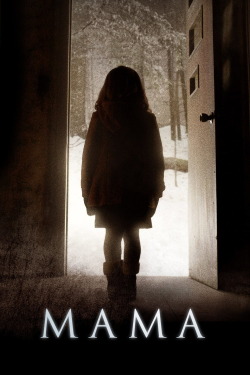
Review of Mama (2013) by Shiira — 12 Mar 2013
"Hey, I love you, girl," Lucas, a hirsute graphic artist tells his boho flatmate, Annabel, the bass guitarist in a three-piece indie-rock band, on the precipice of her incipient entree into womanhood.
She's going to be a mother, or rather, a surrogate matriarchal figure, better known as the stepmom. Lucas' two nieces, Victoria and Lilly, missing for years and presumed dead, are found, miraculously, alive in a woodland cabin, and seemingly without parental supervision.
On that fateful day in the band's rehearsal space, when Lucas breaks the news to Annabel of the girls' improbable recovery, the goth girl doesn't look none too pleased. Suddenly, her cool beau comes with baggage.
Annabel, while talking it over with the lead singer, decides on a reactionary life-choice that betrays her persona, so soon after thanking god in the loo for the close call on a home pregnancy test. The femme singer, quite pointedly, calls Annabel "dude", as in, "You didn't sign up for this, dude," a sisterly endearment loaded with trenchant points in that the masculine appelation evokes a testament to such feminist ideals, chiefly, the outright rejection of traditional female roles.
On her own volition, Annabel follows Lucas to suburbia, taking up residence in a two storey Virginia colonial, as part of an agreement with a behavioral scientist that accedes complete access to the girls for an empirical study on feral children.
Like the wild child from Francois Truffaut's L'enfant sauvage, the girls walk on all fours and undergo an enculturation period. Alone in her vanilla trappings, Annabel, the exiled hipster, rocks the colonial.
Quite a sacrifice for a "girl" whose desert island, all-time, top five musical artists would definitely include Kim Deal. Unlike Laura, Rob's long-suffering girlfriend in High Fidelity, whose slumming is protracted by her love for a arrested owner of a record shop, a sad diletantic man-child who wouldn't allow the paralegal to grow.
Annabel's transition into adulthood, however, is abrupt, and especially curious, since she's the same person: same close-cropped hair, same raccoon-style eye makeup, differing from Laura, who tells Rob, "I couldn't go to work with my hair dyed pink.
" And yet she gives it all up. And not for something good like a career. The woman in flux chooses to be a homemaker with a surprising minimum of fuss. At the film's core, Mama beats a sexist heart, because the filmmaker suggests that all women, down deep inside, want to be mothers.
Laura, too, despite being career-minded, was once an expecting mother-to-be, but fails to carry her child to full-term, since, as she tells it, due to Rob's one-night stand. But let's not forget the record shop owner's rebuttal to his transgressive behavior, in one of many instances where he breaks the fourth wall.
On the bus, Rob humbly admits that Laura is the smart one; he realizes how Laura played him, convincing the in-film narrator that seeing other people was his idea, when, in actuality, she had already started anew with another man: the dreaded Ian.
Laura not only outsmarts Rob; she outsmarts the audience. Laura, a former party girl, who first meets Rob in the midst of his deejay gig at a club, also worked as a legal aid during the day. Rob's infidelity came at the right time; it provided her with a convenient excuse to terminate the pregnancy.
The film seems unaware that she chose to ascend through the ranks of her profession, rather than sit at home with a baby. It's a gambit that pays off, as indicated by Rob, when he muses aloud about the incongruity between her handsome salary and the "dump" she once resided in.
The maternal instinct is neither engendered in Laura nor Annabel, but whereas High Fidelity allows for upward mobility as a transition into so-called respectability: a good job and a better man, signifiers both of personal growth, Mama has a fifties mentality, in which Annabel gives up the life she invented in order to rear children, as proof and verification of her finishing.
She trades her bass for a laundry basket. Akin to Sylvie, the stepmother figure in Housekeeping, the aunt who inherits two girls that accept their new guardian in varying degrees(Ruth, the protege; Lucy, the rebel), just like how Victoria likes Annabel better than Lilly.
Equipped with glasses, she sees that "mama" is just a stay-at-home mother. Today, women who reject the traditional role of wife and mother have someplace to go, but this being the 1950s, Sylvie just got lost, returning home from her vagabond's itinerary of constant walking after her nieces' orphaning.
While window shopping, she cringes at the vacuum cleaner display. Her sister, the one who chose to vacuum, ended up driving her car over a cliff. Hopefully, Lucy will have better luck. Mama, too, plunges in the water, taking Lilly with her.
Victoria survives; she wants to be like Annabel: independent, but the film won't let her out of the house.
This review of Mama (2013) was written by Shiira on 12 Mar 2013.
Mama has generally received mixed reviews.
Was this review helpful?