Review of Malcolm X (1992) by Jay U — 27 Jun 2008
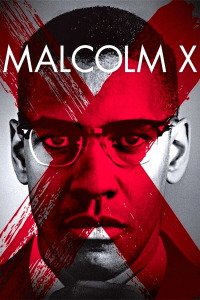
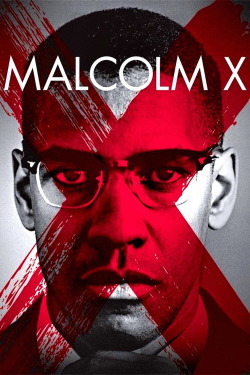
Since I decided to spend time working with the memory of Malcolm X, I naturally needed to become engaged with the two men who best carry on his legacy, Cornell West and Spike Lee. While Cornell West focuses academically on Malcolm X's legacy, tracing the roots of his message and tracking its course into institutional dialogues, Spike Lee has provided us with the visual memory and thematic center for his life. He does this in two films. The first, obviously, is Malcolm X, based on the Autobiography of Malcolm X by Alex Haley. The second Spike Lee film, Do the Right Thing, deals explicitly with the legacy and effects of Malcolm's life.
The film traces the story of Malcolm Little by beginning with an incident with the Ku Klux Klan in Omaha, Nebraska before he was even born. Many scenes are narrated with lines taken directly from the autobiography that the film was based upon. The life story is taken up primarily from Malcolm's first taste of street life in Boston and follows him through New York, prison, life as a preacher in the Nation of Islam (NOI), and his life after rejection by Elijah Muhammad. The film weighs in at approximately three hours. Even though it is long, it is worth it to watch how the character of Malcolm X changes from street dwelling pusher to that of extreme discipline and subjugation to Islamic Law. The part of the story detailing the betrayal of Malcolm X by his beloved mentor, Elijah Muhammad, is in the second half, but it is easily the most moving part of the story.
Artistically, Malcolm X begins in the same way as Patton. With an American flag covering the entire screen. Only in this film, the flag is burning. Behind the image is the voice of Malcolm X delivering one of his speeches. As the flag burns away the image that emerges is the footage of the Rodney King beating. The combination of the speech and the images force the viewer to consider their previous comfortable understanding of Malcolm X's teachings. It does so by rendering the views of Malcolm X, usually thought to be extremely prejudicial with respect to white America, as true, with visual evidence of this truth provided for all of those who wish to ignore it. This is one of the critical messages that recurs throughout the film.
The film spends a large amount of time focusing on the words that Malcolm X spoke in his speeches. These speeches are often depicted in black and white with the original footage of a Malcolm X speech intercut with color footage of Denzel Washington, portraying Malcolm X, making the same speech. The result is that the speech is not seen merely as a piece of the past, but a genuine description, a prophecy regarding the true state of African-American relations in the United States.
This message was not popular at the time, and as we can tell by the ongoing public prosecution of Reverend Jeremiah Wright, it still isn't today. It would have worked well to create a stark contrast in film style to represent the change that occurred in his life after conversion. To do so would have involved shooting the first half of the film in color and the second half in black and white. Doing so would have not only taken advantage of the outrageous colors and stylings of jazz clubs in Boston and the Bronx during the late 30's and 40's, it would have helped to tell the story better as well. Shooting the entire second half of the film in black and white may have been better able to carry the controversial message the Malcolm X carried. This message, which was controversial and frightening to white establishment, was different from that of the NOI in that it carried a message of justice and responsibility to everyone. By doing this the film could have gone farther in mythologizing the man, keeping the issue of black and white/good and evil at the forefront. This matter would continue to exercise a mythologizing force by reinforcing Malcolm's unwavering moral standard after his conversion, especially in light of recent information regarding the indiscretion of another Civil Rights leader Martin Luther King Jr.
While doing research for this post I read a review of this film by one of my most trusted critics, Emanual Levy. The most discussed feature of his review was his negative response portion that deals with Malcolm's pilgrimage to Muslim countries of the Middle East. He feels that the scenes break up the dialogue and momentum of the film. I agree, yet contend that these characteristics were necessary to demonstrate a break. The film really contains two conversions. The first, from lawlessness to a life of extreme discipline with the Nation of Islam characterized by speeches full of hatred with a goal of violent separation. From here, he converted on his pilgrimage to an understanding of Islam as a religion inclusive of responsibility as well as faith by all men and women. He essentially realized that the race problem he perceived was exclusively an American problem, meaning that change could be achieved.
The most outstanding feature of this film is the way that current relevant situations are portrayed in order to give the viewer pause. Not only do these scenes lend philosophical weight, but artistically, they create symmetry in a film that frequently repeats an image as an allusion to the past, and retraces its steps in order to tell a story. Its greatest impact comes from a scene near the end where Nelson Mandela addresses a classroom of students and each of them stands and says, "I am Malcolm X". The Tiger Woods commercial bearing the same likeness was clearly patterned after this scene and attempts to carry out the same dialogue to a new generation.
Overall I enjoyed the film. I am afraid that I still am not completely crazy about the personal style of Spike Lee. While he makes good films, he consistently returns to his in your face style. The music is too loud at moments and he loves to put the camera right in the face of the actors. While I may be referencing his work in Do the Right Thing too much here, I actually feel that it improves Malcolm X. Malcolm's act (and his zoot suits) was too loud and putting the camera in the face of the actors perfectly depicts the in your face message that Malcolm X carried.
This review of Malcolm X (1992) was written by Jay U on 27 Jun 2008.
Malcolm X has generally received very positive reviews.
Was this review helpful?