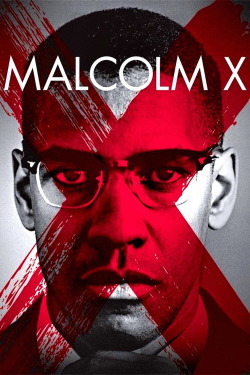
Review of Malcolm X (1992) by Cameron J — 18 Feb 2012
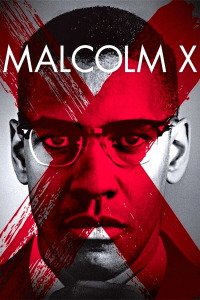
I find it ironic that Denzel Washington is playing who is possibly the most iconic anti-integration black man in history, and next to Will Smith, he's the whitest black man in film, but hey, that only makes the film deeper and more provocative. Almost three-and-a-half hours, it better be provocative. After this, I better want to get plastic surgery to look black and then actually join the Black Panthers, which seems pretty possible, considering that by the time you finish watching this film, the universe will have already collapsed, reset and progressed to the A.D. 1960s again. I love how I'm griping about this film being so long, and it's only - no joke - the [b]"eleventh"[/b] longest film I've ever seen. Holy cow, I need some kind of a life, even if it can't be anything as extravagant as Malcolm X's life. Well, to be fair, Forrest Gump's life wasn't as eventful as Malcolm X's, partially because Gump was just some dumb guy that got caught up in some cool stuff, whereas Malcolm X was black "and" muslim, two people that were doing all kinds of crazy stuff between the '40s and '60s, so one can only imagine what you get when you cross them together. I guess you could say that if you crossed a black and a muslim, you would get "Malcolm Little in the Middle", and by extension, the inspiration for a pretty good film, which isn't to say that this film doesn't fall into one too many missteps here and there.
I'm not gonna say that Malcolm X's life is underwhelming, but I'm not quite sure that the "short" version should be 200 minutes. Well, sure enough, although most of the film is tight, when it goes loose, it falls out, and you with it, because after a while, watching a bunch of black people dancing at a night club get unengaging enough, let alone when you're actually trying to tell a story so much that it eventually loses steam. Of course, what does more to damage this film isn't the looseness, but the tightness, as well as the style. The overstylized storytelling is at its worst during the flashbacks to Little's childhood, where things feel so devoid of genuineness, due to everything feeling so tacked-on and overwhelmed with histrionic energy, especially when it comes to the unbelievably overbearing score. Still, just because that's where the overstylizing is at its most intense, that doesn't mean that overstylizing doesn't plage much of the film, because there are countless moments of "Wait what was that?" or "Wow, that just came and went", and sure, it's not like a meditative film, where overstylizing taints the film's very aura and leaves it to limp along, almost entirely devoid of substance, but there are still too many moments theatrics, and it really intensifies the impact of the final blow that keeps this film from being truly impressive: Spike Lee's underwhelming execution. The film is well-produced, runs a mammoth length and is with a story so worth telling it's unreal, and the latter fact is one known too much by Spike Lee, so much so that even with all of the forced theatrics, he only wants to "tell" the story of Malcolm X, rather than revive it, which isn't to say that this film is totally vacant of emotion, but it is to say that the story structure is too conventional and safe to the point of being messy, leaving every transition in between arcs in Little's life - from his criminal life, his conversion to Muslim and, of course, his leadership of the Black Panthers - to feel inorganic and somewhat inconsistent, because Lee is so desperate to keep Little's story as faithful as possible that he forgets to truly captivate his audience, leaving the film to run on only so much juice. However, the film is nowhere near bad, for although Spike Lee's dream project is all but ruined by his dreaming just a little too big, it's still a fascinating story of a man's entire mindset changing as he goes from being a following nobody to a leading icon, and while it stands to be executed better, it's still an experience worth having, especially considering that, as I said, it's pretty darn well-produced.
What makes the production designs so impressive is the fact that they are subtle, being elaborate enough for you to really see the time, yet pulled back enough for you to feel the time. There's no overemphasis on the '40s or '50s or '60s, let alone the transitions into all of them, yet they're reconstructed so fashionably, keeping you engaged in the time without it feeling as though it's interrupting the story, only supplementing it. The same can be said about the cinematography, which is subtle and graceful. True, early on, the overemphasis on lighting got to be a bit annoying, but on the whole, the cast of a shadow or a beam of light is played upon subtley, but noticably, and it really supplements the tone on many occasions. I must say that I absolutely dug such scenes as the prison solitary confinement sequence, which is illuminated only by what limited light is salvaged through the feeding doors, and it gives you such a perfect sense of isolation and claustrophbia that strongly reflects and symbolizes the anguish and pain that is falling upon the shoulders of Little, not just in that moment, but many others, which isn't to say that cinematographer Ernest Dickerson is the only one carrying scenes like that, because the real star of this show is, of course, Mr. Denzel Washington. Perhaps they could have done a better casting job for the sake of physcial authenticity, but when it comes to embodying such a layered soul as Mr. Malcolm, few people could do as good of a job as the great Denzel Washington, and sure enough, the atmosphere that Washington emits is powerful, whether he's portraying a hardcore criminal like Detroit Red, a searching soul like El-Hajj Malik El-Shabazz or an influential leader like Malcolm X. Spike Lee's heart may be too much in the story for him to really deliver on it, but Washington is layered and riveting in his portrayal of this follower-turned-leader, and it's that portrayal, all but by itself, that makes this film consistently fascinating, compelling, borderline enthralling and genuinely worth watching, because for every occasion of momentary disconnect, it's hard to not find yourself quickly and frequently pulled back in by the subtlety, grace and transformation in Denzel Washington as he brings the iconic Malcolm X back to life.
At the end of the day... or second, or third, or how ever many days it takes you to watch this film, it's hard not to feel a touch thrown-off by moments of overstylizing and looseness, but generally a bit disappointed by Spike Lee's overly conventional, overly safe, periodically inconsistent and ultimately underwhelming storytelling, but what keeps this film an ultimately rewarding one in spite of its flaws is, of course, it's compelling subject matter that is brought to life by subtlety and grace in the production, visual style, but most of all, Denzel Washington, who's layered, transformative and enthralling portrayal of this icon helps perhaps most of all in making "Malcolm X" a frequently and genuinely fascinating and enjoyable study on the life and times of the legendary Mr. Malcolm "El-Hajj Malik El-Shabazz"/"Detroit Red"/"X" Little. Jeez, how many names did he have?
3/5 - Good.
This review of Malcolm X (1992) was written by Cameron J on 18 Feb 2012.
Malcolm X has generally received very positive reviews.
Was this review helpful?