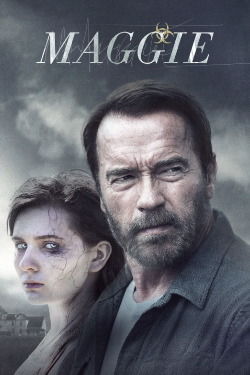
Review of Maggie (2015) by Terminated — 03 Jul 2015
In an over-crowded market where fighting for the flesh of the masses is the norm, it’s always a surprising pleasure to witness one of these somnambulistic walkers twist the event inside out and present something very different in a very familiar setting. To overtly put, Maggie has breathed some new life into the tired zombie sub-genre.
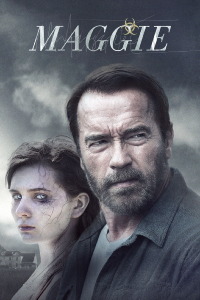
The film opens with the same bleak impact that Charlton Heston introduced in ‘The Omega Man’ (Sagal, 1971) as Wade, played convincingly by renowned action icon Arnold Schwarzenegger, drives through the depressing post-apocalypse as the once beautiful countryside burns its last breath, gradually unveiling the pandemic that is ripping society apart. Wade is searching for his missing daughter, Maggie (Abigail Breslin) and manages to track her down at a hospital, where he’s abruptly informed of the non-curable infection she has contracted and is given a limited timeframe with his daughter, per the government ruling on the outbreak.
This zombie virus doesn’t turn victims into rotten, flesh hungering undead corpses within hours or days; it’s a painstaking terminal illness that emotionally deteriorates the victim and the family and close friends unit suffering intensely. The hopelessness of watching a loved one gradually succumb to an incurable illness is displayed here with such honest depth, which also correlates to the disease that will eventually rip humanity into ruin.
Arnold gives the best performance of his career as a simple, every-day man wracked with the pain of watching his daughter descend into her illness. Wade clearly feels he’s failed his own daughter and as she is dying, the last connection to his deceased wife is fading. Arnold’s comeback to filmmaking hasn’t been kind (the box office returns have been underwhelming and reviews mixed) but Maggie paints him in a different, mature light. Abigail Breslin anchors the film as the title character, witnessing her own body turn against her as the disease distorts her humanity. The necrosis make-up effects are shocking and heightened even more as Maggie twists into an emotional wreck at each instance of the virus closing down her mortality.
The whole ordeal is punctuated by cinematographer Lukas Ettlin, who opts for a subtle yet realistic, intimate style, and the abundance of ‘shaky-cam’ shots gives the constant sense of disruption; you feel Wade’s life tearing apart, a poignant metaphor for the film’s world. The post-apocalyptic iconography that this sub-genre is so accustomed to is represented differently, relying on emotional impact rather than stylistic awe. The colours are faded and there are deep shadows peering over, the unknown taking hold. The zombie make-up effects are less traditional, with deep black cuts and gore unwinding. The scene where Wade encounters the reanimated father and daughter is textually abhorrent, with punctured eyes and near skull-like decay.
But unlike other zombie films, these wandering corpses are given profiles and backstories, as Wade’s action on dispatching these meandering carcasses faces the realisation of their surviving family which mirrors Wade’s own turmoil. Schwarzenegger is able to demonstrate certain depth he has acquired over the years in one heartrending scene as he visits the house of the zombies he just killed to discover desperate carvings on the wall that read ‘Love my daughter, love my family’. Little sub-plots like these reinforce the main thread and builds up anxiety; every cause has an effect.
Henry Hobson has made a unique and strong debut in his first feature-length director effort. To be able to twist genres and turn tired conventions into a dramatic fusion takes skill and craft, and Hobson has proved himself and paved the way for a promising future ahead. The script for Maggie, written John Scott 3, spent years on the Hollywood black list, garnering a positive reputation before the cameras started rolling.
The zombie sub-genre always works best when there is something else going on underneath and Maggie is no exception; quantifying a worldwide outbreak to just a small group of characters and watching their lives fall is all the more effective. It becomes more personalised and the audience can sympathise.
Maggie comes highly recommended for audiences who are looking for a different type of flesh to chew on.
This review of Maggie (2015) was written by Terminated on 03 Jul 2015.
Maggie has generally received mixed reviews.
Was this review helpful?