Review of Made in Dagenham (2010) by Shiira — 20 Jan 2011
Jeannie Edwards is a sports journalist; she's nobody's "sweet baby", but Ron Franklin, her colleague at ESPN, sent their profession back into the caveman days of Phyllis George when he referred to the sideline reporter by that derogatory moniker, right after she interjected on a political matter, to which the twenty-year play-by-play announcer, in front of his on-air team, cut Edwards off by saying, "Why don't you leave this to the boys.
" The self-proclaimed "worldwide leader in sports", to its credit, fired Franklin, although really, what other choice did they have? The potential repercussions, had he been granted a stay of execution, would have resulted in a bombardment of angry protestations upon the venerable basic cable network from women's groups all over the country.
Pure and simple, it was a business decision. There were sponsors to consider. But how did the ESPN brass "feel", independent from public image considerations, about one of their own being subjected to a sex-related condescension previously thought to be an ideological relic of the past, a male chauvinism so outdated, it was the subject of parody in Adam McKay's "Anchorman: The Legend of Ron Burgundy".
As the titular character, Will Ferrell played a broadcast journalist who worked in an era, the late-seventies, when the concept of equal pay for women was still a relatively new concept. A film like "Made in Dagenham", you would think, would have been more timely during the time of disco's reign, but the whole ugly episode at ESPN proves otherwise, so let the struggle for equal pay that the Ford women machinists contended with, this girl's anarchy in the U.
K., serve as a reminder of how women have come a long way..., baby. And "girls", regardless of age and station in life, would be the best way to describe the fairer sex within this primitive milieu.
Girl, in its most literal sense, denotes not being fully-formed, and that's what a female was, a child, essentially, a woman infantilized by institutionalized sexism, and it would remain that way until her wages were in alignment with those of men.
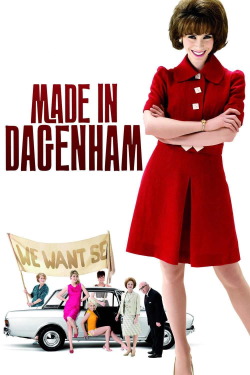
When Rita(Sally Hawkins) answers a reporter's half-baked question, in regard to how she and the other Dagenham workers are coping, the emerging feminist snaps back, "We're women," in which their gender, plainly stated, acts as a corrective measure against men, both friends and foes, who refer to them in lesser terms(girls, ladies, my love) throughout the film.
Some feminists, however, may balk at Rita's need for her husband's validation, or more pointedly, the filmmaker's use of patriarchal underpinnings in order to make the film more accessible to the breadth of humanity, both male and female, when he steals this proto-Norma Rae's thunder by granting the conjugal male too much agency, as "Made in Dagenham" crosscuts Rita's triumphant convergence upon Eastbourne(by bus) with Eddie's pursuit of her(by motorbike), following their blowout on the tenement lawn over their redefined marital roles.
Her speech at the union meeting, in which she implores the male-dominated congregation to support their cause, gets nearly upstaged by Eddie's conciliatory apology afterwards, because it takes the focus away from the bigger picture.
The filmmaker seems more concerned about the state of her marriage. Her activism, and the notion that "Made in Dagenham" is a social issue-based motion picture, loses some of its consciousness raising fervor the very instant we see Eddie in the crowd, and even more so, as Rita cuts through the assembled mass of bodies to reach him.
The social issue, consequently, becomes waylaid by the big romantic cliche, as the love and approval of Rita's husband trumps the fraternal love among her fellow women-in-arms. Rita is nothing like the women of Lizzie Borden's "Born in Flames", militant feminists who wouldn't dream of getting all dolled up(the application of makeup, the wearing of a borrowed red Biba dress) before starting up a revolution.
Although "Made in Dagenham" is weakened by the patriarchal notion that Rita draws her strength from the same hegemonic force that strikes to keep women in the kitchen, this handsome period piece film does echo the Borden film in one key aspect: the camaraderie of women, regardless of their economic situation.
Lisa(Rosamund Pike), the wife of a Ford executive, befriends Rita, an "Estates" housewife, and in turn, is befriended by the Secretary of State(Miranda Richardson), when the machinist is summoned to Westminster for a meeting.
The screenplay, a good one, does a good job of linking the women through words, bad words. Apologizing for her language, Lisa notifies Rita that she called a common enemy, an abusive schoolmaster, a "c*ck".
And the worst word of all, "man", is applied to both Rita("the fourth man") and Barbara Castle("the best man in my cabinet").
This review of Made in Dagenham (2010) was written by Shiira on 20 Jan 2011.
Made in Dagenham has generally received positive reviews.
Was this review helpful?