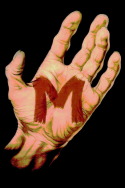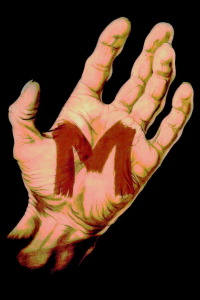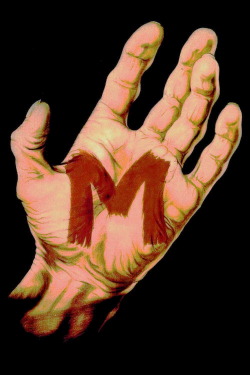
Review of M (1931) by Ross M — 28 Feb 2010
An empty staircase, an empty plate, a ball rolling from behind a bush and a balloon getting caught on eletrical wires. A montage that still haunts almost 80 years later in Fritz Lang's incredible police procedural/psychological thriller, a film that portrayed a society ready to trust whatever the press states and unable to take any suitable action against evil (it was released a couple years before the Nazi Party took over Germany), passing up that responsibility to the Police to deal with a child killer (Peter Lorre before he fled to America) on the loose in a city populated by over 4 million people.
For 8 months the Police haven't been able to catch the killer, despite heavy raids, large scale questioning, analysis of various clues and testimonies from the public which add up to nothing. But the Police aren't the only ones affected by this, the criminals of the city are unable to breathe under the constant scrutiny of the Police force, it's bad for business. With some genius cross-cutting, Fritz Lang switches between a meeting of various heads of Police & state and a meeting between the criminals all discussing how to track down the serial killer, as the criminals decide to find the killer for themselves in order to bring him to "justice".
The criminals & the Police may differ in their definition on "justice" but Fritz Lang paints the whole of society and the film with darkly lit, broad strokes; after the events of one murder is published by the press, everyone is accused of being the child killer, the Police use underhand tactics to get the information they need and the criminals only decide to solve one problem of society when it starts to affect their own interests. But is it the public's duty to take action against any problems the community is facing, or should they let the Police do their job instead? Lang mostly leaves that up to the viewer to decide, while his economic visual storytelling is married to some excellent use of sound.
Lang proved that sound could be fully integrated into the storytelling of a film at a time when other directors were still adjusting themselves to the most recent technical revolution of cinema; the child killer's distinctive whistle when we first meet him proves to be an important clue (it's also used to ramp up the suspense when he encounters another girl later on), a voiceover describing the Police's attempts to discover new leads and clues is laid over the top of a montage of Policemen searching for any shreds of evidence, while a complete lack of soundtrack refuses to offer any cinematic triggers for the audience to feel tension, sadness or any other emotion, Lang simply lays all his visual cards on the table and asks the viewer to take whatever they want from the experience.
As with all great films, there is one truly unforgettable scene late in the film when the child killer is finally caught and put to "trial", Peter Lorre delivering a tortured, famous monologue that manages to accomplish what Bruno Ganz did in "Downfall": Make us feel sympathy for an absolute monster. We only get brief glimpses of him up until his monologue, but when his eyes start bulging and he starts talking about the voices in his head, you wonder just how in-control of his demons he truly is, and the argument over whether a mentally unstable person should be held responsible over their actions becomes disturbingly apparent.
But the ending does not give any real closure, because once you get past the moral murkiness of "M", the sociological debate on how efficient institutions are at curing damaged people, how far people should take the law into their own hands and who is allowed to pass judgement on matters of law, none of it truly matters when compared to the death of children who won't be returning, no matter how many criminals are sent to their death.
Fritz Lang has created an absolute masterpiece, exploring important social issues + attacking the incoming Nazi Party which would affect his life aswell as his career: Refusing to join them (they offered him control of the German Film Industry) he fled to America while his wife (who co-wrote the script) joined the Nazis. The moral complexities of the storyline will provoke many discussions, while Fritz's fluid storytelling is simply excellent, "M" kicked off a whole new genre of movies, and nothing has come close to topping it. But take away the dark feel of the film, the ugly faces of all the criminals and the despair, and you will still find an emotional resonance that is profoundly human inspite of all the evil dealings within the world of "M", a cold examination of a society in despair that reminds us that we are all human underneath, something that we should take note of more often.
This review of M (1931) was written by Ross M on 28 Feb 2010.
M has generally received very positive reviews.
Was this review helpful?