Review of M (1931) by Hemi M — 13 Jun 2011
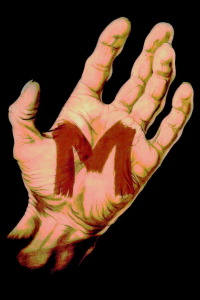
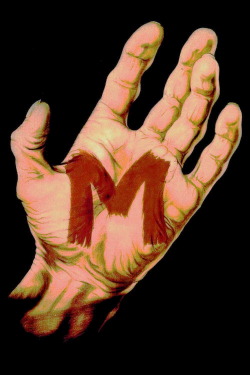
Fritz Lang's M is at once a stark and cynical critique of society and an intriguing crime film. It is something of the an early horror film as well, presenting arguably the first serial killer in a film, and it also represents a police procedural before police procedural's became tangled up in CSI era technological mumbo-jumbo. As if this wasn't enough, the film also finds time to dabble in examining the mind of a serial killer and to question the extent of the law and whether it is morally right for the punishment of a criminal to be taken into the hands of non-officials. On the simplest terms, this is an absorbing mixture of genres that leads to a sum that is greater than its parts; it's a masterpiece of acting, cinematography, sound design, and, above all, atmosphere.
In Berlin, presumably in either the 1920s or early 1930s, panic has stricken the city of Berlin. The cause? A child murderer, revealed to be Hans Beckert (Peter Lorre), who prays on children by buying them balloons, candy, and other things they might enjoy, has caused a wave of paranoia to form in the city and is affecting its residents daily, causing them to remain consistently cautious of everyone whom they see talking with a child in the street, even if the particulars of their conversation only consist of telling the young child the time. Simultaneously, the police, led by Inspector Karl Lohmann, have intensified their search and continue to scour the city for clues as to the identity or whereabouts of the murderer, and the organized criminals in the area are growing increasingly testy with the murderer. The fear he has caused throughout the city has caused people to be more cautious of every criminal's activities, not to mention that the police's increased searching has naturally made it more challenging to engage in organized crime. With their business being adversely affected, the organization's leadership decides to resort to calling on the city's beggars to improvise a carefully planned watch of the city for the murderer in hopes that they will be able to catch him and do away with his evildoings.
M, as envisioned through Fritz Lang's mind, is a stark and minimalist film, most notably when it comes to the sound. Numerous scenes in the film are almost entirely silent, with the exception of the sounds of feet hitting the floor and occasional other naturalistic sounds. In fact, M is probably the most stirring example of what merely the sound of walking can add to a film and the sense of atmosphere and suspense it can create. In addition, the use of the leitmotif of "In the Hall of the Mountain King ", which is whistled by Beckert several times when he is on screen, is quite capable of enhancing the mood of the film. Simply put, the sound is foreboding. Whenever we hear it, without even seeing so much as a shadow, we know that Beckert is nearby. This minimalist but powerful use of sound conveys that Lang was able to make use of the best aspects of the silent films which he had made in the past and infuse them with sounds to enhance the quality of the picture in ways that exceeded simply having the characters talk on screen, an area in which Lang displays commendable restraint. Where-as many other directors would have used the influx of sound into film-making to pepper their films with unnecessary dialogue, Lang understood how to use sound rather than abuse it.
In addition, the cinematography, depicting the city of Berlin, conveys the sense of paranoia and fear that the people of Berlin are feeling. Everything seems steeped in a general mist of gloom throughout the film; Berlin is not conveyed as a happy place to live in M. Everything seems aging and dark, although it is never focused on to the point where it becomes immediately obvious. Instead, the film slowly allows you to realize that there is little hope for most of the individuals within the city regardless of Hans Beckert, and in fact, he is ultimately more of an impetus for those around him to expose their selfishness and their mob-like mentality, as well as their willingness to let much of the crime in the area slide under their noses because they aren't immediately affected by it.
As Hans Beckert, Peter Lorre gives a performance that, up until the last few scenes of the film, is almost entirely silent, excepting of course his propensity to whistle. This is another manner in which Fritz Lang is able to enhance the film via using his extensive history in silent film production by combining this foreboding silence with minimalist sound and occasional dialogue. Due to the limitations of silent filmmaking, actors had to rely almost entirely on their body and especially their face to express emotion, and the director had to ensure that the film was executed in a way that highlighted this aspect of the actors, and this is exactly what Lorre and Lang excel at here. Lorre's use of facial expressions in M is easily amongst the greatest I have ever seen in a film. He is able to convey a childlike simplicity mixed with a bit of overconfidence all covering a demented interior that is easily frightened and horrified.
Late in the film, Lorre is able to display, in a scene where he has to run from the criminals out to capture him and hide in an office building attic in full knowledge that he has been caught, how truly horrified Beckert is by his impending doom. Later still, in a kangaroo court with the criminals as judge, jury, and executioner, Lorre is able to introduce a voice to Beckert. What Hans Beckert does is horrifying and vile, but, in this scene he admits that he only kills because he can't control his urge to do so, and because of Lorre's face and voice conveying absolute horror and honesty, we believe him. It is a masterful scene in its portrayal of a highly conflicted character and a masterful performance in its mixture of silent film economy and facial work with an iconic and mesmerizing voice which can by turns convey creepiness and desperation.
Near the end of the film, another question that had been subtlety infused into the entirety of the film comes to the forefront: Do people have the right to sentence an individual, no matter how horrible their crime, to death without a trial in a court of law? The film provides a conclusion, but, wisely, it doesn't give you an answer. The last scene of M may feel abrupt to certain viewers, but it actually enhances the film even further by leaving the viewer with fragments with which to base their opinion without ever forcing the viewer to accept one conclusion. A further layer of depth is added by the understanding that Beckert, the individual being convicted, cannot control his crimes. However, the individuals convicting him, although committing what would almost unanimously be viewed as lesser offenses, do it by choice. Ultimately M leaves us with questions: Is killing Hans Beckert going to accomplish anything that a trial wouldn't? Is that accomplishment worth killing over, especially when the individual in question can't control his urges to commit the crimes he would be killed for? Is his going to trial going to accomplish anything that killing him wouldn't? Is that accomplishment worth the risk of his escape? And most importantly, what does it say of the people in Berlin that they accuse others of being a child killer on a dime, and yet they willingly let their children roam about the streets without a chaperone, some of them even after the killer begins to commit the crimes?
M is a film that rewards re-watching. The first time I saw it I thought it was an excellent thriller, but the second time I truly understood that it was an absolute masterpiece. The first time I watched it I appreciated its analysis of the manner in which a single person can instill so much fear in a society to the point where they forget their logic in favor of desperation, but the second time, I was in awe of the skill and economy used in this analysis. Every shot in M has a purpose, which is perhaps the most prominent aspect of film-making that filmmakers today could learn from silent films. M masterfully interweaves a desolate and cynical visual sense with a remarkable and pinpoint use of sound to convey its location to the audience, as well as to convey the feelings of the characters within the film. It boasts a terrific performance from Peter Lorre, represents a great director's successful transition from silent film to sound, and it weaves a story so simplistic and prone to be taken in a certain direction on the surface and takes the audience on a much more layered and vastly different trip than they were expecting. This may be a cheap line, but, M, in addition to what it stands for in the context of the film, stands for masterpiece.
Rating: 10/10.
This review of M (1931) was written by Hemi M on 13 Jun 2011.
M has generally received very positive reviews.
Was this review helpful?