Review of Love's Labour's Lost (2000) by Edith N — 16 Jan 2009
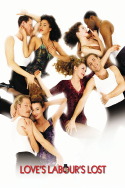
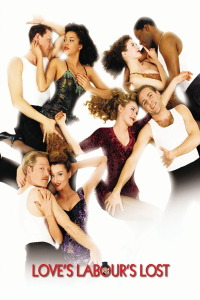
I know. Musical? But oh, yes. Kenneth Branagh has taken Shakespeare, set it in the '30s, and turned it into an all-singing, all-dancing extravaganza. Which features Nathan Lane, as all modern musicals are contractually obligated to do. (Don't get me wrong; I like Nathan Lane. But it's a rare revival cast these days that he isn't in.) Now, I'm not a Shakespeare purist. I like [i]Romeo + Juliet[/i], [i]10 Things I Hate About You[/i], and, if you want Shakespeare and Cole Porter, [i]Kiss Me Kate[/i]. It is a little jarring to go from the original dialogue, which Branagh uses, into "I Get a Kick Out of You" or the various other classics by composers of the era. I'm also not sure why we needed the World War II montage at the end. Yes, Alicia Silverstone plays the Princess of France (no, she doesn't seem to have a name), but it still kind of comes out of left field.
King Ferdinand of Navarre (Alessandro Nivola) has declared that, for three years, he will seal himself into his court and study. No woman may come within a mile of that court unless she wants her tongue cut out. He gets his three best friends, Berowne (Branagh), Longaville (Matthew Lilliard), and Dumaine (Adrian Lester), to go along with this. And then one day, the Princess of France decides that she will pay a formal visit to him, one that he cannot turn away without creating an international incident. Hilarity ensues, of course, as the king and his court fall in love with the princess and her ladies. There's also some subplot that I didn't understand about Nathan Lane and some woman that he brought within the limit, but whose tongue never does get cut out. I think he's our clown, but he seems more tacked on to the plot than, for example, Feste or Dogberry.
I am given to understand by my research that this is considered Shakespeare's most intellectual play. Apparently, it features more wordplay, puns, and so forth than any other play. It's hard to say, as the production doesn't really seem to let the words work on their own. The performances are too broad, for one thing. I don't mean Lane; clowns are supposed to be broad. But Silverstone is pretty much winking at the camera, much as Branagh himself did in his [i]Othello[/i]. It also feels as though every moment that's going anywhere gets interrupted by a musical number that feels out of place. It's true that Shakespeare put songs in his plays, as Branagh had earlier shown in [i]Much Ado About Nothing[/i]. However, these songs fit in with the story, or at least the production. It's true that Shakespeare can fit into any era. I just think you have to pick one for which words you use.
Modern Shakespearean performance owes a lot to Branagh. It's not just that he got a full-length [i]Hamlet[/i] made and put into wide release, though that is an accomplishment all its own. Certainly he didn't introduce Shakespeare to Hollywood, as more than a few productions were made before he was born or thought of. However, I would venture that most of those productions--there are notable exceptions--were not really intended for common consumption. Branagh has always wanted everyone to enjoy his Shakespeare. He puts on the more obscure plays, though I will note that he seems to have missed a few of the popular ones. (No Branagh [i]Macbeth[/i]? Is he afraid of the curse?) I suggest that most people would never have heard of [i]Much Ado[/i] without him, and it's a better-known play. I will also suggest that [i]Midsummer Night's Dream[/i] and [i]Romeo + Juliet[/i] only got made because Branagh was showing that people would go see Shakespeare. (And, of course, Zeffirelli. But that goes without saying.).
I wanted [i]Love's Labours Lost[/i] to be a better movie, as Branagh's [i]As You Like It[/i] was. You would not, as I wrote about the latter, expect Shakespeare to combine well with ninjas, yet it worked. Branagh found the heart of that movie and drove it home. It's an obscure play, known to casual Shakespeareans only as one of the pageboy plays. (People even less acquainted with the works think all the comedies are pageboy plays.) Since there is no crossdressing here, I'd speculate that even fewer people have heard of [i]Love's Labours Lost[/i]. It's the uneven nature of this one, I think, that will probably prevent it from being better known now.
This review of Love's Labour's Lost (2000) was written by Edith N on 16 Jan 2009.
Love's Labour's Lost has generally received mixed reviews.
Was this review helpful?