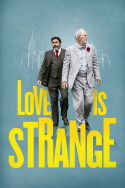
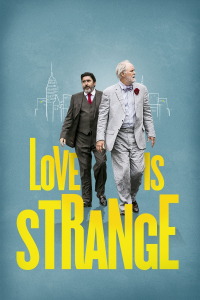
Review of Love Is Strange (2014) by Patrick L — 18 Aug 2015
Featuring a pair of critically acclaimed performances from John Lithgow and Alfred Molina, Love is Strange sounded like a well cast examination of unconventional love.
The fact that Love is Strange is a low-budget production is explicitly clear. Though the scenery is nice, it is obvious that the film takes place in a very limited collection of settings which predominantly serve as the platform for the characters to engage in discussion. It is clear that the most focus put into the production is in the screenplay as the stylish elements of Love is Strange all prove to be very basic.
The cinematography in Love is Strange is very simple. It is composed predominantly of basic frames which capture the dialogue of the characters for extended periods with minimal editing. The minimal editing means that there is little dramatization in the story, letting it develop a sense of strength on its own. However, the simplicity of many areas of the production end up meaning that the strength it develops is very limited.
Love is Strange is a very realistic film, perhaps too realistic for its own good at times. The perspective audiences are given is practically observational as we simply see the day to day life of Ben and George as their relationship comes under difficulties. The dialogue in the film explains their relationships to the people around them, but the focus is about them when you really think about it. However, the relationship between them essentially plays second fiddle to the observational style of the film which makes it feel like it lacks sufficient dramatic material. Love is Strange had the best intentions, but the fact that it didn't have much drama to really feel for meant that it was somewhat emotionally distant. It is certainly a thought provoker, but it is no heart beater. And though Love is Strange is a slow moving film, there are a lot of characters who all have their own personal grievances with Ben or George in one way or another. There is quite a few characters to keep up with yet their relevance to the narrative can be inconsistent and therefore a distraction from the love story at the heart of the tale.
Love is Strange is an unconventional love story not because of its depiction of sexuality but rather because it depicts the concept of commitment. It's not one of those hollow romantic films about trying to stay together with a long distance relationship but rather a peaceful examination of a seriously complicated situation. The film is essentially split into two largely parallel narratives about old men spending the remaining years of their lies separated by a society that puts conservative beliefs and the economy between each other. The subtext in the narrative is complicated yet the film itself is simple in many ways, creating a feeling of inconsistency. The way that the story flips back and forth between the two narratives with no real sense of progression can prove frustrating, and by the end of the film I felt that it ended where it had begun without really going anywhere in the process. Luckily the film is only 94 minutes long, but it is certainly a slow 94 minutes. With the strength of the beautiful musical score they were certainly atmospheric, but it was feeding atmosphere into material which just wasn't stimulating enough.
In all essence, I can't say that I enjoyed the experience of Love is Strange as a whole. I admired the gentle directorial style of Ira Sachs as she made a film which is easy to watch and certainly sporadically stirring, but when it comes to laying down much of a dramatic effect there is clear shortcomings in Love is Strange. Perhaps viewers who are more familiar with the realistic family drama in the film or themes of sexuality will find interpellation in the experience, but I didn't. I didn't feel isolated from the film, I just found that its arthouse approach is a little overdone with experimental contemporary films, particularly in one where the narrative structure can prove tedious. The most beautiful moments of the film come when the narratives merge and the two people involved in the romantic relationship embrace each other because there is a true sense of love felt by the realism in their bond, and this makes the experience more touching. Alas, it is predominantly because of the cast more than anything as the quantity of screen time they share comes up short.
John Lithgow's performance is the best reason to watch Love is Strange. The actor is a charming man who has lost none of his charisma in his decades of acting, and his ability to play a restrained but sexually flamboyant character has not weakened since his Academy Award nominated effort as the transgender Roberta Muldoon in The World According to Garp (1982). In age comes wisdom, and that is certainly a feeling I got from his presence in Love is Strange because I could tell he had a lot to say. This meant that whenever he spoke, he was always the center of attention. His natural voice articulation makes his words important and the touch of a flamboyant edge adds a more likable charm to the character. The intricate little insecurities of the character Ben combined with his restrained energy really convey a sense of honest frailty, effectively establishing a connection between him and viewers who can appreciate the realism of the character. John Lithgow's natural presence in Love is Strange is most welcome and his ability to keep his natural spirit alive yet also convey a sense of physical weakness makes him an easily sympathetic lead.
Alfred Molina is also lovely. Though his screen time is rather diminutive, Alfred Molina plays against type in what I am used to seeing him in. He plays an extremely soft-natured and caring character, gentle with his words but clear in his love for George and somewhat sophisticated at the same time. The beauty in his performance is very organic, and the chemistry he shares with John Lithgow is so natural that it really does reach out to audiences. Alfred Molina delivers all of his lines with smooth charisma and an inspired subtle spirit, making it one of his best efforts from recent years.
And as always, Marisa Tomei's likable spirit and easy approach to the drama makes her a wonderful presence.
So Love is Strange has a gentle touching mood to it and a wonderful pair of performances from John Lithgow and Alfred Molina, but it adheres so much to arthouse style that it becomes overwhelmed by slow subtlety and misguided focus.
This review of Love Is Strange (2014) was written by Patrick L on 18 Aug 2015.
Love Is Strange has generally received positive reviews.
Was this review helpful?