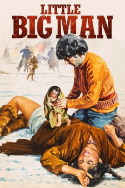
Review of Little Big Man (1970) by Jamie T — 23 Mar 2010
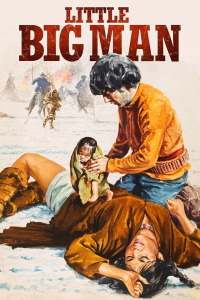
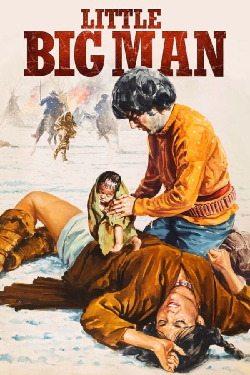
Arthur Penn's carnivalesque Western, though popular at the time, has faded in popularity next to Penn's own BONNIE AND CLYDE and Dustin Hoffman's roles in THE GRADUATE and MIDNIGHT COWBOY. This is a shame, for the film, while uneven, takes an interesting look at the Western, which was at the time in a slow but steady decline.
It's not unlike FORREST GUMP, in that the central character finds himself associating with a wide variety of colorful characters, some real (Wild Bill Hickok and General Custer), and some fictional (the con man Allardyce Merriweather, the chief Old Lodge Skins, and so forth).
But unlike Forrest, Jack Crabb realizes, often with bitterness, the lunacy of his journey, and at one point he is saved from suicide only by an opportunity for revenge. Hoffman's performance as Crabb is a curious one, made curiouser by the shifts of mood and tone in the film.
Sometimes a mumbling buffoon (subtitles are recommended), sometimes a spaced-out hermit, Jack Crabb is as hard to pin down as the truth of the stories he tells, and in an interesting twist, the film is framed by Crabb's interview by a historian at the age of 121; the makeup for these scenes is extraordinary, to say the least, and Hoffman is wholly convincing.
All told, his performance is just what the film needs (that he didn't get an Oscar nomination is highly unfortunate), but one should be prepared for its idiosyncracies. Chief Dan George, who WAS nominated for an Oscar (and unfortunately lost), is wonderful as Crabb's adoptive Cheyenne father (Old Lodge Skins).
He regards the world with an unfailing sense of reverential wonder; even when tragedy befalls him and his tribe, he refuses to succumb to despair, and when his planned death on a mountaintop fails to pan out, he replies cheerfully, "Sometimes the magic works, and sometimes it doesn't.
" George is pitch-perfect throughout, never playing the role for undue laughs, even when Old Lodge Skins discusses bawdy matters (which is often). Almost as good is Richard Mulligan as Custer, who combines vanity and psychopathy to darkly humorous effect, climaxing in his delusion raving at Little Big Horn to a governmental audience that is not there.
The supporting cast is filled with small but memorable roles: Martin Balsam as the conman Merriwether, who "tended to lose parts of himself", is highly amusing in what could have been a one-joke role; Jeff Corey, as Wild Bill, convincingly portrays the desperation beneath his cool facade; Thayer David makes for an entertainingly grotesque Rev.
Pendrake; Aimee Eccles is appropriately sweet and innocent as Sunshine, Crabb's Cheyenne bride; Cal Bellini, as Crabb's frequently humiliated brother/enemy, provides fleeting but effective support; Faye Dunaway is good as the lusty Mrs.
Pendrake, although she overplays her "fallen woman" scene late in the film; perhaps this typifies her manipulative nature, or the film's satirical style, but it doesn't quite come off; that she seems to use the same voice that she used to play Bonnie throws things off as well.
The photography by Harry Stradling Jr. is beautiful, showing off the beautiful Western vistas to their best advantage. Calder Willingham's witty script, adapted from Thomas Berger's novel, is generally well-directed by Penn, who balances the humorous and dramatic aspects of the work with skill; without giving too much away, the death of one character, as shown, is as shocking and poignant as the finale of BONNIE & CLYDE, while the comedy scenes are (usually), played just right, being farcically ridiculous without being chaotic.
This does, however, bring me to the two major flaws which keep the film from being a masterpiece: unevenness and overlength. Some of the sketches are beautifully done, but some, honestly, fall a bit flat.
The character of Little Horse, as played by Robert Little Star, is fey in a very dated way, and he seems more suited to a variety show sketch. Other sequences are glossed over very quickly (Penn's problems with pacing, which marred BONNIE & CLYDE, are not totally resolved here), and are not given a chance to breathe.
And, at 139 minutes long, LITTLE BIG MAN can't help but drag in spots, and, although tightening it might have lost some of the old-yarn flavor of the storytelling, it might have made the whole experience a wee bit better.
Still, these complaints are fairly minor, and the film as a whole remains a highly enjoyable experience, and one that deserves to be more widely seen.
This review of Little Big Man (1970) was written by Jamie T on 23 Mar 2010.
Little Big Man has generally received very positive reviews.
Was this review helpful?