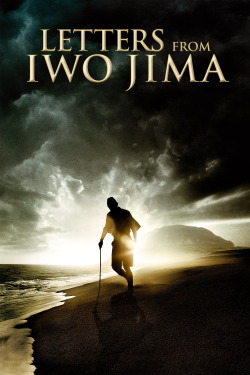
Review of Letters from Iwo Jima (2006) by Markb. — 22 Feb 2007
"No bastard ever won a war by dying for his country", uttered General George Patton as memorably interpreted by George C. Scott in the first two minutes of You-Know-What. "He won it by making the other poor dumb bastard die for HIS country.
" And though Patton fought Germans, not Japanese, the principle, as Clint Eastwood powerfully illustrates in Letters From Iwo Jima, remains the same: the pivotal battle location became a bloodbath for the Japanese fighting forces because, in instructing the men that they would most likely NOT leave the island alive, their commanders were inadvertently setting them up to BE the poor dumb bastards.
The second half of Eastwood's duo of pictures that don't so much commemorate Iwo Jima as put it under a microscope, Letters is far more effective than the previous Flags of Our Fathers because it's much less fussily pretentious (especially in its use of flashbacks) and tells a far more focused, disciplined story that doesn't go in endless different directions.
Tom Stern's "practically-black-and-white" cinematography works more powerfully here, too, because it underlines Letters' depiction of the futility of this battle for the Japanese by pictorially depicting its location, which is defined early on as a vital strategic post, as inhospitable and unworldly, more like a meteorite than anyplace recognizable on earth.
It's fascinating to watch Eastwood in the late stages of his directorial career seemingly doing everything possible to completely redefine its early and middle sections: the intensely pacifistic Western Unforgiven cancels out the larkily ultraviolent work he did for Sergio Leone and others by demonstrating just how valuable human life is and how painful its loss; the anti-mob justice drama Mystic River seriously questions the law-and-order ethics of his Dirty Harry series, and his Iwo Jima films negate the rowdy, Late-Late-Show hyperpatriotism of his Grenada opus Heartbreak Ridge.
But before liberals start firing up the veggieburger grills to welcome Eastwood as one of their own, they should keep in mind that Clint (who as far as I know is still a Republican) is nothing if not impossible to pigeonhole, and Letters From Iwo Jima, for all its implicit commentary on the futility of war, also violates one of the primary tenets in the ultra-liberal handbook: while honoring and treasuring the lives of the individual Japanese fighting men and their likable commander General Kuribayashi (Ken Watanabe), it's also quite unsparing in its criticism of a national culture and mindset that in many ways contributes to their doom.
There are enough ritualistic suicides to rival any film made about the People's Temple in Jonestown, and the Japanese code of combat as depicted here shamefully and unnecessarily wastes human life by advocating dying "honorably" over trying to survive to fight another day.
In a time and place such as our own, when making even obvious, justifiable generalizations about another nationality, religion or culture has become so verboten that even an airline's very sensible recent act of arresting a group of suspiciously-behaving Muslim passengers who seemed to be preparing to hijack a plane is placed under ridiculous scrutiny, Eastwood deserves commendation for doing the near impossible.
This review of Letters from Iwo Jima (2006) was written by Markb. on 22 Feb 2007.
Letters from Iwo Jima has generally received very positive reviews.
Was this review helpful?