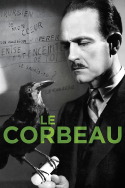
Review of Le Corbeau (1943) by Mel V — 22 Jul 2004
Directed and co-written by Henri-Georges Clouzot ([I]Diabolique[/I], [I]Wages of Fear[/I]), [I]Le Corbeau[/I] (The Raven) is nothing less than a dissection of the moral hypocrisies prevalent in wartime France during the German Occupation. No surprise then that [I]Le Corbeau[/I] was excoriated by both the Right (the collaborationists in the Vichy government working with the German Occupation authorities) and the Left (the Resistance), as well as the Catholic Church (presumably for the representation in the film of the church?s laxity, myopia, and ineffectiveness in handling the moral crisis buffeting the town). Obviously, neither the Right, the Left, nor Catholic Church cared to have their reputations impugned by a film?s presentation of the widespread corruption and moral bankruptcy affecting French society after their early defeat in World War II by the Germans.
Set in a provincial French town (described in the opening titles as ?a small town, here or elsewhere?), the narrative impetus is provided by a series of anonymous, coruscating, ?poison-pen? letters centering on the lead character, Remy Germain (Pierre Fresnay), a charismatic doctor with an enigmatic, troubled past. In the letters, Germain is accused of having a clandestine affair with Laura Vorzet (Micheline Francey), the beautiful, if neurotic, young wife of a middle-aged psychiatrist, Michel Vorzet (Pierre Larquey), and worse, of performing abortions for the town?s women. The doctor also becomes romantically involved with a neighbor, Denise Saillens (Ginette LeClerc), who feigns sickness to attract his attention. The letters, however, proliferate beyond the accusations aimed at the doctor, and rapidly expand to include the entire town. The anonymous writer (or writers) seems to have almost god-like powers of perception and observation, as well as access to deeply private information. No one, then, is immune from the pernicious effects of the letters, from the town?s mayor (accused of incompetence and of being a cuckold), to a 14-year old female postal worker who, like most of the town?s women, swoons at the approach of the mysterious doctor.
In Clouzot?s jaundiced, misanthropic worldview, however, there are few ambivalences or ambiguities. Every character introduced into the narrative can be characterized by venality, egocentrism, duplicity, and/or corruption. Even the lead character, the enigmatic doctor, with his distrusting, spiteful behavior toward the female characters, does little to make himself a more sympathetic character for the audience. One of the female leads, Laura, cuckolds her older (read: impotent) husband with the doctor. The other female lead, Denise, is defined by her malaise (she spends most of her time in bed), her emotionally manipulative behavior, and by her predatory sexual desire (read: promiscuous behavior). For the townspeople, each letter revealing a betrayed trust in turn generates another letter, revealing that for every recipient victimized by a letter, he (or she) has victimized someone else.
[I]Le Corbeau[/I], however, is more (or less, depending on your perspective) than a critique of then contemporary French provincial society. [I]Le Corbeau[/I] is also a tightly plotted mystery/suspense film that depends first, on the proliferation of the poison-pen letters (805 letters, by the film's final count), and then later, on the ultimate revelation of the anonymous letter writer and his (or her) motivations for writing the letters. Clouzot skillfully follows the elements present in the best mystery films (and novels): create a group of characters, each with their own, hidden motivations, who could be responsible for the letters, then follow the main character as he attempts to eliminate the possible suspects sequentially. Less a detective than an audience stand-in, Remy Germain, is rarely, if ever, correct in his suppositions about the anonymous writer and the writer?s motivations. As the protagonist, Remy is passive and often wrong, especially when it comes to understanding human psychology. It its Dr. Vorzet who leads Germain on the investigation into the letters, providing him with clues (and theories of morality) at key points in the narrative. The identity of the writer, however, isn?t revealed until the penultimate scene, after Germain has mistakenly accused not one, but two other characters of being the writer, and after the townspeople have falsely accused and imprisoned a third character.
Although the clues are carefully laid out as the plot unfolds, the audience is continually distracted from discovering the identity of the writer through Clouzot?s pacing and narrative structure: the audience becomes primarily concerned with Germain, his relationships with the two female characters, and the rest of the townspeople. The question of the writer?s identity becomes a secondary concern, except at key points in the narrative, where the question must be foregrounded for the plot to continue. Even then, Clouzot misdirects the audience multiple times, smoothly shifting the suspicion from one character to another (until the penultimate scene, when both the audience and the lead character discover the identity of the poison-pen letter writer). Clouzot, however, chooses not to end the film with the expected moment of triumph of the protagonist over his antagonist. Instead, that confrontation, and the expected sense of satisfaction, is withheld from the audience. Clouzot ends the film with a stark figure shrouded in black, acting without remorse or compassion. The audience is left with a chilling, disturbing perspective of a worldview that, at most, gives cold comfort to its flawed, limited characters. Highly recommended.
This review of Le Corbeau (1943) was written by Mel V on 22 Jul 2004.
Le Corbeau has generally received very positive reviews.
Was this review helpful?