Review of Lawrence of Arabia (1962) by Cinefiles — 29 Apr 2015
The historical epic has been a staple of the motion picture industry since the silent era. Over the years, it has evolved to mesh with the times and meet audiences' expectations. Viewers in the 1910s got D.W. Griffith's racist Birth of a Nation, while movie-goers in the 2000s were poleaxed by the trite but visually impressive Pearl Harbor. In between lie the best of the epics, and, while it's impossible to single out one as being at the inarguable top of the heap, David Lean's Lawrence of Arabia is certainly a contender for the position. Riveting from beginning to end, featuring stellar performances, amazing cinematography, and a story without a trace of fat, the film does everything an epic is supposed to do - and more.
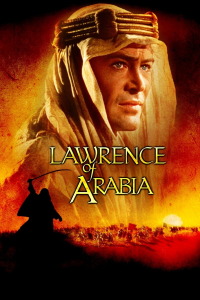
Lawrence of Arabia recounts the larger-than-life exploits of T.E. Lawrence (Peter O'Toole), an officer in the British army serving in the Middle East during World War I, who, according to one observer, "was a poet, a scholar, and a mighty warrior. He was also the most shameless exhibitionist since Barnum & Bailey." The film opens in 1935, with a prologue that shows Lawrence's death as a result of a motorcycle accident, followed by his funeral. The time frame then shifts back more than 20 years to Cairo, where Lawrence is about to begin the greatest adventure of his career. His commanding officer orders him to enter the desert and make contact with the Bedouin Prince Feisel (Alec Guiness), who is a British ally in the fight against the Turks. What follows is not only an account of how Lawrence became a pivotal figure in the Arab revolt against the Turks, but of the nearly-Shakespearean rise and fall of his character.
The director's cut runs a little over 3 1/2 hours, and every moment seems necessary. The pacing is tight - there's plenty of action and adventure interspersed with character development, plot exposition, and majestic visuals. Therefore, it's hard to believe that a theatrical version exists in which more than 30 minutes of material was excised. Indeed, most people who saw this film during the 1960s and 1970s weren't getting the entire picture (although Lean was involved in the trimming done to create the 3 1/4 hour print widely seen in U.S. theaters and the 3-hour version shown on television). Fortunately, in the late-80s, the original edition of Lawrence of Arabia was painstakingly restored (with the participation of David Lean and the surviving actors). The restoration was handled so expertly that, watching the new print, it's virtually impossible to see the shifts in visual acuity that often mark the inclusion of previously-eliminated scenes.
The most compelling aspect of Lawrence of Arabia is the way in which it dissects the fluid, often-contradictory personality of the title character. Like many of the best classic "war" movies (such as Patton), this one uses the battles as a backdrop for a character study. The combat sequences in Lawrence of Arabia are perfunctory, with few of the details shown. This allows us to focus on the individual at the epicenter of the storm. When we first meet him, Lawrence is an oddball craving a mission in the desert (calling it "fun"), something that his fellows shun. After spending some time with the Arabs and being asked why he likes the desert, he has a simple answer: "It's clean". The movie explores Lawrence's friendship with Sherif Ali, and shows how the Arabs willingly adopt him as their leader, even though he has white skin. But Lawrence's psyche suffers a severe blow after his torture at the hands of the Turks. Initially, he is unwilling to return to the desert, but, when commanded to do so, he comes back driven by a newfound lust for killing and a desire for revenge. His final mission - the capture of Damascus - shows Lawrence's dark side.
There is one visual oddity associated with the manner in which Lawrence of Arabia was filmed. Because it was not possible to shoot the night scenes at night, they were lensed during the day using light-damping filters. So, while it looks like night, the camels and horses cast noticeable shadows. Today, computers would be used to digitally erase these anomalies (then again, today, the filming could be done after dark), but their existence in Lawrence of Arabia adds a certain otherworldliness to those scenes in which the "night-shadows" appear.
For David Lean, widely regarded as one of the masters of epic filmmaking, Lawrence of Arabia represented the most ambitious undertaking of a fruitful career. Restored to its full length in 1989, the version available today shows the story as Lean intended it to be seen - provided the viewer is able to see it projected, not compressed onto a TV screen. While it's true that Lawrence of Arabia still works on the small screen, it is robbed of one of the most important aspect of any motion picture spectacle - the awe factor. When that is present, this becomes an event - something that even the most restless viewer will become lost in.
This review of Lawrence of Arabia (1962) was written by Cinefiles on 29 Apr 2015.
Lawrence of Arabia has generally received very positive reviews.
Was this review helpful?