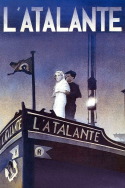
Review of L'Atalante (1934) by Arturo S — 02 Jan 2010
L'Atalante is indeed one of the greatest films ever made. In fact, it's perhaps my favourite French film in general. It's a masterpiece of sheer genius and a love for filmmaking. It has moments of tremendous hilarity, romance, and heartbreak.
The film is about Jean, a barge captain, and Juliette, a couintry girl, who are married, despite doubts from Juliette's family. They then commence their voyage on Jean's barge, the eponymous L'Atalante, with his crusty first mate, Jules and an young boy. Right from when they get on the boat, the couple's love for each other is threatened by the conditions of a barge life, Jean's libido, and Juliette's longing to see Paris. When you look at it, the story is so simple that you would think it to be a generic 1930s romance. It takes more than one viewing (especially if you don't speak French) to grasp the artistry of how Vigo composes the film.
One could describe the film simply by listing its most beautiful shots. Among these are the opening shots of the barge itself, the wedding procession that seems intent on spreading gossip as Jean and Juliette seem to glide across the countryside, Juliette walking down L'Aralante, the crew first singing the "bargeman's song", Jules and his record, Jean's swim, the characters' night apart, and the final aerial shot.
One brilliant scene to point out is when we see Jules' cabin. The viewer is immediately awestruck with the the sight of this bizzare first mate's souvenirs taken from around the world over what must be decades. Then there are alternately bizzare, hysterical, and simply poetic shots, such as Jules' puppet dance, the camera peeking over his and Juliette's shoulders to observe the cabin, the hands in a jar, and Jules' tattoos. There is also the playful relationship between Jules and Juliette that makes them appear as family in a toy shop, which is then ravaged by the destruction brought on by Jean.
Unconventional angles and motions, courtesy of Boris Kaufman, mingle with the rigourously detailed mise en scene to bring out hidden meanings for the events of the film and build up each scene with glorious harmony.
But compsition is not all the film has to offer. The performances of the cast are incredible. The characters in this film feel like real people, whose decisions are polarized beween right and wrong. When they do something in the film, it is natural and liberated. Jean (Jean Daste) is aware of the extremes he sometimes goes to in order to maintain his marriage and the reliance of his crew. Juliette (Dita Parlo) is in constant struggle to affirm her love for Jean while realizing her indepedence. The boy is a silent and impartial observer who treats the crew as more than caretakers and no doubt learns from their challenges.
But, these characters do not compare to the force of nature that is Jules, played by Michel Simon. Here, we have one of the funniest characters to come from French cinema. Always taking the situation in his witty, sarcastic manner, he exemplifies the old man who has seen everything and wants to take it easy while keeping up his rough and tough image. Any scene with Jules is a joy to watch, you just have to do so.
What also has to be mentioned is Jaubert's musical score. Amazing when put beside the images of the film. It evokes the simple, breezy nature of travelling on a boat along the French coastline, the excitement of a working-class nightclub, and the pomp of the city life. Essentially, it adds to a state of mind the film gives you as you watch.
The tragedy of L'Atalante is that it was the last film Jean Vigo made in a meager but groundbreaking filmography. After its release, he died of longstanding tuberculosis. Legend says that he directed scenes of the film from a stretcher. True or not, L'Atalante was the product of a true calling that Vigo could not ignore. It is because of this persistence that his films have had a lasting influence on cinema which it ultimately deserved.
This review of L'Atalante (1934) was written by Arturo S on 02 Jan 2010.
L'Atalante has generally received very positive reviews.
Was this review helpful?