Review of Lakeview Terrace (2008) by Parker M — 22 May 2012
3 Stars out of 4.
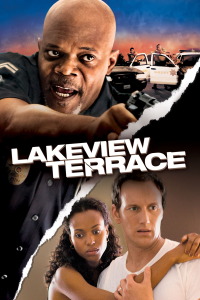
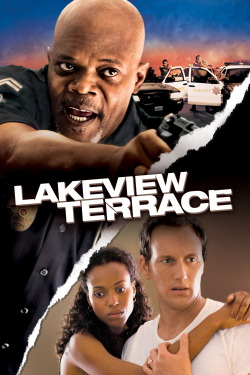
I've watched Lakeview Terrace at least three times, and after each trek through this suburban jungle, I've convinced myself that I'm crazy: I actually like this movie. Lakeview Terrace definitely croaks around the three-quarter point, but it's one of those rare quasi-pot boilers that make you curious about its characters. And who wouldn't be surprised? It's got Samuel L. Jackson ruling with de jure rhetoric as an overly traditional cop and even Patrick Wilson and Kerry Washington as his neighbours. The incandescent mode of topic: he's caucasian and she is black. Ever wondered what Wilson from Home Improvement was like behind that face-heighted fence? Well here's a film that provides the answer -- but it should not be called Home Improvement but more like Home Devolvement. Or to spin off Michael Moore's most recent Americana documentary -- Suburbia: A Hate Story.
It's all shining rainbows, blossoming daffodils, and smiling joggers at first for Chris (Wilson) and Lisa (Washington). They meet and greet with the neighbours and move into their nicely grand modern home. It's not until they meet Abel Turner (Jackson) when the heat is turned up. He washes his car across the hedge, sits on his patio eerily, gazing his eyes over at the two. But Chris and Lisa don't think much of it: it's normal for birds to stare when new ones move into the nest.
But Abel turns out to be a grinning menace abut. He becomes passive aggressive of Chris and Lisa's inter-racial marriage and just like that, things become difficult. Security lights from Abel's house gleam into the two's bedroom, Chris's car's tires are flattened, and Abel demoralizes Chris at a party. What happened to neighbour-neighbour communion?
Lakeview Terrace is irrefutably silly, arbitrary, and absurd when it should not be. Abel has the colour issue on his side -- blue, he's a bobbie -- that he can corner in Chris and Lisa and wait for anytime to move in for the kill. Perhaps the character is too dumb for his own good at times. But Samuel L. Jackson makes us look at the character in a more ascertained way: he's definitely the bad guy, but why? How can we turn the tables on his character, negate his past, his privileges, his inner conflict that he too can become as vulnerable as Chris and Lisa. Chris and Lisa were meant to escape to a family life but now they are cornered in. Lakeview Terrace, in a relatable way, can act as the marriage we'd never want to have.
Or maybe I worded it wrong. There is no problem with inter-racial relationships. Lakeview Terrace has this sincere maturity in coping with this subject. We deal with Chris and Lisa not as characters that yell and scream and quiver with fear, but as people not necessarily blaming Abel for their problems but themselves. It's the human impulse. When things get bad, we may blame others at first, but ultimately we end up blaming ourselves. Intuitively. I was fascinated watching Wilson and Washington deal with their characters, in terms of having a baby, getting by, Chris smoking outside the house, and the competitive aspect between the two on who struggles harder being married to a racially different spouse. In a word or two, Lakeview Terrace is ostentatiously authentic. I know that's an oxymoron.
Lakeview Terrace, for the first 90 minutes, moves at the pace of a Hitchcock film. Its gentle, it drops its hints like breadcrumbs, while in a subtextual sense, telling us the answer to the movie as a whole. We watch these characters with pity, an omniscient sympathy, knowing that things will inevitably move from push to shove. Pretend you are watching Hitchcock's Shadow of a Doubt, in which you challenge yourself watching the movie to prove that the film will uncoil itself against the antagonist and prove his or her guilt. That way, you win and so do the good guys. There are no whodunits in Lakeview Terrace as it dares to centralize on its characters, establishing the problems that surround the goofy premise to make it almost seem, well, credible.
Are there elements that leave you cold? Of course. Take the tepid aspect of the forest fires nearby. They act in no way like some natural menace as The Birds did or Shyamalan's The Happening, theoretically, tried to do. And there's Abel's two children, who are aging adolescents reticent towards their father, since the daughter is infatuated with a white boy. The ignorance of these side stories do reduce Lakeview Terrace's significance as character drama, but watching Wilson and Washington perform is, by no means, scutwork. They aren't just characters, they're people too.
But the primary motivation is Samuel L. With his charisma, he could play Adolf Hitler and be believable and likeable. He's humorous, haunting, complex, and taciturn. Lakeview Terrace may feel like a rip off in the end, but it can also show you how far things can go when neighbours don't like each other. And no, it's not because one uses pesticides.
I SAY--See It.
This review of Lakeview Terrace (2008) was written by Parker M on 22 May 2012.
Lakeview Terrace has generally received mixed reviews.
Was this review helpful?