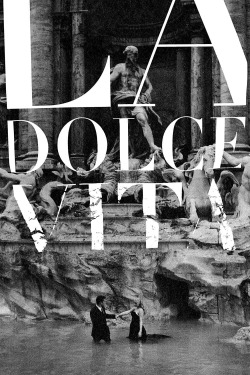
Review of La Dolce Vita (1960) by Michael K — 13 Apr 2008
A helicopter carrying a statue of Jesus flies over drab terrain dotted by boxy postwar apartment high-rises. Working-class men, sweating from the heat and their labors, wave acknowledgment; then we see glamorous young women in sunglasses on a roof terrace. "Where are you taking him?" they shout. But male lead Marcello and sidekick Paparazzo can hear nothing over the noise of the helicopter, leaving them with little to do but smile wistfully. It's a striking visual concept, and one that touches on every one of the ambitious themes ahead: the ironic, disconnected condition of modernity; the loss of faith; the chasm between social classes; and the search for truth in the form of human connection.
Fellini's neorealist period, as characterized by the autobiographical I Vitelloni, comes to a decisive end here; La Dolce Vita could read as autobiographical too - after all, Fellini moved to Rome at 18 and never looked back - but what's completely fresh about this construction is the surreality, or perhaps magic-realism, of Fellini's Rome (a magic-realism that was to echo throughout the rest of his canon: the fairy-tale world of La Strada; the fantasized harem scene in Otto e Mezzo). It's rendered in stark, modern strokes: The interior of a hospital is a minimalist white canvas. A jarring jump-cut teleports us from a statue of Jesus to dancers in a hip Roman nightclub. A prostitute looking down from an elevated sidewalk suggests (and foreshadows) a priest gazing from a church balcony. In this world, everything is remixed and juxtaposed where you least expect it. Indeed, nothing is sacred. Fellini had MTV's game, two decades ahead.
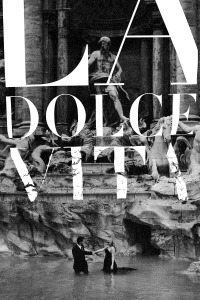
The film's structure is more episodic than narrative, taking its form in seven acts, interspersed by smaller vignettes. While the interludes serve the somewhat utilitarian function of developing Marcello's character and following his travails with Emma, his devoted girlfriend, it is the main chapters - expansive, laden with symbolism, and often inscrutable on first sight - that truly carry Fellini's social commentary. The first of these, in which Marcello and Maddalena engage the services of a prostitute, purports to show us modern Roman moral depravity, but below the fold, it really has more to say about class; Ninni's pimp is none too pleased about the unconventional arrangement that ensues, but after our protagonists leave an apparently generous gratuity, it's clear who retains the upper hand as the pair is warmly welcomed to stop by again. A visit from American actress Sylvia similarly begins as a light-hearted send-up of the folly of celebrity, but turns a bit darker as Marcello, fancying himself ever the dandy, whisks Sylvia away from a party; stray cats and the Fontana Trevi prove to be of greater interest to the flighty actress than his heartfelt advances - they literally don't speak the same language, and the night ends in a fistfight with Sylvia's drunken American boyfriend Robert.
Marcello's visit to Steiner is the most overtly philosophical of these pieces; Steiner seems merely a foil for Marcello's own emotional state when he speaks of "the hell that hides behind peace." Each setting has a distinct look, and usually in between we see Marcello driving, narratively moving us between contexts and visually reminding us of the diffuse worlds he inhabits. The unifying theme is Marcello's struggle to find genuine connection with another human being, and in this epic struggle he merely stands in for a symbol - the modern man, the journalist, the cosmopolitan, who seems to have no home and few true friends. Even family is no refuge here, as an awkward encounter with his own father demonstrates: the father picks up a showgirl, right from under his son's nose, while Marcello is left to muse to Paparazzo: "I never really knew him...".
Fellini has captured, with remarkable prescience, the postmodern condition of perpetual verisimilitude: in this stylized world, everyday life is a performance, celebrity is fleeting, and the social pecking order is just another parlor game. Marcello gets a taste of his own medicine as he struggles to get rid of Paparazzo in the hope of an intimate moment with Sylvia, but finds that in a world driven by the dazzle of the media, to be genuine is not so easy as it appears. And in what may be the most exquisitely bizarre sequence in the film, evocative of the contemporary phenomenon of reality television, a small town is overrun by film and radio crews upon the news that local children have seen the Madonna. The cameramen ask the villagers to pose... the children run around pointing at the "visions"... the crowd follows... the technicians coordinate lighting details by radio... who is really in control here? The lines between director, actor, editor and viewer - between fact, fiction, and perhaps autobiography - have blurred. "The medium is the message," and absent context, only the image remains...
This review of La Dolce Vita (1960) was written by Michael K on 13 Apr 2008.
La Dolce Vita has generally received very positive reviews.
Was this review helpful?