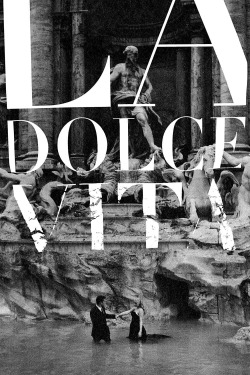
Review of La Dolce Vita (1960) by Mario E — 15 Sep 2009
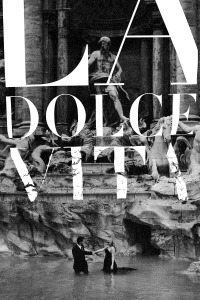
What makes a film unforgettable? What makes it trascendental? What's more, what makes it a stepping stone in cinema history for other films and what makes it a perennial classic that lives on and on, talked-about and never-endingly revered by cinema buffs and general audiences alike? Well, I believe it's a well-balanced combination of perfect directing, a practically flawless screenplay, entrancing acting, adequate music and a production design that compliments all of the above. In that case, Federico Fellini's "La Dolce Vita" fills all of the requirements.
It's about a reporter (Marcello Mastroianni) for an Italian tabloid, who spends his days and his nights mingling around the high society and writing about what everyone comes to know as "the sweet life". Throughout the film, we follow him as he encounters a wide variety of these kinds of people, and has he traverses through their lives and their life styles. We see him befriending a famous American actress (Anita Ekberg), an insanely wealthy socialite (Anouk Aimée) who's also his lover, we see his dysfunctional relationship with an overprotective and suicidal girlfried (Yvonne Furneaux), his adoration for his cultivated and very wise mentor (Alain Cuny), his disinterested and estranged father (Annibale Ninchi) and a colourful cast of other characters who perfectly exemplify precisely that- the "sweet life" of the rich people we've all come to alternately adore and hate.
As any truly great piece will do, this film isn't simply about telling a good story, but about making a point on various topics and using not only plot and dialogue, but settings, costumes and images to deliver a complete tour-de-force. I've also learned from expert film critics such as Roger Ebert about the symmetrical quality the scenes have of expresing said points.
The first scenes, where Marcello, our hero reporter, meets with the witty and ninphomanous wealthy lover are charged with a sexual tension that's shocking in its openness and the lack of importance and obious normality all the characters involved give the situation. These are people who are completely hedonistic and nihilistic, for whom nothing is sacred, for who immorality is celebrated and who seek amusement in what should probably be unthinkable to 'normal' society. We begin to establish our hero's personality and moral dilemma, as he strives to become a part of this renowned society but as he recognizes he's aguely admitted but seldom noticed as a valuable member.
Notice for example the scene with the American actress, her dull and certainly dim-witted personality, and how her looks and fame alone make people swoon and kiss her shadow, while her personality reveals an emotionally empty person and a tedious/boring character. She leads Marcello, our hero, in a wild romantic chase, seeming available but impervious to his obvious fascination for her.
The next scene, where the people's boredom and disrespect for religion is mixed with those who's fanatism and adoration for all this sacred clash, is yet another type of chase, where it's not Marcello himself who's led in a chase, but the whole idea of morality in itself.
Basically, every scene makes a point on a certain area of society, subtly using images and dialogue to show the viewer the truth behind what the "sweet life" is idealized to be. The film begins with a statue of Jesus Christ being carried by helicopter to the Vatican City, and the film ends with a group of rich people leaving a crazed orgy at dawn and finding a sea monster caught in some fishermen's net. Roger Ebert will tell us that the beginning shows us something beautiful but fake and distant (the statue), while the end shows us something horrible but real and palpable (the sea monster). I completely agree with him. That's what Fellini intended to do: he showed the life of the rich and famous in it's entirety, and we begin by seeing it as something beautiful, amazing, something we would like to be a part of...but something that's far away and unobtainable. The ending sums up what we saw about the so-called sweet life, being monstrous and gruesome, but as real and as current as we live today.
Each of the main characters Marcello encounters (the actress, the wealthy lover, the suicidal girlfirend, etc...) are perfectly developed and we can gather a great amount of knowledge from them. The actress with her lack of care and infuriating stupidity, the lover with no grasp on the term "love" and a constant seeker of sex, the girlfriend, exceedingly overprotecting and yet lovable in her devotion, Marcello's mentor (the wisest and most profound of these who we draw vitality from and who, by the end of the film, has destroyed the only hold on whatever sanity we might have found in this kind of people)...these are all people who reinforce and re-affirm the structure of the film.
Nino Rota's score is perfect, a mélange of musical genres adhering themselves flawlessly to each scene. The cinematography is epic, enveloping us in the moment, missing nothing and admitting into our view everything that goes on, at times in perspective, at times introspective. The costumes, settings, etc...well, they're amazing.
And Marcello's character. It changes and turns around countless times, revealing this sad, sad man who can't possibly make up his mind about anything, and who has come to depend so much on this life that's taking his soul away. It's astounding, I tell you!
I saw this film about three years ago, and while it shocked me and left two or three memorable images, I made nothing out of it. Now I see it again while trying to review it as fairly and as professionally as I can and I can fully claim it to be one of the greatest movies I've ever seen.
Rating: 4 stars out of 4!!
This review of La Dolce Vita (1960) was written by Mario E on 15 Sep 2009.
La Dolce Vita has generally received very positive reviews.
Was this review helpful?