Review of La Dolce Vita (1960) by Matthew S — 03 Aug 2015
A large statue of Christ is being carried to the vatican via helicopter. It flies over the late 1950's Rome. As God seems to be symbolically blessing the ancient city over which he files, we soon find the workers, players, sunbathing beauties and our protagonist watching from below. This is a Rome in transition. WWII has been over for almost 15 years and the city is changing quickly. It is fairly obvious that the religious icon flying over has very little to do without what is going on below. Thus begins one of the greatest films of all time.
As Marcello Mastroianni's hedonistic and conflicted popular celebrity lifestyle journalist makes his way across Rome's terrain he guides us into what become scenes or mini-episodes that form "The Sweet Life" to which the Italian title refers.
Federico Fellini is just starting to his his new cinematic style. Cinematographer, Otello Martelli, and composer, Nino Rota, along with his leading man are the key artists who help to turn this loosely-constructed film into one of the most lavishly beautiful, romantic, glam, insightful and most influential works in cinematic history.
Despite the satire and cultural commentary, this film retains it's power thanks to the iconic moments and scenes Fellini creates. Everyone has at least two favorite scenes. Though, for me, this is a movie of espisodes. Each one more or less fitting together to form a sort of salute and farewell. More than just Rome is changing. So is the culture and all those who live in and around it.
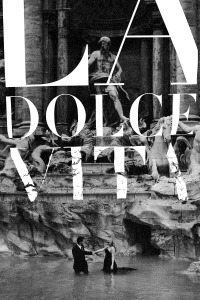
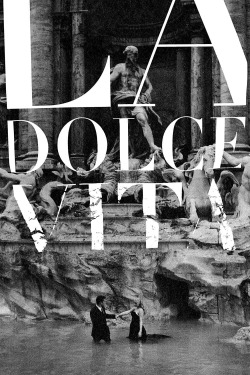
My favorite episodes are the beginning with The Christ hanging by a rope on his way to the Vatican . The other is one of the film's longer episodes in which a hot and famous Hollywood movie star, The Legendary Anita Ekberg, arrives in a self-absorbed glee as the "paparazzi" dangle on her every fake move and turn of phrase. When she is asked what she most enjoys about life, she delivers one of the best lines I've ever heard in a movie: " "I like lots of things. But there are three things I like most. Love, love and love." Later, near the end of all-too brief time on the screen she will saunter into that fountain and inspire a glam imprint on our collective brain.
Like a lot of the characters in this film -- She isn't particularly "likable." But she is "here" to stay. Fellini not only captured this era, he ended up helping to form it.
This is an epic with an epic-like running time. But the screen is filled with so much to see and so many things to say -- it is hard to imagine not loving it.
It actually doesn't matter if we love it or hate it. Fellini's s La Dolce Vita is true cinematic masterpiece that is both modern and old-fashioned.
This review of La Dolce Vita (1960) was written by Matthew S on 03 Aug 2015.
La Dolce Vita has generally received very positive reviews.
Was this review helpful?