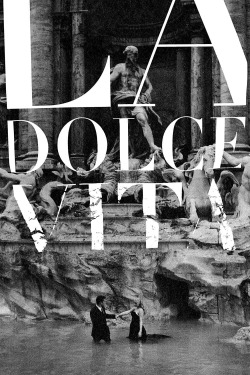
Review of La Dolce Vita (1960) by Arman P — 25 Feb 2013
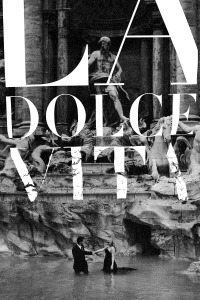
The story of human search for happiness and meaning of life.
The story is formed through Marcello (the protagonist) interaction with Sex, Church, Literature (he tries to become a writer) as well as the depiction of different characters, for instance women of different characters, his father, Steiner (intellectual character who "just seem to be high"), orgy of hypocrite old people and so on and so forth. Fellini attains this road-map through the episodic structure of La Dolce Vita.
Marcello, seeking love through Sex with different people, becomes so degraded such that he cannot even see the simplicity of life, recognize his primal search for meaning of life, when he simply turns back to the the simple country girl tries to communicate with him on the beach because he is so absorbed by the masses.
I found the following (from somewhere in internet) useful:
-----------------------------------------------------------------.
Considering that Aristotle's function also deals with parts and wholes of an idea, perhaps it would be fitting to apply it to Marcello's life and his ultimate descent. Even from the onset of the movie, we can be clear that Marcello does not have a specific function, which has also been considered to be an occupation, and that he does not enjoy doing it. Therefore, we can understand that happiness is, essentially, an unattainable idea for him. Aristotle states that the function of something is what gives it meaning, it must be unique, and cannot be done by another object just as easily. Keeping that in mind, by analyzing Marcello's actions and his continued, but failed, attempts to find meaning, we can easily see, by relating Aristotle's ideas, that he is not a being with a specific function or meaning, a direct relation to his inability to find happiness. Marcello, despite his aspirations, does not serve a function which sets him apart or gives him meaning. Throughout the movie, he is constantly unsatisfied by his life, his job gives him no satisfaction, nor does his home life or girlfriend.
We can see Marcello take on a variety of degrading tasks to attempt to find this meaning however. His attempts to write meaningful works, such as the book he starts, and the random parties and sex he engages in, can be viewed as mere attempts to find meaning, although nothing of what he does throughout the movie give him any more meaning or function than he begins with. Therefore, it seems only like a natural course of events that he comes to degrade even further, having lost his primary functions in life. Aristotle states that the ultimate function of humans is to live a life according to reason. It becomes very clear throughout the movie that Marcello is simply not capable of doing such a thing. Marcello's life is not rational, nor is it reasonable. It is chaotic, it is unorganized, and it is a search with so many lose ends that it becomes impossible to follow or control.
This lack of function and reasoning is ultimately destroyed with the death of his idol and mentor Steiner, the one man whom he idealized and who succeeded somewhat in giving him a rational order and sequence, which is symbolized by his book, which, interestingly enough, he is incapable, at least in the course of the movie, in putting down so much as a single word. Also interesting is that in the time when he attempts to write his book, he is introduced to the purest character of the movie, the young waitress, who represents purity and reason, therefore, according to Aristotle, the meaning of life and of the soul. After Steiner's suicide, Marcello comes to believe that nothing can ever bring happiness. He cannot be complete in the life that he has been living, and it seems that even the promise of a "better" or more complete life only brings it own unhappiness. Somewhat counter to Aristotle's argument, it seems that even perfect reason and function cannot always bring happiness of their own accordance. After the death of Steiner, Marcello seems to lose any of the possible reason or function that his life might have held, which was largely focused on betterment and future possibility. Following that, his complete degradation as viewed at the end of the film does not so much come as a surprise, but more a perfect following of Aristotle's argument of the functional soul, that which has no rationality, and no function (Marcello has abandoned even journalism by the conculsion), can never be complete, and thus never achieve happiness. At the very end of the film, Marcello is incapable of even recognized the purity and reason of life, as symbolized by the his loss of identity with the waitress who attempts to waive at him across the beach.
Of course, none of this is to say that Marcello did not have potential or at least the possibility to attain more in his life. It is important, to truly understand the film, that the steps which lead to his loss of potential and his disintegration of his psyche and collapse of his higher self are made clear. There is no easy answer as to what exactly creates the confusion and disillusion within Marcello. Of course, it becomes apparent within the opening moments of the movie that Marcello has little respect either for himself or for those around him. Perhaps this is really the first step in his complete disintegration by the end of the movie. Even from the few opening minutes, Marcello shows no respect for himself or the people that he is attempting to write a story about or photograph. From there, the path that Marcello takes seems set out before him, he cheats endlessly on his girlfriend, has no respect for women, and reacts with anger more than sympathy after his girlfriend overdoses.
This review of La Dolce Vita (1960) was written by Arman P on 25 Feb 2013.
La Dolce Vita has generally received very positive reviews.
Was this review helpful?