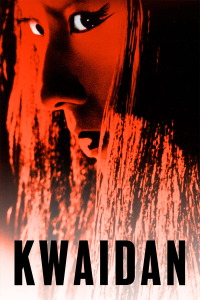
Review of Kwaidan (1965) by Ninja I — 18 Nov 2010
One of the most punctiliously created supernatural fantasy films ever made, Masaki Kobayashi's Kwaidan is also one of the most remarkable. While many model black-and-white ghost films before it would good-humouredly reflect on the life of the paranormal, this extravagant widescreen color production handles the hereafter face-to-face, as something utterly and chillingly unfeigned. As directed by Kobayashi, Lafcadio Hearn's four legends unfold across the screen like forms of the stylish Japanese watercolors of historical eras in which the film takes place. During the opening credits, ink of assorted shades churn around in clear water, alluding to the mixture of the paranormal with reality which is in store.
Shot thoroughly on mammoth studio sets, with a wholly post-synched and vigilantly restrained soundtrack, Kwaidan is nearly as far from filmmaking "realism" as it's achievable to be. Indeed, several of the exterior scenes are on interior sets, allowing Kobayashi extensive liberty to enhance surrealistic dashes to the sky backdrop. However in going to such radically elaborate extents as acclimatizing facets of Kabuki and Bunaraku puppet theatre to filmmaking practice, Kobayashi accomplishes a delicate fusion of realism and stylization. He makes tangible a visualization in which splendor and repulsion don't just share with but harmonize each other.
The first episode, The Black Hair, relates of a poverty-stricken samurai who leaves his tolerant, devoted wife when he finds the opportunity to marry a wealthy man's daughter. However the samurai swiftly learns that assets and security portend nothing beside genuine love. Craving his first wife, he goes back to her. Joyfully, while his old house may be rather rundown, she hasn't changed at all since he left. Her stunning black hair is as radiant as ever. Ecstatic at this intriguing spectacle, he promises to stay with her forever. Nevertheless, what's actually beneath her ostensibly unaffected condition? And what would forever with her truly signify? Disillusioned passion comes in another pretext in the film's following installment, The Woman of the Snow. Located in a grim ice-covered woodland, it chronicles a meager woodcutter vulnerable to a snowstorm with his mentor. Hiding in a hut, the duo folds from fatigue. Yet when the woodcutter stirs, he sees a mystifying ghost-like woman blowing her sub-zero breath over his mentor's body, killing him. Noticing the woodcutter, the lethal apparition shows mercy to him, although in doing so, she cautions him that he must never tell anyone what he's witnessed. Ten years pass. The woodcutter is a comfortable family man. His wife is admired by the village as an epitome of fortitude and loveliness. And, so self-assured is our protagonist in his family that he's ready to tell his wife about the inexplicable woman who almost killed him.
When the men are initially lost in the forest, the fuzzy likeness of a massive eye looking down on them can be seen in the sky. After the young woodcutter faints in the snowstorm, he comes to to discover the forest has distorted into a dreamlike snowscape. Where once had been an evocation of an eye in the sky, now there are numerous eyes unmistakably observable. Later in the section, when the woodcutter and his wife cavort through the fields, the sky is portrayed in pink and orange hues, conveying an idyllic affection to the actions.
In the film's third and most gruesome episode, Hoichi the Earless, the paranormal comes in a markedly diverse variety, and the sky is a tranquil blue until the battle between the clans, when it turns an irritated orange for the rest of the combat. Set in a Buddhist monastery, the narrative focuses on a blind musician who savors singing songs of the olden sea combat between the clans whose burial grounds are nearby. Indeed, so moving is Hoichi's singing and biwa-playing that the ghosts emerge and insist the blind man give a sovereign-ordered recital for them. Hoichi's keen to do so, although his late night performances before his vaporous spectators put a sprain in his wellbeing that catches the notice of the monastery's head monk (played by magnificent Kurosawa regular Takashi Shimura). Warning Hoichi that the specters will dismantle him if he keeps playing for them, the monk takes safety measures by painting the blind singer's whole body with prayer verses to protect against poltergeists. Regrettably, he neglects to cover Hoichi's ears.
The film's closing chapter, In a Cup of Tea, brings the narrative succession to a conclusion with a fable about storytelling in which a writer relates of a fighter who encounters the mirror image of someone else while looking into a cup of tea. Shortly the warrior is met by this intruder in person. However in daring him to a duel, our hero discovers he's handling a dreadfully intangible apparition. As the film illustrates in its eerie, Twilight Zone-oriented finish, this is reached via the actual practice of storytelling itself. It makes an appropriate, droll ending to a film that with exquisiteness, delicacy, and distress tows us further from reality and nearer and deeper into the mystical.
This review of Kwaidan (1965) was written by Ninja I on 18 Nov 2010.
Kwaidan has generally received very positive reviews.
Was this review helpful?