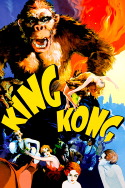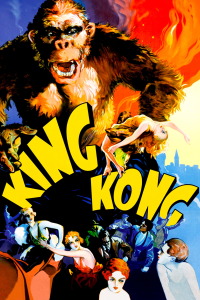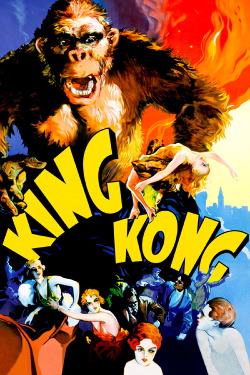
Review of King Kong (1933) by Ricardo O — 06 Jun 2011
Movie Synopsis:
At the start of the picture, we are introduced to an adventurous, flamboyant documentary filmmaker Carl Denham (Robert Armstrong), who goes off sailing to unknown parts around the world to film his latest. Having a hard time trying to find the right girl to play the lead for his picture, he runs into a young, attractive girl Ann Darrow (Fay Wray) who agrees to go along with him and his crew. The two of them set sail on the S.S. Venture to film on a mysterious island in the Indian Ocean.
During the course of the voyage, Ann manages to fall in love with the First Mate Jack Driscoll (Bruce Cabot). They reach ?ull Island?and stumble on what seems to be a ceremony of some sort in which the natives dance circles around a terrified girl, all the while chanting, ?ng! Kong!?The chief (Noble Johnson) and the witch doctor (Steve Clemente) spot Denham and his crew and order them to leave. However, when they see Ann, the chief offers to buy the "golden woman" to serve as the "bride of Kong," as he and his crew have ruined their ceremony. Denham refuses, and all of them hastily retreat back to the ship.
Later that night, a band of natives sneak aboard the ship and kidnap Ann. They strap Ann to a large sacrificial altar just inside the huge gate and summon Kong, a huge gorilla-like creature that lives on the island. Kong discovers Ann and carries her off into the jungle. Denham, Driscoll, and the rest of the crew set out to rescue Ann from the beast.
Along the jungle trail, dinosaurs attack Denham and his crew, including a Stegosaurus, and a Brontosaurus. Many of his crewmembers are killed. Kong himself even battles with a Tyrannosaurus Rex. Driscoll eventually finds and saves Ann from Kong's lair but are then pursued by him through the jungle. Kong destroys the native village while he searches for Ann but is finally subdued by hand-tossed gas bombs. Denham and the rest of his men capture Kong and take him back with them to civilization.
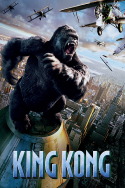
Back in New York City, Denham exhibits Kong on a stage for the entire world to get a view of the "eighth wonder of the world." Kong breaks loose from his chains on the night of his Broadway premiere, thinking that Ann is being hurt by the reporters' flash bulbs. Now free from any restraints, Kong goes off into the city in search of his beloved Ann destroying train rails and looking through buildings to find her. He then takes Ann in his hand and climbs the Empire State Building. At the top of the building, Kong gets into heated battle with a squadron of biplanes trying to shoot him down. He takes one of the planes down but is wounded by others and eventually falls his to his death. Driscoll gets to the top of the building and is reunited with Ann, meanwhile down below Denham makes his way through the large crowd to look upon the fallen creature.
Movie Review:
Co-director Merian C. Cooper had long had a fascination with gorillas ever since his childhood days and also previously made a couple of documentaries (Grass in 1925 & Chang in 1927) with co-director Ernest B. Schoedsack so it's no surprise that he wanted to make a film about a gorilla kidnapping a woman. After having successfully made those previous documentaries of third world societies, Cooper was brought to RKO by legendary producer David O. Selznick as his executive assistant. To liven up the deal, he promised Cooper that he could make his own pictures. Cooper immediately began developing The Most Dangerous Game, a story about a big game hunter, and hired his friend and film partner Schoedsack to direct. A huge jungle stage was built for the production and it starred Robert Armstrong and Fay Wray who would both star in King Kong. Once that film was underway Cooper turned his attention to another fantasy picture called Creation, a story about a group of travelers shipwrecked on an island filled with dinosaurs which would end up being shelved. However, the ingredients were already set in place as special effects wizard Willis O'Brien created all of the stop-motion footage that impressed Cooper so much, he scrapped the whole thing and started developing one of his earlier stories about a gorilla, but now he knew how to make it economically by getting rid of the komodo dragons and using the studio?M)s existing jungle set.
The scriptwriting process began with a rough draft by mystery/adventure writer Edgar Wallace. However, Cooper thought the draft needed a lot of work but Wallace died just after some revisions. Cooper insisted that not even a single line of this early draft made into the final work, but he still gave the writer a screen credit because as producer he had promised him. Cooper then called James A. Creelman (who was still working on the script of The Most Dangerous Game) to work with him on several drafts for the film. Many details from Wallace's draft were cut and they changed the names of the characters to what they would end up being. The "beauty and the beast" bits of the film were first developed and Kong's escape was eventually switched to a Broadway theater. Due to time restraints, Creelman had to temporarily drop out of the production to devote his time to the Game script. Cooper felt that Creelman's script was too slow-paced and full of hammy dialogue so he brought in writer Ruth Rose (Ernest B. Schoedsack's wife) to clean the script up and tighten the action. She rewrote the dialogue and created the opening scenes showing Denham finding Ann in the streets. Cooper approved of her script for production.
Given that both Cooper and Schoedsack had different styles of directing they eventually agreed to work separately. Cooper?M)s style was slower and more precise while Schoedsack?M)s style was quick and active. Cooper worked on directing the miniature and special effects scenes while Schoedsack would work on directing the live-action scenes. Though they did work separately, the work that both of these directors put into the production of the film does not disappoint for one second. There maybe bits of dialogue and acting that are a bit creaky but for the most it all works quite good thanks to the nearly perfect pace that Cooper and Schoedsack developed. The story itself may not be as sophisticated as other stories of the same genre but its still quite good.
Being a predecessor of special effects laden films like Jurassic Park and Alien, modern viewers for the most part may not be as impressed by this film as those that viewed it on its premiere, but those who have an understanding of the imagination and artistry that Cooper, Willis O'Brien and his special effects crew put into it may come to appreciate how brilliant the effects really are. O?M)Brien had previously shown what kind of effects guru he was with the classic silent film The Lost World but it was in King Kong that he achieved the sophistication and beauty that made everything else before look like child?M)s play. Even this last viewing of the film, I was in awe of how well the effects still are. They may not look as physically real as the CGI effects sci-fi/fantasy films use today but for my money, I'd rather invest my money in stop-motion as there is something about the expressions that Kong gives that seem more human than anything today's CGI can conjure up. Because of this, King Kong's special effects still rank high on hot it affects the viewer on a much deeper emotional level.
Despite the special effects not being up to modern standards, King Kong is a film that still works. It is a film that continues to entertain viewers thanks to a very solid script and excellent pacing and direction by directors Merian C. Cooper and Ernest B. Schoedsack. It is still one of the most iconic films ever made as one mention of the title conjures up the many famous shots of famed creature (especially that of Kong on top of the Empire State Building). It is one of the most thrilling pieces of cinema ever created, one that can be compared to other adventure masterworks like Lawrence of Arabia and Raiders of the Lost Ark on a purely engrossing entertainment level. It's an adventure film that rarely ever gets topped. 10/10.
This review of King Kong (1933) was written by Ricardo O on 06 Jun 2011.
King Kong has generally received very positive reviews.
Was this review helpful?