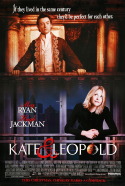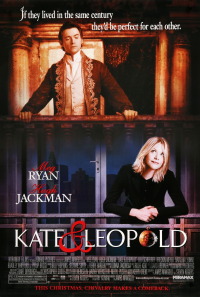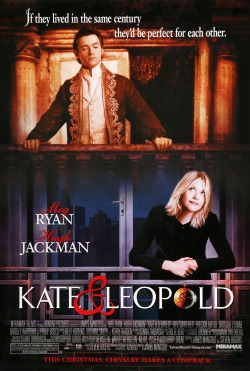
Review of Kate & Leopold (2001) by Edith N — 27 Apr 2010
Defeating Paradox With the Power of Love.
The first thing you have to know is that there are two cuts of this movie. The critics saw the original, and they picked up on something the filmmakers apparently hadn't, though I've no idea how you could miss it. It's a bit of a spoiler, but since this is a romantic comedy, not much of one. I mean, obviously, they're going to end up together, right? So yeah, the thing is, we find out at the very beginning that Leopold (Hugh Jackman) is the ancestor of Stuart (Liev Schreiber). At least in the very beginning of the director's cut. It's the bit that they cut, because every critic to see it followed that train of thought to its station. You have, too, right? It's astonishing that they didn't. So they cut all the stuff which explained it, and that kind of makes other bits of the movie fail to make sense. This is why you need to present your script to a third party, someone who can read it and note that, before you go into production. And listen to them--as Michael Bay did not listen to Ben Affleck.
Leopold is supposed to get married instead of just living off his family. He's an inventor, but they can't take his invention--the elevator--seriously. He is supposed to go downstairs and announce his choice of bride, but he sees Stuart and chases him out into the street and ends up falling with him off the Brooklyn Bridge and into the modern day. Stuart lives upstairs from his workaholic ex-girlfriend, Kate McKay (Meg Ryan). Kate wants nothing to do with Stuart--and the next morning, when he goes out to walk the dog, the elevator isn't in the shaft. Stuart, like so many of us, rather took it for granted that it would be there when the door opened, and he ends up hospitalized. In one of those chains of events that only works if you don't know anything about the modern medical system, he ends up locked in an institution for long enough for Kate and her brother, Charlie (Breckin Meyer), to get to know him. She gets Leopold a job selling margarine, because he's sexy and trustworthy, and of course there is falling in love and the building of paradox and so forth. Leopold has to go back to 1876, or else there will be no elevators--and, in the director's cut, no Stuart.
Which I have to tell you is just one of the anachronisms floating around this movie. Kate steps into an elevator at one point in the movie, and it's labeled "Otis." This is the name of Leopold's manservant (Philip Bosco), and it is because one Elisha Otis had invented an elevator company over twenty years before the time Leopold is taken from. One which I caught is, when Kate's boss, J.J. (Bradley Whitford), is going on about [i]La Boheme[/i], Leopold corrects him. Which is charming and all, except it wasn't written until 1896. Similarly, Gilbert and Sullivan wouldn't have their first hit for two more years, and it was [i]H.M.S. Pinafore[/i], not [i]Pirates of Penzance[/i]. The costumes are, historically speaking, all over the place; Leopold's is from a time a bit too early. At the end, there is a sleeveless dress which would be shocking to 1876 eyes. The Brooklyn Bridge wouldn't be dedicated for years, and John Augustus Roebling (Andrew Jack) is seen giving a speech four years after he died. And so forth. There are some people to whom it seems history is this amorphous blob, and if it happened in the past, who cares where in the past it happened?
The manners Leopold displays are intended to be period-appropriate, though a truly mannered person wouldn't be such a jerk about it. Leopold briefly shows a distaste toward independent women, but he then doesn't even blink when it comes to facing a black woman as a cop; he's much more upset about the dog-doo law. Still, there are certain aspects to his behaviour that are intended to make us a little wistful. Leopold actually listens to what Kate says, and when he's upset her, he apologizes for it. Whereas Kate apologizes for J.J. that Leopold showed him up as being a pretentious liar, despite the fact that she has grounds for a lovely sexual harassment suit against him. He is honourable. He is a gentleman. We see him at the beginning about to marry for money, but somehow, it doesn't happen. How he'll support himself is unimportant. One assumes it's the elevator money, and it does, upon further consideration, seem that Stuart doesn't much have to worry about money, either. He doesn't seem to have a job, and that apartment in Manhattan wouldn't be cheap.
One of the interesting things about time travel films is how they choose to deal with the issue of paradox. This one seems to be going with the idea that, while it is theoretically possible to change the past, history tends to fix itself. Yes, it seems that it is possible for Leopold's existence to be wiped out--but it also seems as though there's no real hurry there. Stuart is nowhere near as worried about the prospect of being wiped out of existence as, say, Michael J. Fox was in [i]Back to the Future[/i]. Of course, he's also not fading away. I suppose it's possible that he'll wink out of existence at some point, but we don't know when that point would be. Either way, though, time seems to depend on the events of the film. (Incidentally, another anachronism comes up at the beginning of the movie when Roebling refers to the concept of spacetime, which wouldn't really be developed as an idea for about another thirty years.) Somehow, Stuart is still gadding about while everyone is obligated to walk up all those dozens of flights of stairs because the elevators have disappeared. Which actually makes less sense the longer you think about it.
This review of Kate & Leopold (2001) was written by Edith N on 27 Apr 2010.
Kate & Leopold has generally received positive reviews.
Was this review helpful?