Review of Kagemusha (1980) by Edith N — 18 Mar 2010
A Bit Lengthy but Worth the Time.
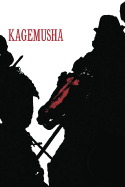
It is a continual source of delight to me when, in the library's catalog, I hit a Kurosawa film. Especially one I've heard of. He's one of three or four directors who have that effect on me. You see, even when the subject matter of the film, as in this case, involves a lot more Japanese history than I'm likely to understand any time soon, I still want to watch it all the way through for the sheer quality of filming. One of the most impressive aspects of Kurosawa is that he was able to do both the sweeping and the intimate with the same skill. This film is full of panoramic shots of soldiers, both infantry and cavalry, moving across the landscape, astonishing sunsets as much a part of the scene as the fluttering battle flags. There are also the tender shots of a man and a child, bonding in ways which will not be seen as quite so pleasant in context.
Shingen Takeda (Tatsuya Nakadai) is one of those rulers who has stand-ins for occasions when he has something better to be doing but must be seen to be somewhere anyway. His half-brother, Nobukado (Tsutomu Yamazaki) has been doing it, but there are too many occasions where the two men must appear together. Nobukado has found a nameless criminal with such an uncanny resemblance to Shingen that they're played by the same actor. Shingen is mortally wounded, and he makes his advisors promise that the nameless criminal will continue to impersonate him for three years, enough to strengthen his clan's position and, presumably, give his young heir, Takemaru (Kumeku Otowa) the chance to grow a little older and be able to keep the throne away from the boy's father and Shingen's son, Katsuyori (Kenichi Hagiwara). Initially, the criminal flees, but when he realizes how important his impersonation is to the clan, he stays--and develops so much into the role that he is able, by himself, to make wise decisions about the clan's military strategies.
I know essentially nothing about how close the events of the film are to the historical reality. The film climaxes in the Battle of Nagashino, in which the real Takeda clan suffered a major defeat--but the clan apparently continued under Katsuyori's rule for years afterward, whereas the film implies that they are utterly destroyed. Apparently, the deception, which lasted about two years, is actually probably real. Or possibly, anyway. Sources seem confused. Maybe Kurosawa preempted the Coens by some fifteen years? Anyway, I'm not even sure if the Franciscan friar (Francis Selleck, entertainingly enough) is an anachronism. I've mentioned before that Japanese history is not exactly my area of study, but it feels worth mentioning again. I don't know anything about any of this, basically, except what Kurosawa has chosen to show me. I don't know about these clans, what territory they control, their history. I do know that Kyoto was still the capital at the time, if that helps.
I'm not sure how much that's important, though. The fact is, this is about the titular shadow warrior, who probably doesn't know all of it, either--how much do most people know about the more intimate aspects of their government? He knows the broad details--like who controls where, I'd assume--but he is stepping into a world he could never have imagined himself in when he was rescued from crucifixion. (Which apparently the Japanese did. Who knew?) He loves his "grandson," though most of the rest of his world confuses him. Still, he is driven by a love of his feudal lord which I think surpasses understanding for a lot of modern audiences, especially American ones. After all, we've spent most of the last four hundred years trying to establish that there are no lords over good Americans (provided you were a white male landowner, at least), and I suspect very few of us love our politicians in the same way, though at least it seems that the thief doesn't have anyone in his own life to be abandoned by the deception.
I have, over the years, become increasingly intrigued by Kurosawa. It isn't just in his filming style that he encompasses the great and the intimate, you see. After all, there is someone commanding that field of men. The kagemusha himself makes decisions at one point which send men out to fight and die, though the final events were after he no longer controlled armies and could only make decisions about himself. This film seems, in many ways, to be about futility as much as anything, but we must see what these people hope to achieve before we see how meaningless it really is. These people think they are riding into glory for their clan, you see. The real Shingen dies declaring that his flags should be flying over Kyoto, that he should be invading that very moment. And maybe, if his army had, his clan would have ruled Japan. At least for a while. But Shingen still would have been dead, as would those men who fought for his goals.
This review of Kagemusha (1980) was written by Edith N on 18 Mar 2010.
Kagemusha has generally received very positive reviews.
Was this review helpful?