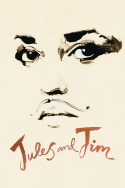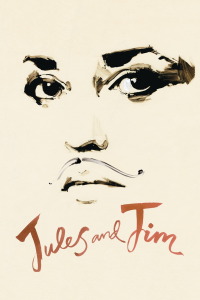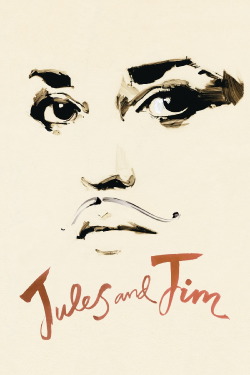
Review of Jules and Jim (1962) by Lintang M — 14 Jan 2008
I'm still reeling from my first viewing. François Truffaut takes on a seemingly impossible subject: the nature of women. Through Catherine, he creates an enigmatic and self-contradictory subject while through her lovers, Jules, Jim, Albert and many others we're not given, Truffaut asks us to understand what's not intended to be understood. The art tropes in the first part of the film, where Catherine is compared to the smiling goddess statue, reinforced by the freeze-frame poses, seem to suggest that we see her through an objective lens first and foremost. It's through this lens that Catherine is filtered and obscured. And when in the film Jim says he understands her, Catherine replies, ?I don?t want to be understood.?
Knowing Catherine is an exercise in futility, and I have to question my own motives for wanting to understand her erotic capaciousness. I ask myself whether I want to understand because knowledge is instrumental to my self-preservation, or perhaps a preservation of my masculine identity (as Jules seems to be harshly emasculated by Catherine's affairs), or whether Catherine is a valid factor at all in who I am. Who am I, in relation to the Catherine archetype?
I think it's the idea of a woman that fails here. Love is never in question. Jules et Jim is a story of identity. It's through Catherine's choices, to live or die, to love or leave, that she's actualizes her being which in the end seems to be the more appropriate perspective, a subjective one.
This review of Jules and Jim (1962) was written by Lintang M on 14 Jan 2008.
Jules and Jim has generally received very positive reviews.
Was this review helpful?