Review of Jojo Rabbit (2019) by Markhreviews — 09 Nov 2019
If you’re going to address Nazism and every imaginable anti-Semitic trope through farce, it’s a really, really good idea not to muck it up. Writer/Director Taika Waititi doesn’t.
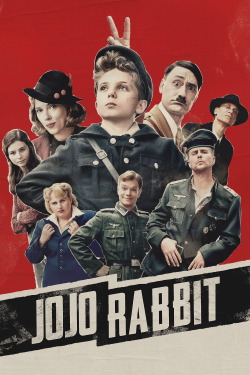
The premise of this film is unique. Ten-year-old JoJo (Roman Griffin Davis in his professional debut) and his mother live in 1940’s Vienna near the end of World War II. JoJo’s best friend is an imaginary, wildly inaccurate Adolf Hitler (played by Waititi). Early on, JoJo eagerly anticipates a weekend of camping, indoctrination and adventure with the other Hitler Youth. But as the film moves along, his blissfully rabid world view begins to come unhinged when he discovers the Jewish girl his mother is hiding in the attic.
This film’s greatest asset is its mastery of shifting tones. Initially, it trades in broad, slapstick humor. JoJo’s adoration of Hitler and all he stands for is offered as a hilarious example of the blind idolatry one can only hope is unique to ten-year-olds. By Act Two, the tone begins to shift and the horrors all around JoJo start to slide into focus. In one scene, JoJo and his mother are walking through the town square when several sets of dangling legs appear in the foreground. When JoJo asks, “What did they do?” his mother replies softly, “What they could.” By Act Three, the brutality of WW II is on full display, with the film taking on a full-blown (pun intended), serious anti-war tone.
Another great reason to see this film is the supporting cast. Nobody does crazy better than Sam Rockwell (“Seven Psychopaths,” “Three Billboards…”). Here, Rockwell is in full manic mode, exhibiting a blustering braggadocio totally unsupported by reality, a skill he has perfected over several films. As JoJo’s mother, Scarlett Johansson is so compelling and such a sympathetic character that love between mother and son eventually becomes one of the dominant themes of the film. Steven Merchant and Rebel Wilson add additional support. As the girl in the attic, New Zealand-born Thomasin McKenzie conveys a world-weary kindness one would expect from a person much older than her nineteen years.
In its juxtaposition of slapstick humor with Nazi horrors, “JoJo Rabbit” treads some of the same ground explored in 2017’s equally excellent “The Death of Stalin.” Both films play for laughs that carry an undertone of dread. But this film clearly has its own points to make about the insanity of blind devotion and about the risks of unthinking tribalism.
“JoJo Rabbit” excels by drawing the viewer in with its initial humor, then using the built-up good will to provoke serious personal thought and reflection. In so doing, it solidifies Taika Waititi’s reputation as a thoughtful provocateur. Overall, this is one of the best films of the year.
This review of Jojo Rabbit (2019) was written by Markhreviews on 09 Nov 2019.
Jojo Rabbit has generally received positive reviews.
Was this review helpful?