Review of Jojo Rabbit (2019) by Bertaut1 — 17 Jan 2020
A hilarious piece of political satire that isn't afraid to be serious.
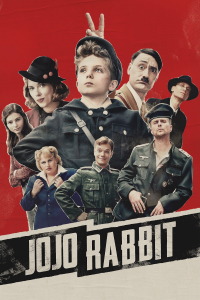
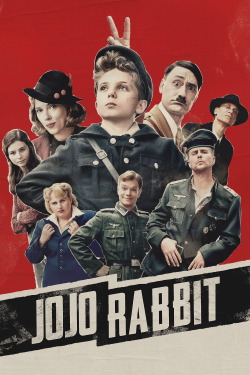
Based loosely on the 2004 novel Caging Skies by Christine Leunens, Jojo Rabbit is a political satire written and directed by Taika Waititi. Positing that the first casualty of indoctrination is objective truth, Waititi follows in the footsteps of filmmakers such as Charlie Chaplin (The Great Dictator), Mel Brooks (The Producers), Roberto Benigni (La vita è bella), and even Quentin Tarantino (Inglorious Basterds), in attempting to defang Nazi ideology by rendering it utterly absurd. Marketed as an "anti-hate satire", the film has no easy task – to use Nazism as the (mostly) humorous background to what is essentially a bildungsroman, without it seeming exploitative or dismissive. And Waititi manages this tricky balancing act exceptionally well. The satire and slapstick elements are as funny as anything in his filmography, and the film's more serious moments (of which there are several) arrive like an absolute gut-punch.
Großdeutsches Reich, 1945. In the fictional town of Falkenhem, ten-year-old Jojo Betzler (an astonishing debut by Roman Griffin Davis) lives with his whimsical mother Rosie (Scarlett Johansson doing probably the best work of her career) and his imaginary best friend - none other than Hitler himself (a ludicrously over the top Waititi), or at least Jojo's conception of Hitler. Believing absolutely in his duty to the state, Jojo attends a Hitlerjugend camp run by the cynical Cpt. Klenzendorf (a powerful performance by Sam Rockwell that was outrageously ignored by the Academy), who was forced to leave the front line upon losing an eye. However, the overzealous Jojo is injured and forced to return home. At which point, he discovers his mother has been hiding a young Jewish girl, Elsa Korr (a nuanced performance from Thomasin McKenzie), in a crawlspace.
The film mixes slapstick humour, caricature, satire, dramatic irony, and hope, but never does it seem like its ignoring or trivialising real suffering - when the comedy is dropped and Waititi gets serious, the tonal shifts pack a shocking punch. Crucially important to the film's tonal qualities are director of photography Mihai Mălaimare, Jr.'s bright, colourful palette and Ra Vincent's whimsical production design. Together, they speak to the fact that this is Jojo's worldview rather than objective reality, with the look of the film reminding me a great deal of The Grand Budapest Hotel (2014). It sure doesn't look like any World War II movie you're ever likely to have seen.
Thematically, the film examines multiple issues; the devotion of motherhood, the importance of kindness in defeating indoctrination, the disconnect between unchallenged ideology and complex reality, the predetermined attitudinal stance towards the Other, the clash between doing what one knows to be right and what one is expected to do. Klenzendorf's arc is especially telling in this respect. Introduced as a hyperbolic caricature, the source of some of the film's biggest early laughs, as things progress, we realise there's considerably more to his character, and he commands what's easily the most moving scene in the whole film. This is Jojo's story, however, with much of the runtime concerned with his attempts to rationalise the cognitive dissonance between what he's been taught and what he can see with his own eyes.
Of course, although set in 1945, Jojo Rabbit is really about today, as it mocks political extremism, particularly people who hate based on ethnicity or religion. Jojo's belief that Jews are demonic figures capable of powerful magic stands in for people who believe all Muslims are terrorists or all Mexicans are rapists. In this sense, the film is partly about the role adults play in inculcating children into hate and partly about exposing the power of propaganda to subvert truth. But so too is it about rising above such ideology, no matter how ingrained it might be. And although all of this is presented humorously, it never becomes didactic or monolithically preachy – Waititi balances his tones too well.
Of course, Waititi does gloss over some of the more horrific atrocities carried out during the War. The Nazis in the film are, by design, cartoonish, although that is done so as to render them as easily dismissed. The reality, of course, was far darker, and it wouldn't have hurt to have at least one Nazi who isn't a figure of fun. In this sense, the film doesn't represent the awful truth, but it never claims to.
Jojo Rabbit is beautiful, emotional, heartfelt, and devastating, but mostly hilarious and always hopeful. It's an extraordinarily sweet film without ever becoming saccharine, as Waititi strikes a perfect balance between comedy, tragedy, and drama. It's a very funny World War II film which imparts a vital message for our confused and divided world of today – if we let them, love will always trump hate, hope will always light a way through the darkness.
This review of Jojo Rabbit (2019) was written by Bertaut1 on 17 Jan 2020.
Jojo Rabbit has generally received positive reviews.
Was this review helpful?