Review of Inherit the Wind (1960) by Brandie M — 28 May 2011
3.5 Stars out of 4.
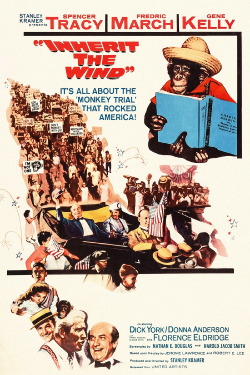
Stanley Kramer's Inherit the Wind is probably a masterpiece for atheists and cheap, portentous evolutionist's propaganda towards Christians. It's a film that talks a lot, using very little visual detail and commenting on the state of society through its characters. Like Billy Wilder, Kramer is fascinated more with characters than style, and that is just as well if Inherit the Wind is to be taken seriously as a humanized foray on creationism, not just an empty tirade.
All the names of the characters are altered but one immediately thinks of The Scopes Monkey Trial in Tennessee in 1925. Then, a high school biology teacher - John Scopes - was charged for violating a state law for teaching evolution in his class. It took place in Dayton, Tennessee where Clarence Darrow acted as Scopes's attorney and William Bryan was the prosecutor. Eventually and - I would argue - inevitably Scopes (spoiler) was found guilty, but soon enough the verdict was overturned. (end spoiler) It was a revolutionary trial, a moment when evolution - the underdog - became an equal to a theory that has gradually become the black sheep of the West.
So 35 years later comes this movie with a title derived from the Book of Proverbs. The context of these words imply that any man who rebels against his home shall "inherit the wind". The term which, I assume, means the inheritance of nothing. For a title with pious connotation, the film itself backhands that reference by creating a narrative that is totally in favour of atheism and evolution.
Kramer, know for his "message movies", was a Hollywood director on a mission. Known beforehand for The Defiant Ones and On The Beach and later for Judgment At Nuremberg and Guess Who's Coming To Dinner?, Kramer has been accepted (and targeted) for his boilerplate messages and siding with the politically correct side of societal issues. Here Kramer takes a step back in those predictable positions and sides with the "dark side" or as Matthew Brady calls it: "science, the way of darkness.".
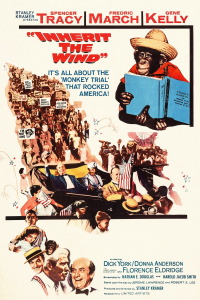
But let's introduce the characters. The John Scopes is renamed Bertram T. Cates (Dick York), Darrow as Henry Drummond (Spencer Tracy), and Bryan as the demigod Matthew Harrison Brady (Fredric March). Tracy and March had just starred together as Dr. Jekyll and Mr. Hyde so their casting here is uncanny and rather perfect. Gene Kelly even stars as E.K. Hornbeck, a journalist of The Baltimore Herald ready to abase the fundamentalists. We first see Hornbeck chewing an apple, indulging on the forbidden fruit and proud of his original sin. Very clever.
And Inherit the Wind is very funny. Surprisingly harsh too. The Scopes Monkey Trial was originally declared "a whole matter [that] is something to laugh about." Life Magazine in particular mocked the Tennessee fundamentalists calling them "not up to date in their attitude to such things as evolution." Kramer here relentlessly scoffs at the fundamentalists, making them slithering, frothing, and bigoted reptiles of their own tree of misbegotten knowledge. One of them even calls evolution "evo-luted" and Brady is tricked by Drummond into comparing a human's freedom to a sponge. Christians are caught with their pants down in Inherit the Wind.
It's an easy attack for a courtroom drama. If one - like myself - is indifferent to the evolutionist-creationist controversy they will immediately find themselves siding with the evolutionists because the film is clearly a work of protest. But when you think about it, the fundamentalists were doomed in this trial because they took superstition to the courts and law does not support the metaphysical - I guess that's circumstantial evidence. It is an idea facing off against another idea, and it thinking it was the absolute voice of reason was its downfall in the case. Despite the verdict, it was clear the Scopes Trial made a statement against religious fanaticism.
The theme song is "Old Time Religion", a homily supporting the infallible Brady, a public figure admired for his belief in God and creationism. The town's people sing it like an army chant, going off to war with pride and jingoism. They are so blinded by their vanity that they see no reason to accept evolution mainly because it is not Christian. When we look at USA now, this has to be considered. Politicians, particularly Republicans, make the base of their campaign religion. America is a Christian nation and that is just as important as believing in civil rights. Inherit the Wind is a less controversial view when seeing it today because I tend to agree with what it says. But back in 1960, this was unprecedented and it is here Kramer, unwittingly, shows the non-linear progression of history.
And though Inherit the Wind is loosely based on a 1925 trial, it is not tackling bygone ideas. Kramer designs a parable, brazenly denouncing McCarthyism and the Establishment, that is the Church, government, big business, and military. Kramer seems obsessed with his material, eager to question all that rules him. And this pugnacity of Kramer's gives Inherit the Wind the right urgency, and a pace ahead of its time. It's on the floor and ready for battle.
Most importantly this is a film about ideas. As Drummond submits: "An idea is a greater monument than a cathedral." Should we argue that? Most likely no, considering what Inherit the Wind is best at bringing new arguments to the table, making us laugh, and then silencing and forcing its audience to reflect on the nature of 20th century society. And then ours today.
If the film leaves me cold anywhere it is that it never makes a character out of Bertrand Cates. It feels afraid to do so in fear it would form unnecessary biases and unimportant questions about Cates, the target of fanaticism and the quiet voice against it.
Drummond renders evolution a powerful voice, bringing a sturdy case to the courts saying Cates is going to jail to gratify a self-appointed prophet. In a great scene, Drummond calls a witness to the stand. The witness is in fact Brady. Here Drummond breaks Brady down, using the Bible to unravel its own flaws. It's a rare moment in Inherit the Wind where we sympathize with Brady because he loses the merit of his life-abiding idea - the greatest tragedy to any man. We can understand that.
Kramer even slides in a taste of melodrama providing Cates with a love affair with Rachel Brown (Donna Anderson), the daughter of a preacher. It's an interesting chance for Kramer to form moral ambiguities with Rachel's dilemma in siding with family and religion or self-perpetuating passion and secularism. Unfortunately, it just feels tacked on and has little essence to the story. It is Drummond and Brady who are the key characters of Inherit the Wind, and they make for a genius feud that is tragic, funny, unique, and intense.
Inherit the Wind has an angriness to it, suppressed by its cheeky humour. The blend works well. Kramer is fascinated and adamant with adding another view to the world, while also imbuing a little slashing satire. The courtroom in Inherit the Wind is mighty warm (a little Hellish for you?) with everyone cooling themselves with funeral parlour fans. It's the running joke throughout all the courtroom scenes.
A masterpiece? No. The film does not achieve enough cinematic aesthete to bring it to new levels. Also, some of Kramer's plot embellishments act as - well - only that. But there is one scene where his visual plays a significant part. When Drummond delivers his final speech Kramer holds it on one shot, emphasizing confidence and persistent, transcendental eloquence.
When you least expect it Inherit the Wind surprises us with a sad ending, a type of conclusion that moves us in ways we would not quite imagine. Following, Drummond stands in the empty courtroom, picks up a Bible with his right hand and Darwin's Origins of the Species in the other. He walks out, clutching two views that - quite literally - now are hand-in-hand.
This review of Inherit the Wind (1960) was written by Brandie M on 28 May 2011.
Inherit the Wind has generally received very positive reviews.
Was this review helpful?