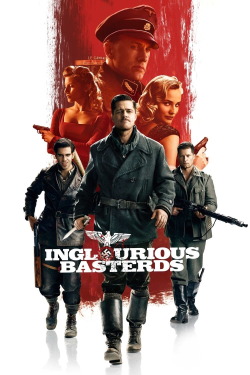
Review of Inglourious Basterds (2009) by Blake P — 09 Jul 2015
Quentin Tarantino is the Jerry Seinfeld of directors. Not that he's a neurotic Jewish man that carries around the weight of materialistic complaints - it's that his projects continually seem as though they're heading in one direction (let's use comedy as an example, shall we?), but end up being about nothing. Nothing as in genre, as in writing, as in plot, tend to end up being all about Tarantino and his obsessions, and not much else. If Tarantino wasn't a brilliant madman, I don't know where his films would go; can you imagine if he was a boring guy that forced us to sit through his innermost fixations?
Thankfully, he's never made a film resembling something hackneyed or trite; even his worst, "Death Proof" (which in turn was part of his double-feature project with Robert Rodriguez, "Grindhouse"), is so gleefully entertaining that calling it bad never seems to be an option. Saying it wasn't as good as "Kill Bill" or "Pulp Fiction" would be much more accurate. Truth is, it's impossible for Tarantino to make a bad film - his weakest moments still make our cinematic senses come completely undone.
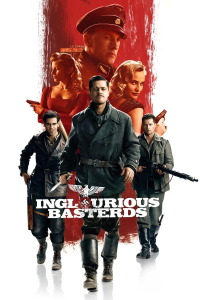
"Inglourious Basterds" is his seventh film. It is also, dare I say, his most mature. His violence is as depraved as ever, and his love of the exploitation feature is at its loudest; yet "Inglourious Basterds" seems to be more fond of tension than pulse-pounding thrills and exchanges, dressed to the nines in conversations that always seem to end in carnage and loaded with sadistic characters whose demons are disguised by archetypes that suit them (the hero, the villain, the femme fatale). It is his most sprawling film, at nearly three hours, and it is his most highly budgeted - but here, he no longer seems like the some punky indie kid who happens to have a great ear for dialogue and a delectable eye for photography. His boyish adorations are still on display, but this time around, he's more subtle with them.
It's 1944, in Nazi occupied France. World War II is raging. Hitler (Martin Wuttke) is at his most powerful, not realizing that death is waiting just around the corner. But Tarantino wants you to do him a favor - forget that you ever took AP History, that you had ideas of how the war ended. Dive into his pulp fantasy. Who needs to look at Hitler as anything but a perpetually screaming, red-faced, maniacally cackling dictator when you have Colonel Hans Landa (Christoph Waltz), aka "The Jew Hunter", tracking down Hitler's so-called vermin with smooth-talking sadism? Who needs patriotism when America is represented by Lieutenant Aldo Raine (Brad Pitt) and his Inglourious Basterds, who avenge the deaths of their men by beating and scalping enemy German soldiers? Who needs a hero when you have Shosanna Dreyfus (Mélanie Laurent), a femme planning to utilize her theater during a Nazi film premiere as retribution for the death of her family?
One could get offended by how willingly Tarantino rewrites history for the sake of lurid fun, but why consider obeying political correctness at a Tarantino film? Leave your prudishness at the door - I promise you'll have a better time that way. This is, after all, one of the most innovative war films ever made, if you can even call it a war film. It mocks the stupidity of the Nazis with scathing satirical pronunciation, slowly but surely assembling itself into a revenge movie more calculated than either one of the "Kill Bills". It's slower, more methodical in its actions - but Tarantino can hardly make something burn sluggishly. "Inglourious Basterds" is written and directed with a great deal of style and energy, but it is clearly realized by a filmmaker who knows his strengths and wants to show them off just as much as he wants to branch out. He often lets silence speak louder than words, and when his words speak, they seem to be laced with an assortment of explosives sure to go off. Here, everything is at stake. You can forget about the fun and games of "Pulp Fiction" - these characters have bigger things to worry about than pissing off the mob.
The performances are just as powerhouse as Tarantino's brazen inhibitions - the actors not only fit into his vision like a silky black glove; they also make use of their heightened charismas like standout character actors on the loose. Pitt is a laugh-a-minute as the Southern accented Aldo Raine; you can just as easily lose yourself as he delivers monologues to his dopey Basterds as you can when he's attempting to disguise himself as an Italian as Shosanna's movie premiere (plot twist: he fails miserably). Laurent is a succulent cocktail of bitter, droll, and ruthless, a new muse for the Uma Thurman admiring director; Diane Kruger, as double-agent/German actress Bridget Von Hammersmark, gives the film some of its best lines as the celebrity who is simply too good for this shit. But the film belongs to Waltz, who is so unnerving in his smarmy calmness that the second he loses his temper we can only pull back in terror.
"Inglourious Basterds" is an untouchable film of sorts; even if you find its violence too aesthetically gratuitous, its humor too masochistic, you can't deny just how special of a filmmaker Tarantino is. I hate to use the word "special" - isn't that label used for bratty tots barely getting by anyway? - but a cinematic world without Tarantino seems like an empty one. So it's good to have a Venus Fly Trap in a grouping of poppies. There, you'll find a unique talent quick to name a cameoing Mike Myers after a giallo queen.
This review of Inglourious Basterds (2009) was written by Blake P on 09 Jul 2015.
Inglourious Basterds has generally received very positive reviews.
Was this review helpful?