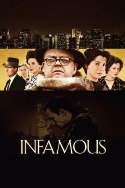
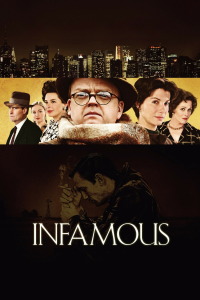
Review of Infamous (2006) by James J — 10 Sep 2009
Look, I'm Well-Known!
The "real" Truman Capote (here Toby Jones), if there was such a thing, was an inveterate name-dropper. That is one of the things the film does very well. I will note that none of the people whose names are worth dropping in small-town America are characters in the film--while we get Juliet Stevenson as Diana Vreeland, we do not get Humphrey Bogart, no matter how much Truman talks about him. And Truman talks about him a lot. Over and over. Clearly, he does so because he knows that knowing Bogart and Sinatra and Brando will give him a wedge to get into these people's lives. None of them care about Diana Vreeland or Slim Keith (Hope Davis)--come to that, neither do I. On the other hand, I do think that he would have been more likely to drop their names around me in the assumption that I, an educated person, would care. What I don't think he'd be able to understand is that I think less of him for all the name-dropping, not more.
Capote has read an article about murders in a middle-of-nowhere Kansas town, and he thinks that this is a great thing for him to write about. Because he is so into himself, he rapidly comes to the conclusion that he, and he alone, can turn this into a new and exciting form of "reportage." He hauls his childhood friend, Harper Lee (Sandra Bullock, of all people), down to Kansas with him, possibly the best idea he has in the whole story. She is down-to-earth and not at all as bizarre and flamboyant as he, which means people like her and put up with him until he grows on them as well. At any rate, when the killers are actually caught, he decides that he must get to know them so he can write his book properly. Here, I think the movie delves into some unwarranted speculation, indicating that Capote and murderer Perry Smith (Daniel Craig; really) had a relationship more both physical and romantic than I believe the evidence warrants believing happened. Of course, how much of it is the man and how much of it is the character may be considered up for debate as well.
This movie suffered inevitable comparison with the previous year's outstanding [i]Capote[/i], and I think it suffers for the comparison. On the other hand, I just don't think it's very good. I think the conceit of having Capote's New York friends comment on his trip to Kansas and experiences therein is a little cutesy. Honestly, I'm not entirely sure I think that the Capote presented here is all that realistic. Or, come to that, the people of Holcomb. The events may be factually correct; I neither know nor care. In fact, I've little doubt that they are. I believe that Capote and Harper Lee got invited to a local family home for Christmas, and I believe that Capote wormed his way into local society with tales of Ava Gardner and Marilyn Monroe. However, it is my understanding that the people of Holcomb still didn't like him terribly and believed--in my opinion accurately--that he was just using them for his own purposes.
I also didn't need some of the relationship scenes between Capote and Smith. The interactions between the two were complicated, of course, inasmuch as Perry Smith really didn't have certain human aspects and therefore would not have been an easy person to know. And Capote was Capote and therefore almost certainly a pain in the butt. (Especially if you're Gore Vidal.) However, there was at least one scene I really don't think is at all plausible. I know that prison authorities really did let Truman Capote get closer to the killers than he honestly had any right to do, whether they wanted him to or not. But I think the fascination Capote had for Smith was more psychological than sexual, and I think Smith was really more interested in dominating this famous man, this man who had any number of things that he didn't and never would have if he'd lived to be a hundred. To dominate a man who beat Humphrey Bogart at arm-wrestling? Twice? Now, there's a coup not many prisoners can say they had.
The final hypothesis of the movie is that the death of Smith, there in front of Capote's eyes, is what ended Capote's interest in writing. This may well be true, and that's something interesting and worth considering. However, I just don't think this movie really develops the idea as well as it ought. I think the film, like Capote itself, is too interested in being seen as clever, whether it really is or not. It name-drops, too, though it name-drops in a way that I think we're supposed to assume makes us smarter than the hicks in Kansas. I also think it, like Capote himself, kind of looks down on those people. Someone said she'd never read Capote's book, but honestly, who has? I challenge you to even name anything but [i]In Cold Blood[/i] that the man has written. If you are very aware of things, you probably know that he wrote "Breakfast at Tiffany's," but other than that, what can you name? The final irony, of course, is that it's based on a book by George Plimpton, who I think was himself name-dropping by mentioning that he knew Truman Capote enough to document the man through interviews with people who knew him. And who cares about George Plimpton, either?
This review of Infamous (2006) was written by James J on 10 Sep 2009.
Infamous has generally received positive reviews.
Was this review helpful?