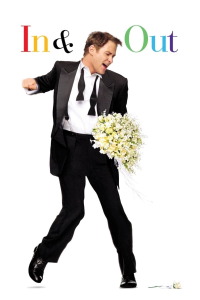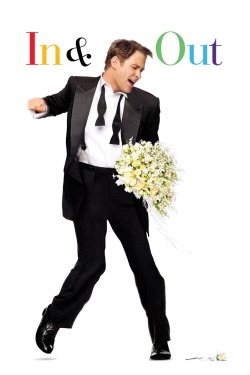
Review of In & Out (1997) by Honey Grace P — 20 Sep 2009
Since When Does Biking Mean You're Gay?
Before we get started, I have to admit to something. I am not doing a review of the full movie. I am doing a review of the first, oh, half-hour or forty-five minutes. I absolutely could not make myself watch beyond that, because I wanted to escort Kevin Kline and Joan Cusack into a better movie, one that wasn't so hopelessly offensive. I know it doesn't think it is. It thinks it's charming and enlightening. It thinks that it's teaching us all a valuable lesson about our stereotypes and so forth. However, it then pretty much promptly goes on to confirm every last one of them. I was horrified about a minute or two in and just couldn't take it any more about halfway through. I just couldn't do it. And, no, I normally don't write reviews if I haven't finished movies. I think it's inappropriate. However, I really need to get all of this off my chest, because I would like to hope we can all get beyond some of this, but we won't if our attitudes aren't confronted.
Cameron Drake (Matt Damon) is a small-town boy who has made it about as big in Hollywood as you can. He has just won an Oscar. He gives one of those dreadful, ham-handed speeches that just makes you think that, sometimes, there's a reason these people spend so much of their time speaking someone else's words. It's painful. And, toward the end of his speech celebrating the stupid gay soldier movie he's won for, he outs his high school English teacher, Howard Brackett (Kline). Who is going to be marrying a woman three days after the ceremony. Now, the whole town believes that someone who does not seem to have spoken to him since graduating and moving away knows better than his parents (Debbie Reynolds and Wilford Brimley), his friends, and his fiancée--Emily Montgomery, played by poor Joan Cusack. This is also apparently such a huge story that all the television networks run to cover it, because such a thing is shocking and has never happened before.
Eesh. Where to begin? I'm going to get to the obvious in a minute, but consider this. Joan Cusack is supposed to have been one of Matt Dillon's teachers in high school. She is clearly intended to be a frumpy old maid. In 1997, Matt Dillon was thirty-three years old, and it's reasonable to assume that the character he's playing here is about that. In order for this to work, Joan Cusack's character has to be at least in her forties and probably late forties at that, possibly matching Kline's fifty. Only at the time, Joan Cusack was thirty-five. Now, I've kind of resigned myself to the fact that a man can have a female love interest in a movie who's fifteen years younger than himself but that it's a joke if it happens the other way 'round. But come on, here, people. Joan Cusack is a talented comedienne, and she's not an unattractive woman, and while, sure, she's mostly known for being John Cusack's sister, who cares? Don't make her old!
But the elephant in the room, here, is the gay thing. The first problem is that, again, everyone who knows Kline's character assumes that Matt Dillon must know something they don't. No one seems to consider that he was wrong or lying or whatever. Was he a favourite student? Possibly. But there's no indication that there's still any contact now, because the very mention of Kline in his acceptance speech started as a pleasant surprise. I know there are some people who are awfully closeted, but that makes it less likely for Matt Dillon to have actually known what he was talking about. But Kevin Kline was articulate, well-read, clean, interested in show tunes, and rides a bike. Rides a bike! I mean, we trot out every gay stereotype we can think of, pretty much, for Kevin Kline to fit into, and unless I missed a memo somewhere, I think they're almost making new ones up. The film is just so casually accepting of the fact that all gay people are like this and it's not okay that I just had to give up. I couldn't take it any more.
Sadly, I do not doubt that Kline's character would be in danger of losing his job. I do believe that there are teachers and students who would ignore years of pleasant interaction because of something that they didn't know during that time but which is of vital import now. It's not as though Matt Dillon had announced that Kline had molested him. So there's that, and that's bad enough. But the fact is, the movie doesn't even seem to want us to be unsure. There's an expression called the "transparent closet"--the closet everyone can see into but you think you're hiding in. (Carson from [i]Queer Eye[/i] apparently came out to his parents just before the show aired, leading everyone to say, "But they had met him, hadn't they?") The filmmakers here have put Kevin Kline into one, and we're all supposed to laugh about it. We are not joining someone on a voyage of discovery about himself. We are pointing and laughing at the sissy, and I thought we'd gotten over that by now.
This review of In & Out (1997) was written by Honey Grace P on 20 Sep 2009.
In & Out has generally received mixed reviews.
Was this review helpful?