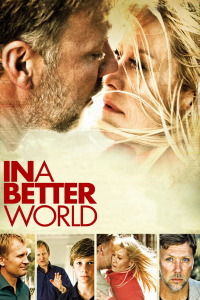
Review of In a Better World (2010) by Edith N — 26 Apr 2012
Sometimes, You Even Blind Yourself.
Below a certain age, grief and sociopathy look an awful lot alike. Of course, to a certain extent, just being below a certain age has things in common with sociopathy. In a way, that's what sociopathy is--never growing up and learning empathy. As you are starting to grow out of that stage, a major blow can cause you to regress, especially if no one pays attention to your suffering. So I spent large amounts of that movie convinced that one of the kids was a burgeoning sociopath, because that is something which develops that young, but it may not be the case. Of course, we only see him in extreme circumstances, and there's not much you can tell about people then. At least, not exclusively. You need both, and since the movie begins with a death, there is no tranquility on which to reflect. It is when we compare the two that we get a picture of the child.
The child is Christian (William Jøhnk Juel Nielsen); his mother has just died of cancer after his father, Claus (Ulrich Thomsen), assured him he'd be all right. They move from London back in with Claus's mother (Dynah Bereket, I think), where Christian begins school. As he walks in on his first day, he sees Sofus (Simon Maagaard Holm) and his gang picking on Elias (Markus Rygaard). Elias is the son of Anton (Mikael Persbrandt), who commutes regularly to Sudan, where he works as a doctor in a refugee camp, and Marianne (Trine Dyrholm), herself a doctor but in a local hospital. Anton and Marianne are separated. Christian and Elias pair up against Sofus, even holding a knife to his throat to make him stop picking on them. Anton is horrified, especially because he spends all day working with the victims of warlords. When he gets picked on by a random guy (Kim Bodnia), Anton goes out of his way to show that he can stand up to it and doesn't need to fight back. The lesson doesn't take, not least because the guy, Lars, isn't even a little sorry about what happens and seems to treat everyone that way.
The scenes in Africa rather seem to happen in another movie, but they are incredibly powerful. It is clear where Anton gets his determined pacifism, but there is a scene where even he has had enough, though what he does is relatively nonviolent. What is done afterward . . . is not. Both fathers try to convince their sons that violence isn't the solution, and the sons cannot quite seem to believe it. And it certainly is true that Sofus will not be bothering them again. It's also true that Anton needs to use something a bit more firm than the mild words he says to Morten (Toke Lars Bjarke), his younger son, to get him to stop misbehaving. Revenge, it's plain, is not the answer, because there is always revenge. But what is the difference between revenge and justice? How can justice be found in a place that seems beyond law, be it Sudan or the schoolyard?
In fact, the original name of the film translates to [i]The Revenge[/i], or something along those lines. I have always found it interesting to consider why names get changed in translation. As it happens, there are several acts of vengeance in the movie, but the question of what world is better gets left rather unanswered. Christian is angry with his father because Claus promised him that his mother would be all right--probably after his mother was known to be terminal. Doubtless the boy was repeatedly assured that his mother was in a better world. It is also true that Denmark seems a much better world than Sudan. On the other hand, Lars says horrible things about Anton because Anton is Swedish. To the Sudanese, the differences between Sweden and Denmark don't much matter, and of course it's arguable that they do not compared to what the Sudanese in that camp are going through. But even in so-called better worlds, there are still things wrong.
The question the movie leaves us with is what it would take to stop its monsters. Sofus is still a boy, and it's possible that less work would be required to turn him around. It's also possible that he isn't a monster, just a hurt and angry boy lashing out at weaker boys, and it's possible that he will grow out of it. (Which should not be taken as an assertion that he shouldn't have been punished for it either way.) But what, when you get right down to it, is the difference between Lars and Big Man (Odiege Matthew) other than scale? Lars only has the ability to terrorize a neighbourhood; would he terrorize an entire countryside if he could? Would Big Man, instead of cutting pregnant women, merely pick fights with harmless passersby? Where does it stop? And, perhaps as important, where did it start?
This review of In a Better World (2010) was written by Edith N on 26 Apr 2012.
In a Better World has generally received very positive reviews.
Was this review helpful?