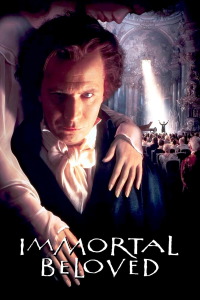
Review of Immortal Beloved (1994) by Thomas P — 17 Jul 2011
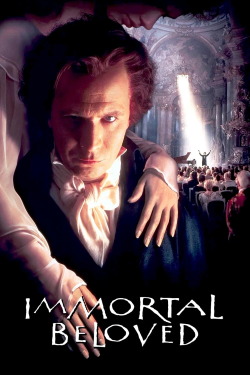
"Immortal Beloved" is a beautiful film that combines the power of the great Ludwig Van Beethovenâ(TM)s music and stunning imagery. One scene in particular stayed with me throughout the film. A boy runs through the forest at night to a perfectly still lake, and floats on his back. The camera pulls back, and we see the stars of the sky reflected in the water. And then it seems as if the boy is floating in the firmament - lost in the stars. On the soundtrack, we hear the "Ode to Joy" from Beethoven's Ninth Symphony. I believe in this scene we see the dreams of a young Beethoven never to be and the everlasting sorrow he would feel.
What the writer and director Bernard Rose has accomplished in "Immortal Beloved" is a journey into the mind of Beethoven with a series of images as vivid and convincing as a dream.
The film unfolds like a biographical puzzle. Beethoven after his death left a letter addressed to his "immortal beloved," with no hint as to the identity of that person. Rose has created a fantasy about Beethoven that evokes the same disturbing, overjoyed passion we hear in his music.
The film opens with Schindler (Jeroen Krabbe), Beethoven's confidante, beginning a search for the immortal beloved. As he visits the important women in Beethoven's life in hopes of discovering the secret love, we see flashbacks to the composer's disorderly and unstable existence, his magnificent music helping to tell the tale. The momentum of the story takes over, and we identify with a tortured genius whose deafness cut him off from the immortal sounds he was giving to mankind.
Gary Oldman plays Beethoven in the film. Beethoven is depicted as a man on the edge of madness, obsessed with women, even more obsessed with Karl (Marco Hofschneider), the young nephew he hopes to turn into a prodigy. He wages a lifelong campaign of hate against Karl's mother, Johanna (Johanna Ter Steege), telling his brother Caspar (Christopher Fulford) she is a foul slut. The movie proposes an interesting explanation of Beethoven's hatred of her and love for her son.
If Johanna is, by default, one of the three most important women in Beethoven's life, the other two are Countess Giulietta Guicciardi (Valeria Golino), who becomes his student and patron, and the older, wiser Countess Anna Maria Erdody (Isabella Rossellini), who stands up to Beethoven after he has gone into court to wrest young Karl away from Johanna, his mother.
In the scenes with Giulietta we see Beethoven's status as the most sought-after lion of the European musical scene; in his day, a great composer was the equivalent of today's rock stars, swooned over and showered with attention. He becomes the countess' piano teacher, but does not always play the game according to her world's rules: "A mistake is nothing," he tells her, "but the fact that you thump out the notes without the least sensitivity to their meaning is unforgivable, and your lack of passion is unforgivable. I shall have to beat you." She thinks he is teasing until he slaps her so hard that tears well in her eyes.
The scenes with the Rossellini character are among the best in the film, because here he finds a haven from his debts, from his troubles with the law, from his wars with his relatives, from his fawning admirers and mocking rivals. She sees most clearly his curious obsession with young Karl, which takes an odd turn: Beethoven stops composing entirely for five years in order to supervise Karl's education as a music virtuoso, despite the boy's tearful pleas to be allowed to become a soldier.
Beethoven's deafness is a subject through much of the film, including a precarious scene where the Rossellini character leads him from the stage after he grows confused during a public performance, and another in which he touches the wood of a pianoforte to hear the music through his fingers. He tried desperately to conceal his deafness, fearing it would destroy his livelihood, and on the soundtrack Rose sometimes reproduces what Beethoven may have heard: curious low rumbles, like the echoing of whales. Particularly of interest is how the general public simply assumed his deafness was part of his neurotic behavior, that he was just mad or had some mental defect.
"Immortal Beloved" has been made by people who feel Beethoven directly in their hearts, and are not approaching him through a classroom or historical setting. Beethoven writes to Schindler at one point, arguing: "It is the power of music to carry one directly into the mental state of the composer. The listener has no choice. It is like hypnotism." The viewer of "Immortal Beloved" likewise has no choice, and for the same reason.
This review of Immortal Beloved (1994) was written by Thomas P on 17 Jul 2011.
Immortal Beloved has generally received very positive reviews.
Was this review helpful?