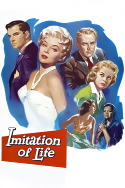
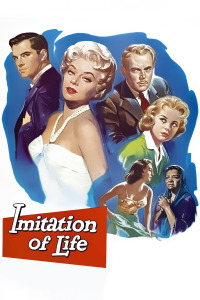
Review of Imitation of Life (1959) by Jesse L — 01 Aug 2004
(DVD) (First Viewing, 4th Sirk film).
Once again, Douglas Sirk piles on the melodrama and hysterics to explore a serious social issue. Remaking John Stahl's 1934 film starring Claudette Colbert and Louise Beavers, he takes on racism and familial relationships by telling duel stories of two mothers and the problems they facce with their two respective daughters.
Lana Turner, the ultimate example of a glamorous Hollywood star with marginal talent, is the ambitious actress whose career destroys her relationship with her daughter (Sandra Dee); Jaunita Moore is Turner's servant/ friend who struggles with her headstrong daughter (Susan Kohner), who has light enough skin to pass for a white girl. The quality of the performances and material varies, but Moore has a quiet dignity that fleshes out her character more than it deserves (very similar to Hattie McDaniel's iconic performance in [b]Gone with the Wind[/b]), and the sexy, rebellious Kohner clashes epically with her mother, and gives a startlingly vivid performance. This was a star-making role for Kohner (who retired after several more films), and both women received Academy Award nominations for their work.
I was really interested in this film to see how the issue of racism would be handled in a major Hollywood film on the eve of the Civil Rights Movement. I came out with very conflicted feelings. The races angle [i]is[/i] heartbreaking, but I kept wondering if it was the actresses who were giving the storyline its bite, and not the content itself. At first glance, Turner's character appears to be surprisingly progressive in her close friendship with a black woman and her daughter, but there's always undertones (that often surface in the confrontations with Kohner's character) that seem to indicate Turner's perspective that everything would be okay if the black characters accept their lot in life, and sticks to that. The film tries its damnedest to condemn Kohner's behavior, but I couldn't help but feel that her attempt to free herself from social stigma was legitimate, if devastating to watch. That said, the end, where Moore is finally given her dues, nearly made me cry. And perhaps that's why I ended up slightly resenting [b]Imitation of Life[/b]- my emotions were mercilessly being played despite my intellect's best effort to not let them be.
But I don't want to give the wrong impression- I did think [b]Imitation of Life[/b] was a good film, and I think I prefer it to both [b]Written on the Wind[/b] and [b]All That Heaven Allows[/b] (though [b]Tarnished Angels[/b] is far and away my favorite Sirk film at this point). It plays you like an organ, but that was its intent, and ultimately, it's hard to resist.
This review of Imitation of Life (1959) was written by Jesse L on 01 Aug 2004.
Imitation of Life has generally received very positive reviews.
Was this review helpful?