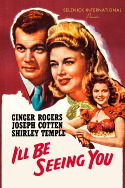
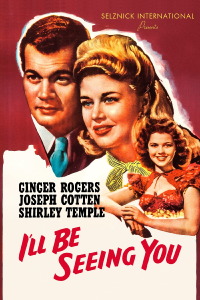
Review of I'll Be Seeing You (1944) by Kevin R — 04 Dec 2011
Bold Stuff for 1944.
I spent the whole movie waiting for Ginger Rogers to break down and acknowledge that Shirley Temple was really her daughter. I was looking forward to it, too; I wanted to know how they would have gotten it past the Code. The timing isn't even tight; Ginger Rogers turned seventeen the year Shirley Temple was born, which is how old Shirley Temple's character was in the movie, and they are obviously afraid she'll go to the bad, as it used to be called. But the woman playing Shirley Temple's mother, Spring Byington, was in her forties when Shirley Temple was born, stretching believability just a hint. I suspected it was one of those deals where the older relative adopted the younger one's illegitimate daughter so the birth mother didn't have to experience the shame but the baby was kept in the family anyway. Honestly, this was somewhat more interesting than the actual plot, which also kind of surprised me with what they were willing to say.
Mary Marshall (Rogers) is on a train to visit her aunt (Byington) and uncle (Tom Tully). As she is, in fact, Ginger Rogers, the various servicemen on the train are all hitting on her. But she actually talks to Zachary Morgan (Joseph Cotten), and it turns out they're getting off in the same small town. Only this is not a coincidence; Zack doesn't seem to be going anywhere in particular, and he follows Mary. He was wounded, and he's suffering from a mild case of battle fatigue. He can recuperate from that as easily there as anywhere, and he likes Mary. Who, it turns out, is on a Christmas furlough from prison, where she is serving a six-year sentence for manslaughter (more on which anon). Zack is able to tell Mary his secret, but she has a harder time revealing hers, even though she's falling in love with him and has to go back to prison after the holiday.
Here's the thing. As Mary describes it, we're not talking manslaughter. We're talking pure self defense. Someone was attempting to rape her, she fought back, and the guy fell out a window. She didn't want him to. She just wanted him to stop attacking her. And she had no reasonable expectation that pushing him away from her would involve a fall out a fourteenth-story window. (Which, given architectural superstition, was probably the thirteenth.) Your standard caveats apply, of course, but her lawyer can't have been any good for her to have actually been convicted, much less gone to prison. At best, she ought to have gotten probation. It's quite obvious that the whole thing was a setup, and I can't believe they found a jury willing to convict such a sympathetic defendant of the obviously accidental killing of such a total sleaze. No wonder she's given a Christmas furlough and isn't thought of as a "real" criminal!
It's still true that her secret is bigger than his, though his was a much bigger secret in 1944 than it would be today. This is a time when Patton was able to slap [i]two[/i] battle fatigue victims before it became a major issue. (The famous one even turns out to have had malaria at the time, not that anyone knew it.) Even today, the US military doesn't have enough mental health personnel to care for all of its PTSD patients. Though my understanding is that it's becoming easier and easier to actually get treatment and not be seen as a malingerer. And certainly Mary and the Marshalls are thrilled enough to do something for an actual soldier that they don't care if he's a soldier who is on leave for battle fatigue. Heck, if he is, he got that way doing his duty for Mom and apple pie, helping to fight the Nazis and all that. It's like the bayonet wound he is also established to have. It's actually a very modern attitude toward his condition.
Possibly the strangest thing about this is that it's a Christmas movie. The whole thing takes place in the week and a half from just before Christmas to just after New Year's. It was released in January, but releasing Christmas movies around Christmas seems a bit more modern of a development; [i]It's a Wonderful Life[/i] was released about two years later, followed by [i]Miracle on 34th Street[/i] that May. In fact, I'm starting to wonder if any Christmas classic was in wide release the Christmas it came out--[i]The Bishop's Wife[/i] was the February after [i]Miracle[/i]. (Though they all had Christmas releases in New York.) It's an odd tradition, but there we all are. I don't exactly expect this to join the others in the '40s Christmas movie pantheon, but it's probably a lot easier to get from Netflix at that time of the year.
This review of I'll Be Seeing You (1944) was written by Kevin R on 04 Dec 2011.
I'll Be Seeing You has generally received positive reviews.
Was this review helpful?