Review of Ikiru (1952) by Steff A — 31 Jan 2010
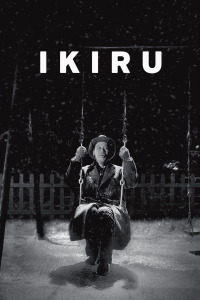
The best drama in cinema history? Quite possibly. For me "Ikiru" will always be a sentimental, inspiring and heartwarming story. It is a film that will make you think about many things in life and contemplate on the possibilities that lie ahead of you. I must say that it really puts "The Dead Poets Society" to shame. The effect of this movie is not really derived from the actual story because it is a fairly common story being thrown around in many mediums from times immemorial, but it is the way Kurosawa and his wonderful cast handled that story that will bring a tear to your, while never reaching melodramatic proportions.
This fairly common story is about a man named Kanji Watanabe who's dying. He realizes he's dying and wants to finally live his life after thirty years of being a public servant. But life still works in mysterious ways. At first he tries to party and celebrate with a writer he met in a bar. A usual way to handle the last days of your life. But still all the sake or women in the world can't rest the itch inside him. He needs something more and the next outlet will be love for him. We see him befriend an ex co-worker, a girl full of joy and life but much younger than him, and tries to project on her all the love he has, It is a fine line between the emotions of a lover and that of a father, he mainly needs her to stay alive a little longer. In the end she inspires him to do something meaningful, something that in some way will better the lives of the people he leaves behind. He decides to support the building of park until his last breath.
Of course, as forementioned, the factor that seperates the stoy of Watanabe from other stories of people facing death and coming into the terrible realisation that time doesn't move backwards is the way that Kurosawa handles it and captures it on film. At this point I should say that "Ikiru" is my first Kurosawa film and I can't comment in his directing skills in general. Still already from this low-key drama you can get a sense of greatness that only a true master can surround his film with. The movie is long and the pace is slow with a few exceptions and it is through this way that the feeling of doom evokes on us. You can feel, as our hero gathers the pieces of his life's puzzle, what he feels and it is really hard to cope with that. Also what Kurosawa does in this film is to transcend this personal story to a hard hitting social commentary. He projects many parts of society through the main story. Family, goverment, friendship, the common people, love and death. What's fascinating is that he does that by given a lot of attention to his secondary characters, to events irrelevant to the main story that run in parallel with it and to humour. All these happen with great subtelty in a way that adds greatly to the story with ever drawing our attention away from the main character. Worth of a mention is also the way that Kurosawa handled Watanabe's death. You don't expect it when it comes. I guess this happens with death. But again it serves the movie greatly because it allows the director to play with non-linear structure that help's connecting the dots between what everything that the movie is trying to convey.
Certainly, creating such a complicate and emotionaly deep movie would have gone to waste if the cast didn't live up to the task. Fear not, though, for this cast is something of a dream come true with every actor fitting to his or her character in way that is hardly seen in movies, theater or any form of acting for that matter. Takashi Shimura is Watanabe. He is the perfect example for an actor that becomes one with the character. Every simple glance, let alone the way he delivers the new found wisdom of Watanabe, allows to enter his soul. His acting follows the subtelty of the movie and when he must do something excessive, some streched expression, he does that with grace and is even more heartbreaking than the rest of his performance.
This movie wants to have the audience thinking for a long time after the lights are on and it succeeds. It is such the wisdom of the character and the way he affects everyone in the movie that we can't help but be affected ourselves. What is really important to understand is that his wisdom isn't that of a scholar that wants to show everybody how to live, all high and mighty. It is the wisdom that every single one of us possesses and can realise once he sees the truth about life and it's true value. Watanabe's life is merely a sign, one of these things that you can always witness but only seldom understand, to their true extent and power. These are the things that define one's journey through life.
To sum up, I'm speechless. In a good way. This movie has taken me aback and has made me contamplate on life greatly. It is a rare gem of a movie that can only be found once in a bluemoon. This is one of the life achievements that everybody would want to be remembered for and certainly Kurosawa will be for ages to come.
This review of Ikiru (1952) was written by Steff A on 31 Jan 2010.
Ikiru has generally received very positive reviews.
Was this review helpful?